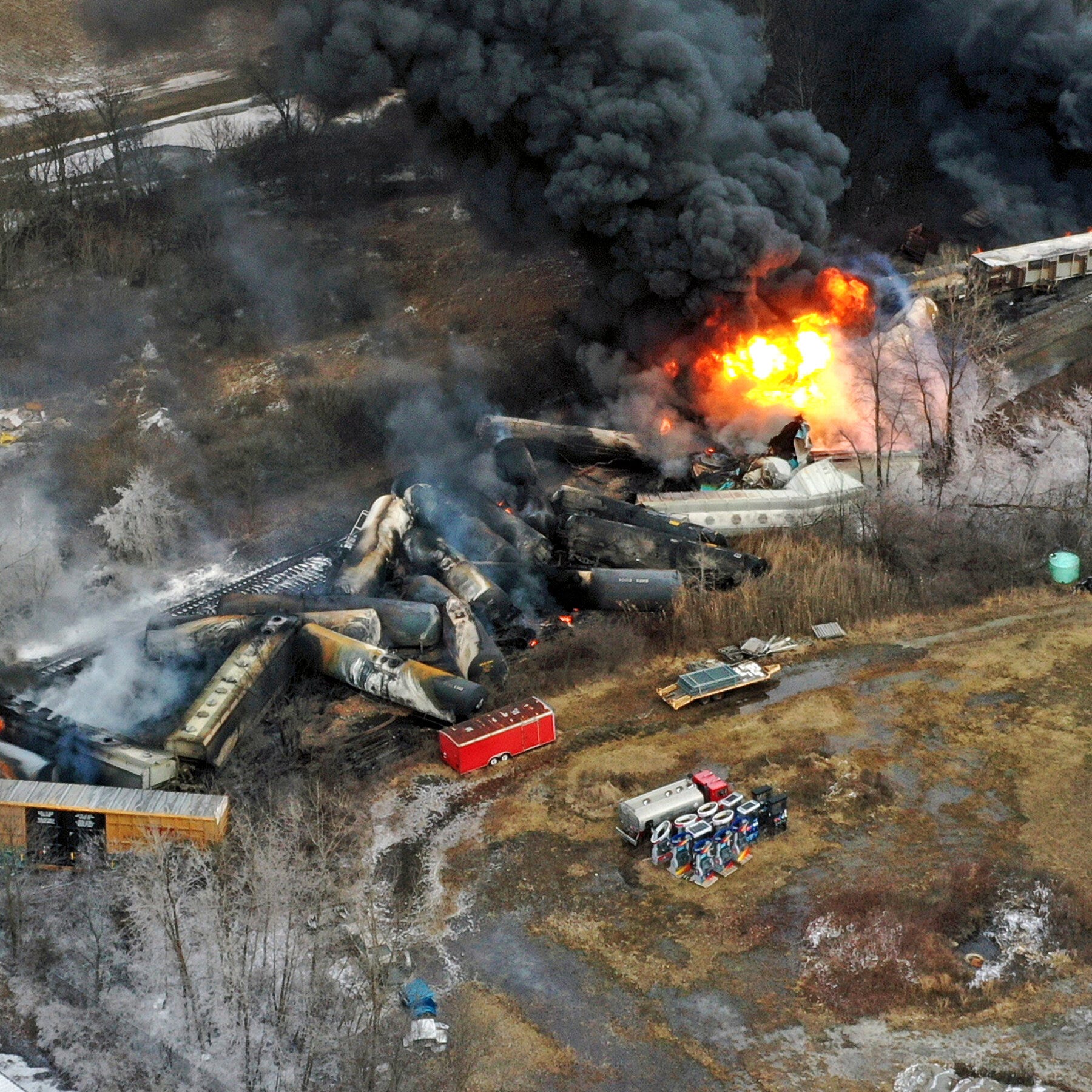
An important ruling in the wake of the East Palestine derailment from February 2023 occurred this week. From an AP article on the result,
“The company that owned the railcar that caused the devastating East Palestine train derailment in 2023 won’t have to help pay for the $600 million settlement Norfolk Southern agreed to with residents.
“An Ohio jury decided Wednesday that GATX isn’t liable for the settlement even though the failure of a bearing on its railcar carrying plastic pellets caused the pileup on Feb. 3, 2023. GATX has maintained Norfolk Southern operated and inspected the train and all the cars and was responsible for delivering the cargo safely.
“‘GATX is pleased with the trial outcome, which affirms what we have known for some time: Norfolk Southern alone is responsible for the derailment and resulting damage in East Palestine,’ the company said in a statement.
“Norfolk Southern called the verdict disappointing but said it won’t affect the railroad’s commitments to everyone affected by the derailment.
“‘For more than two years, Norfolk Southern has paid the costs related to the derailment while acknowledging and acting on our own responsibility for the accident. Our belief has always been that GATX shares in that responsibility and should also be held to account,’ the railroad said in a statement.”
Also important to highlight that, although GATX got off the hook, Norfolk Southern did recently settle with Oxy, the shipper who’s product caused the environmental response. Details of the settlement weren’t announced, but it appears that Oxy is going to help foot some of the $600m bill from the personal injury lawsuits.
NS had a similar lawsuit targeting the various car owners in the derailment to try and get them to assist with costs from the environmental cleanup. That was thrown out by the judge last year based on his perception that Norfolk Southern, “didn’t show that the derailment was caused by anything the other companies could control.”
I’ve seen a number of comments on the ruling as “strange.” I think it’s anything but. Believing that NS was going to get anything out of GATX flies in the face of Rule 1.
For those unfamiliar with Rule 1.a, it states,
“Each handling line is responsible for the condition of all cars on its line.”
In other words, once a car leaves the shipper’s property, anything that happens to it is the responsibility of the railroad. Since the derailment occurred on the railroad’s line, it was the railroad’s problem.
Now, this doesn’t mean that the car owner is completely devoid of responsibility. There are a number of rules and practices governing the packaging, loading, and quality of lading for shipment in rail transportation. But all of that occurs at the shipper’s site before the railroad takes possession.
Once the railroad takes possession of the car, it has to implement policies, procedures, investments, etc. to reduce the risk of derailments. When a railroad fails to institute these safeguards, then the government has the responsibility to get involved if the costs are detrimental to the public. Same goes for the shipper.
It’s impossible to understate the importance of this foundational principle to the industry. Each party focuses on what they can control. All activity is organized around this division of responsibility.
That’s why I was most interested in whether the courts would leave Rule 1 intact from these lawsuits. To me, this was Rule 1 on trial. After two lawsuits, it’s clear that the courts believe this is the most sensible way to continue.
A System In Need of Repair
There is a misplaced belief that the current maintenance practices in the industry are sufficient, and that the risk of another East Palestine-sized derailment is unlikely. The data, however, tell a different story. (You can read a comprehensive review of the numbers from the Hum white paper).
The NTSB investigation provided several facts as to why the bearing on the GATX car failed:
The railcar in question passed several hot box detectors before an alert was finally issued.
The bearing was already on fire before the final detector saw it and issued the alert.
If you think acoustics are the solution, square this circle - the last 7 times the railcar passed an acoustic bearing detector the reading was corrupted by excessive noise, likely from a loud wheel or brake.
After East Palestine and in an effort to reduce the impact of costly or unnecessary regulation, the AAR was quick to double down on the existing wayside detection system that had failed to prevent the accident in the first place. “We just need a few more wayside detectors and we’ll have this buttoned up in no time!”
Far too little attention was given to the fact that the entire approach is wrong. The industry allows a railcar with tens of thousands of gallons of hazardous materials to move at highway speeds held up by bearings that are run to the point of failure before removing them from service. In layman’s terms, it’s a bit like running on bald tires and hoping you can safely pull onto the shoulder when one of them blows.
The ability of the railroad’s wayside detection system to eliminate derailments relies on three things:
A wayside detector needs to correctly identify a bad bearing.
The detector needs to communicate to the locomotive engineer to stop the train.
The engineer needs to receive the alert and take the correct action.
If any one of these three steps fails, the bearing derails the train. All of this of course needs to happen in a matter of minutes if not seconds.
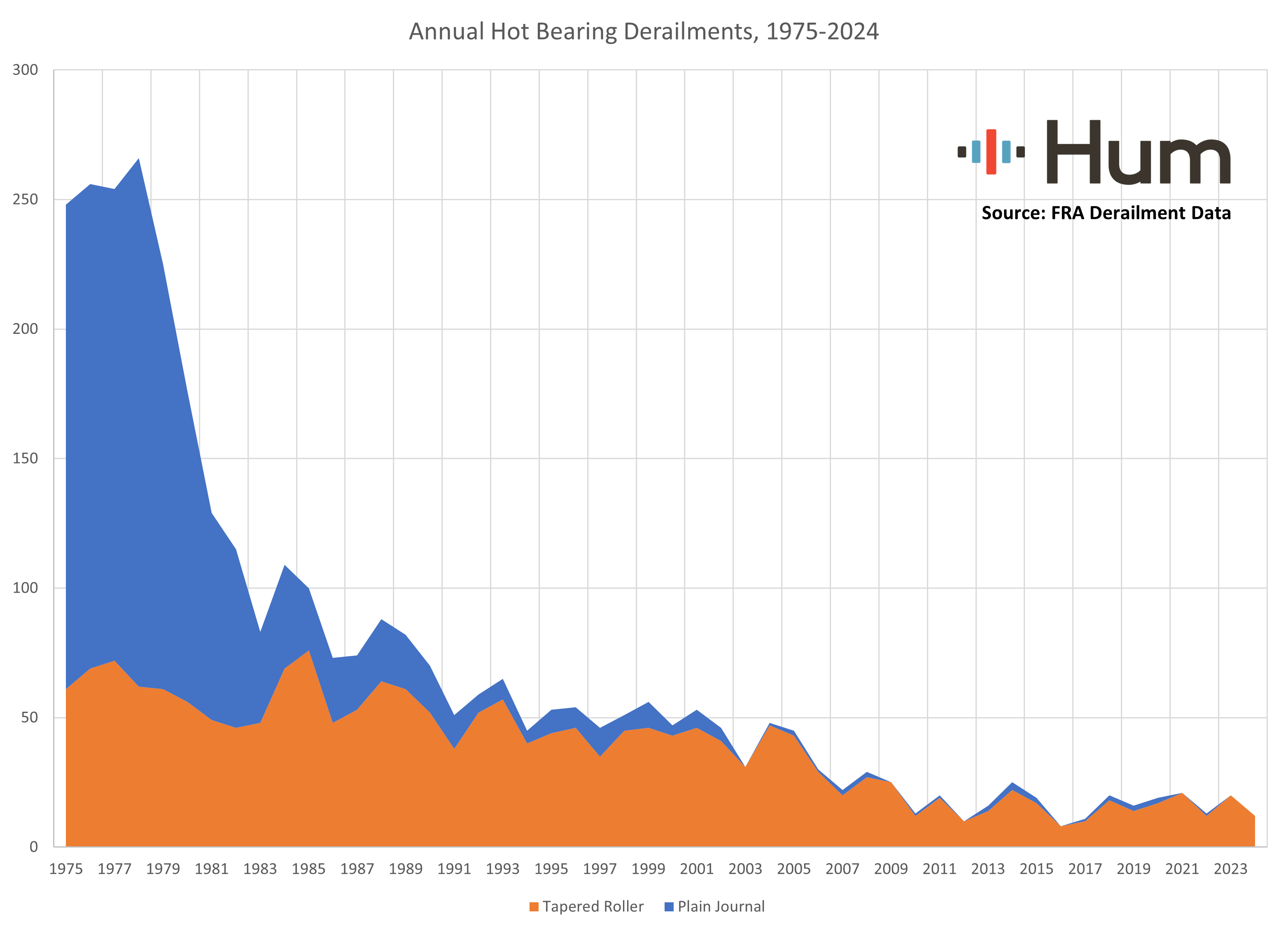
In my critique of this system, I am not ignoring that it has been successful in removing bearing derailments over the years. Going back to 1975 as shown in the chart below, the change has been quite dramatic. But you also can’t ignore the fact that derailments have flatlined without any further reductions since 2010.
No other industry allows critical machinery to run to the point to failure in this day and age. Preventative and condition-based maintenance programs, such as vibration analysis of rotating components, have been the bread and butter of reliability programs for more than three decades in general industry. Yet, neither the AAR, nor the industry press have identified this systemic failure.
In This Together
The reason Rule 1 makes sense is because it puts shippers/car owners and railroads in their areas of control. A shipper doesn’t have a say in who the railroad puts in the locomotive cab, how they’re trained, or how they operate the train. Similarly, a railroad doesn’t control how a shipper loads a railcar. But that breaks down when it comes to railcar bearings. These are a shared responsibility.
Today’s railcar bearings are all sealed, tapered roller bearings. The primary wayside detector, the hot box, was developed during the age of the plain journal bearings, which were far simpler and easily observable by an inspector. Except in minor instances where seal failure allows for grease to seep out of the bearing, visual inspection of today’s bearings is useless.
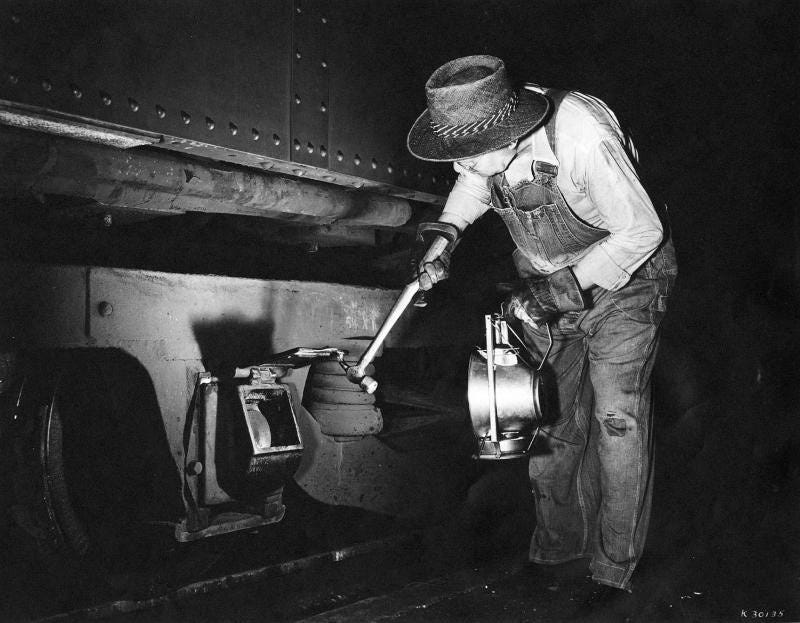
This means that while shippers and car owners can inspect brakes, seals, lids, placards, lading, etc. etc., they cannot determine the condition of the railcar’s bearings by visual inspection alone. They rely on railroads to do that with wayside detection. This is why GATX could confidently argue that it did everything within this system the right way. The current system is completely reliant on the railroads to try to catch these failures in transit.
Another issue with the current system is what I call the “lowest common denominator of maintenance.” Roughly 75% of railcars are owned by non-railroads. Because a railroad needs the ability to replace a bad bearing when it occurs, they’ve been given the authority to replace wheelsets at their discretion and bill the car owner for the time and materials. This necessary evil is a classic principal-agent problem.
Because the railroad doesn’t own the car, it’s not looking to reduce the total cost of ownership of the car. If a wheelset needs to be replaced, it’s going to grab the nearest one, slap it under the car, and push it back into service. Same goes for other light duty repairs. This has led to the practice, or at least the belief, among car owners that certain railroads look to put brand new $3,200 wheelsets on private cars, take the used wheelsets, refurbish them, and then put the used wheelset under their own cars.
Similarly, because a railroad is relieved of the maintenance responsibility of a railcar once it’s off that railroad’s line, the perverse incentive exists to simply pass off known maintenance issues onto another railroad at interchange. I don’t know that this practice happens a lot, but you can see how bad actors can take advantage of it.
Among the negative incentives, there is a stark lack of positive incentives. Why should a railcar owner invest in premium components, like a safer bearing or longer lasting wheels? What benefit do component suppliers have to invest in the R&D to create safer products or higher performance?
If a railcar owner were to adopt improved bearings or wheels, what’s to stop their railcar with the latest whizbang gear from getting replaced 10,000 miles down the track? That investment isn’t secured. Railroads with the best of intentions relying on 80 year old wayside technology that can have a 30% false positive rate on average, can completely eliminate any cost savings generated from improved components.
The car owner has little incentive to establish better maintenance practices or invest in better equipment. This is another big issue that has stagnates innovation and stifles creativity.
Repairing the Repair System
If we’re going to truly eliminate, or at least drastically minimize, the chance for another East Palestine event to occur in the future, we need to repair our repair system. Is there a way to realign incentives between car owners, railroads, and shippers, such that each receives the value they pay for? Moreover, is it possible to create a new system that rewards innovators and helps railroads attract the highest quality rolling stock onto their network?
My principles for a new repair system:
Car owners are compensated for adopting more rigorous safety programs, higher quality railcars, and improved predictive maintenance technology.
Railroads reduce their risk of carriage by attracting higher quality rolling stock onto their network.
Component suppliers are rewarded for creating new, innovative products that improve safety, efficiency, and performance.
In this system, everyone wins. To bring this about, three vital steps are needed. First, the underlying maintenance triggers have to shift from reactive to proactive. Wayside defect detection with a high degree of false positives needs to be replaced with higher accuracy systems like continuous onboard monitoring sensors. Overmaintenance of railcars, even while missing critically defective bearings, increases wheelset maintenance on the order of $50-100m/yr. That’s just direct material costs and doesn’t include increased number of setouts, disruption to operations, etc.
Second, the industry needs to adopt replacement-in-kind rules. If a car owner invests in a premium wheel that can last 4x as long as a standard one, they should not lose that investment 15 minutes down the road. The investment in safer, more efficient equipment will only occur once railroads help to protect that investment.
This does create increased inventory size as more parts have to be stocked at common maintenance points. However, by reducing unnecessary maintenance due to shifting from wayside to onboard monitoring AND by utilizing better maintenance scheduling because more accurate detection gives you months rather than minutes to act, the total demand for spare inventory can be drastically reduced and carefully managed.
Third, car owners should be compensated for improved equipment investment. Forcing them to eat all increased ownerships costs such as happened as a result of the FAST act does not do this. Sure, regulation is effective at providing results, but that’s only going to get the bare minimum. Create positive incentives and let the market take over.
Railroads can do that by offering railcar owners freight rate discounts for evidence of improved equipment. In the case of onboard sensors, a rate discount also provides a clean transfer of value if railroads ask for the sensor data in return.
A bunch of tightwads may balk at that idea, but please tell me, why should a car owner give you their sensor data in the first place? If they spend the money to put devices on their cars, why should they turn around and flip it to the railroads for free? Offering the rate discount accelerates the technology adoption which in turn accelerates improved safety and performance outcomes.
Railroads benefit in both those areas - safety and performance - when car owners choose to invest in higher quality rolling stock. Fewer maintenance needs, maintenance that can be performed at the right place with the least amount of operational disruption, fewer out-of-round wheels tearing up expensive rail track, fewer in-service failures, reduced wayside system maintenance requirements. The benefits to railroads goes on and on. Surely they can find two nickels to rub together to start the flywheel spinning!
If the rail industry can shift from a reactive, misaligned maintenance system to a proactive, everyone-wins system, the safety and operational benefits would be immense. It would also kick off a new wave of innovative technology and products that would create a virtuous cycle and, finally, solve the chronic issue of bearing derailments once and for all.