In “The New CP, Same as the Old CP,” I highlighted how CPKC had managed to grow its automotive carloads, but how that may have come from CN rather than trucks. From the article,
“CN automotive volumes have declined by 23k carloads even as CPKC’s volumes have grown by 13k carloads since 2023. If anything, that net loss of 10k carloads indicates potential lost business to the road, not growth.”
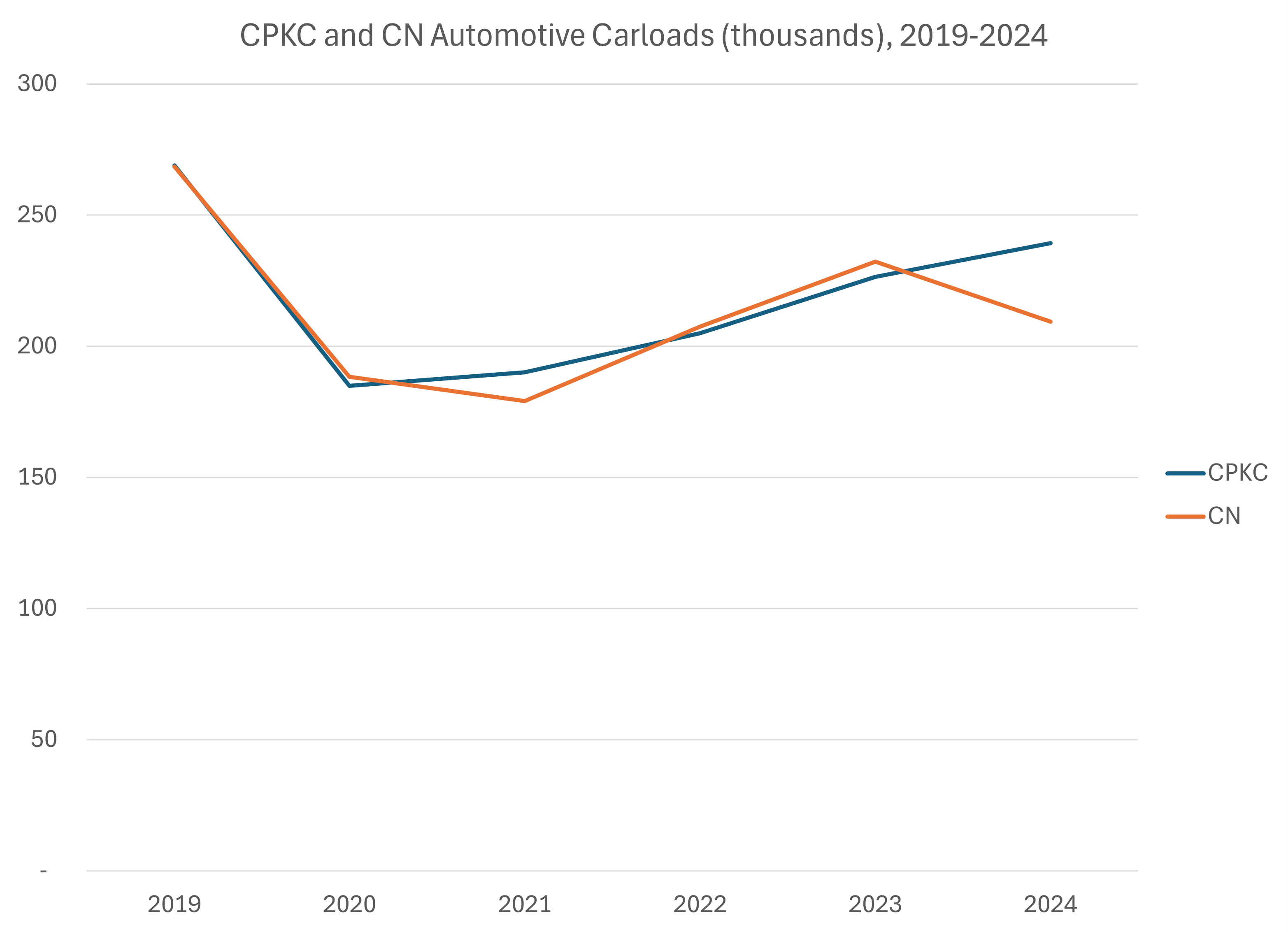
I’m not sure this is a simple modal loss story. The story, in fact, goes far beyond Canada or any particular Class 1’s franchise.
Globalization
Let’s start with some basic economic principles. In a hyper globalized world like the one we live in, trade surpluses have to balance with trade deficits. If one country imports 100 bananas, that has to show up as a surplus on someone else’s trade balance (100 banana exports).
Today, aggressive mercantilist policies from countries like China, where producers are subsidized at the expense of consumers, generate trade surpluses that must be accommodated by other countries. Those deficits are primarily borne by Western countries (US, Canada, Australia, UK) as highlighted by this chart from Brad Setser.
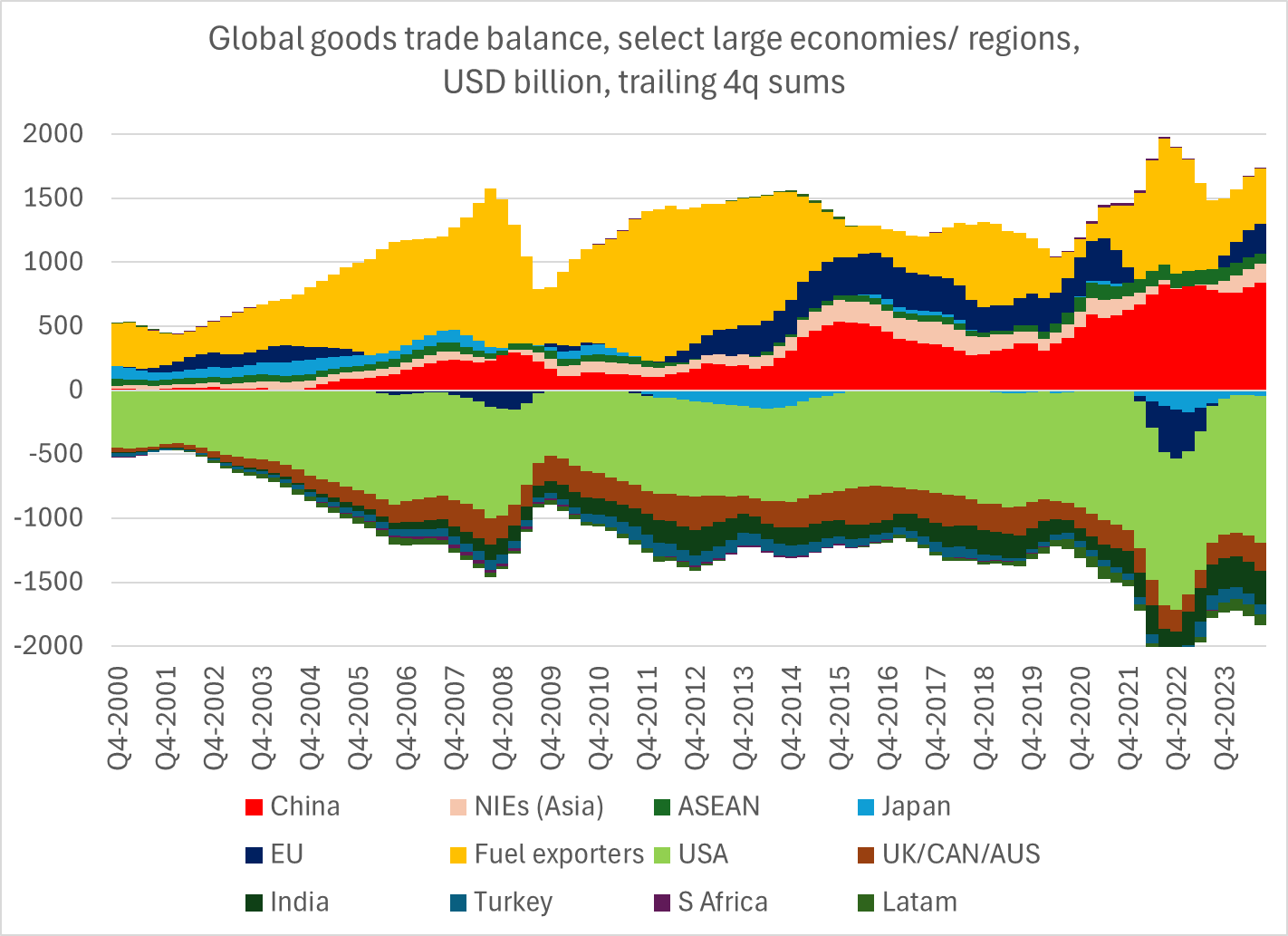
This type of exchange is being carried out in a very pronounced way in the automotive industry. The chart below of Chinese auto production and consumption may be the most important one from 2024.
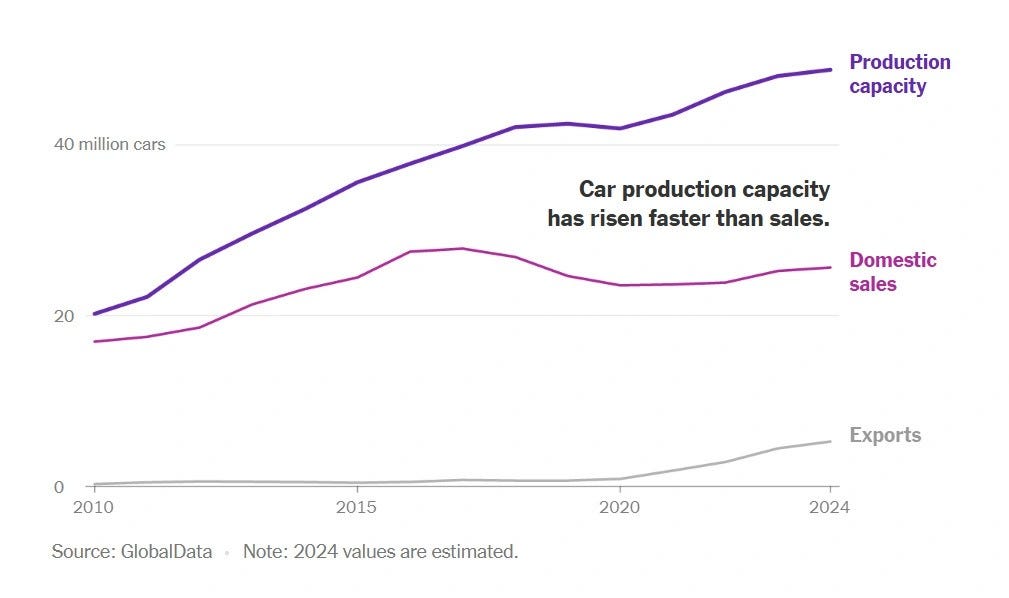
China’s ability to produce cars has far exceeded its domestic demand. Current annual production capacity is estimated to be 40 million ICE (internal combustion engine) vehicles and another 20 million EVs. This is mind blowing, given the global automotive market is estimated to be around 90-95 million vehicles.
Since production capacity continues to increase, subsidized by cheap financing from state banks and a now depreciating RMB relative to the dollar, those cars have to go somewhere. Increasingly, they’re finding their way to foreign markets to displace other manufacturers.
(Side note: The alternative for China’s excess capacity is to either shut down production, thereby increasing unemployment, or raise wages, which would spur domestic consumption but do so at the expense of producers who would have to decrease margins or go out of business).
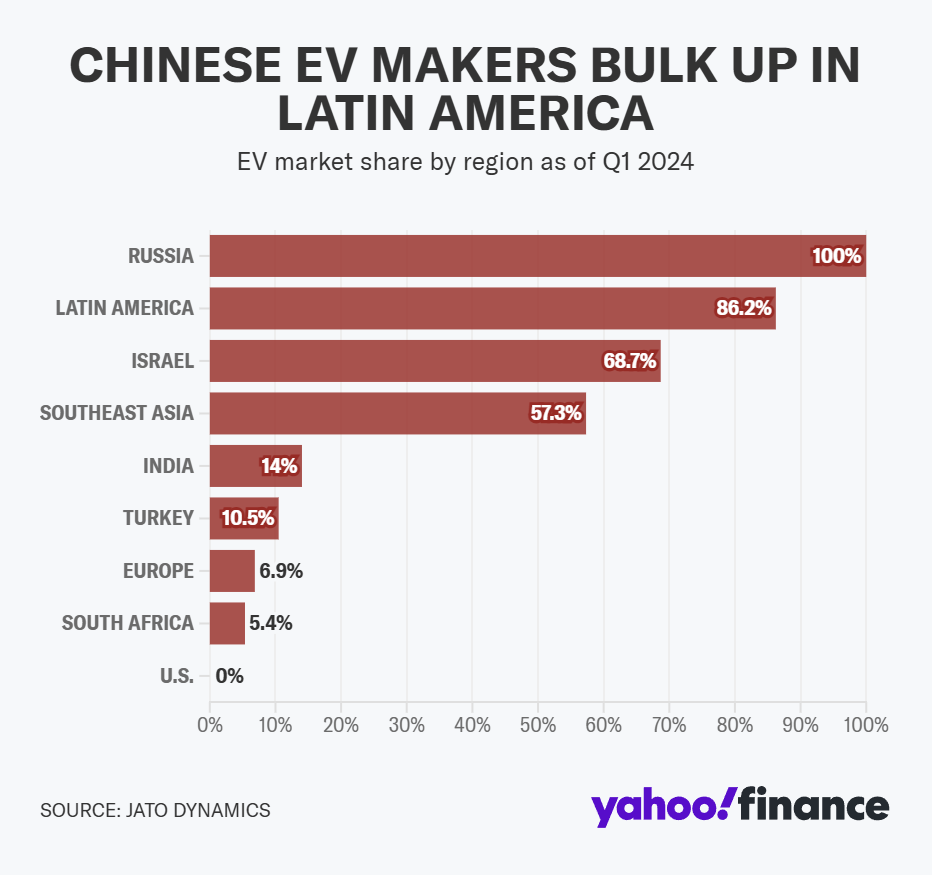
Mexico is increasingly one of those places Chinese vehicles end up with BYD, one of the leading Chinese EV firms, looking to place a factory there. From a May 2024 Reuters article,
“Chinese automaker BYD unveiled the Shark, a mid-size hybrid-electric pickup truck, in Mexico on Tuesday, as its regional chief brushed off new U.S. tariff hikes on Chinese EVs, saying the company was not eyeing an entry to the U.S. market.
“The Shark strengthens BYD's foothold in the North American market with a vehicle aimed directly at incumbents Ford, General Motors and Toyota.
“It is for now only available in Mexico, executives said, and is the first time the world's largest electric-vehicle (EV) maker has launched a new product outside its home country.
“BYD chose Mexico because of the rapid growth in demand for pickup trucks in the country, Chief of Americas Stella Li said.
“The unveiling event in Mexico came hours after U.S. President Joe Biden announced steep tariff increases on an array of Chinese imports, citing unfair competitive practices. Duties on Chinese EVs were quadrupled to over 100%.
“U.S. Trade Representative Katherine Tai later said that the United States is weighing tariffs on imports from Mexico.
“In an interview with Reuters after the event, Li said the U.S. tariff hikes have no impact on BYD, which plans to build a plant in Mexico.
"We don't have plans to go to the U.S. market, so this announcement does not impact us at all," Li said.
"When we build a Mexican plant, we only consider the Mexican market and other countries' markets, we have not considered the U.S.," she added…
“The presence of Chinese automakers in Mexico has grown exponentially since 2017. One out of 10 cars sold in Mexico last year was from a Chinese automaker, with MG Motors, a unit of SAIC dominating nearly half the market.”
I, for one, am entirely convinced that BYD isn’t looking at the US at all with its new Mexico plant.
You can see the threat that such an action would have on US and EU auto companies. (We import a lot of European cars). They are already feeling the effects of a China running rampant in global auto production.
The global auto industry has been in turmoil since the pandemic. Just look at the highlights from 2024:
All while China autos are ripping. Or, as was aptly put by some guy I just came across on LinkedIn who seems to know what he’s talking about,
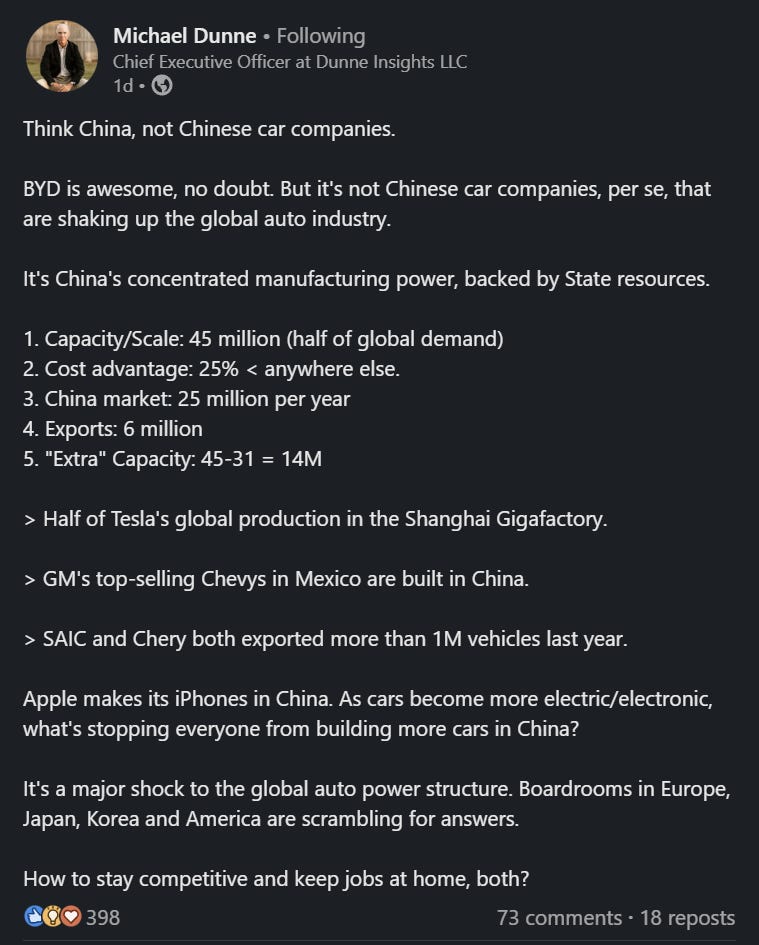
The excellent Brad Setser said much the same about where all of this is going,
“The global market—with massive overcapacity in China’s internal combustion engine (ICE) sector, massive capacity expansion in China’s EV sector, effectively unlimited credit for Chinese manufacturing firms from China’s state banks, and a Chinese yuan that is weaker against the dollar than it was back in 2008—is pushing for global auto manufacturing to become more like global electronics manufacturing, with a concentration of global production in a single region and, for that matter, a single country.”
What that means is that, left unchecked, China’s ability to produce the next generation of EV and battery technology for automotives will see China significantly cripple European and US automakers. Japan (Toyota, Honda, Nissan) and Korea (Kia, Hyundai) have a better chance of surviving, but not by much. Honda and Nissan are in merger talks, as another sign of non-Chinese auto weakness.
Well Here’s Your Problem
At the heart of the automotive companies problems lies the EV, or, more specifically, the dual problem of mastering the technology and generating the demand.
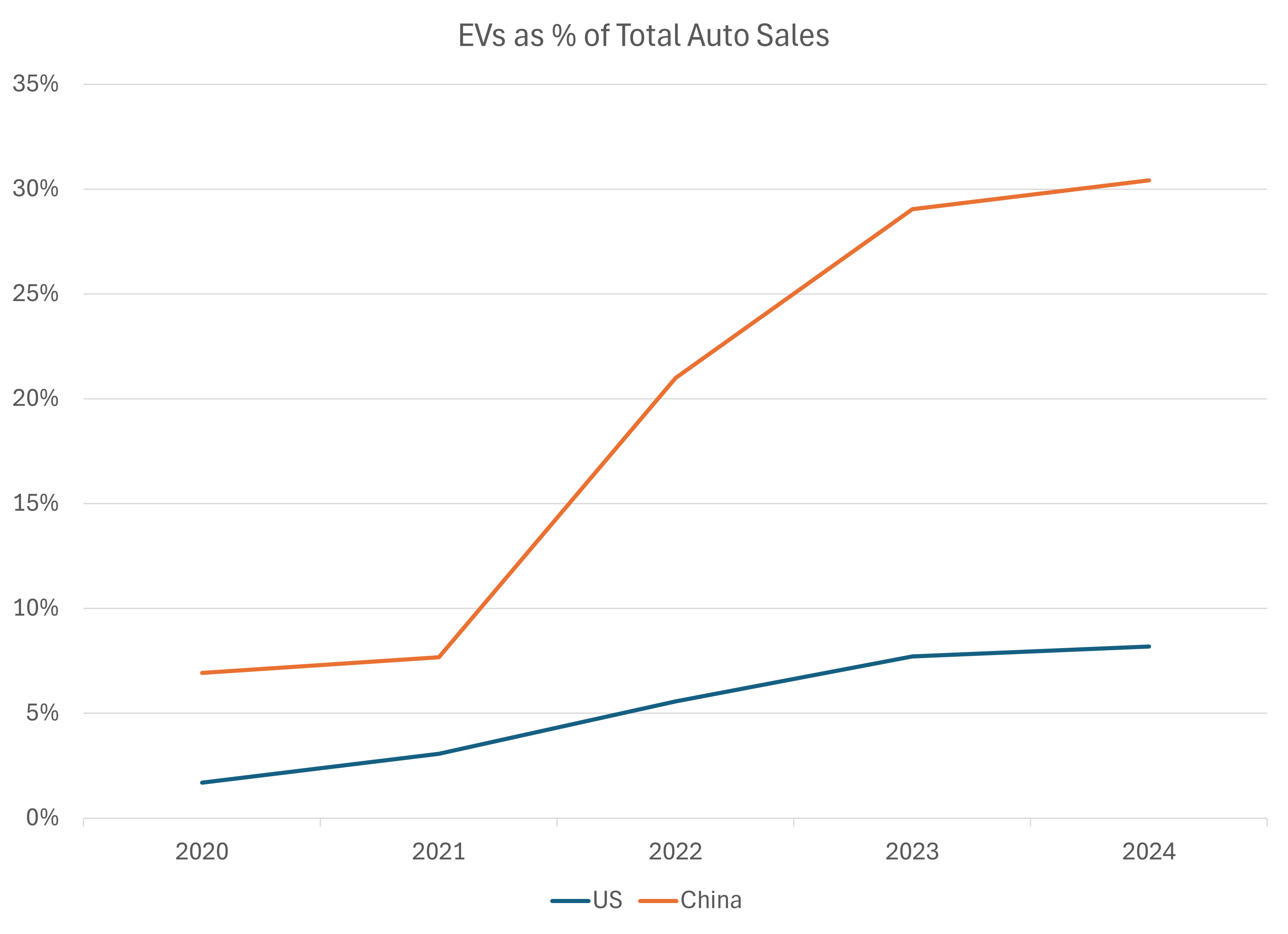
First, the latter. The Biden administration did its best to lower barriers preventing consumer adoption of EVs. Massive legislation was enacted to give consumers tax credits for EVs, subsidies to battery manufacturers, and building out charging infrastructure. Despite all these efforts, EV adoption has flatlined at about 8% of total US sales. Meanwhile in China, EV sales took off and reached 8.5 million in 2024 compared to 1.3 million in the US.
Second, it seemed that everyone except the Chinese auto manufacturers has struggled with EV technology, with the notable exception of Tesla:
EV startups like Fisker and Lordstown have gone bankrupt while Rivian isn’t out of the woods yet.
The Europeans, VW and Stellantis (if we can call the former Fiat Chrysler a European company), both went through leadership changes due to delays and missed targets on EV delivery.
One of the cited benefits of the Honda-Nissan merger, supposedly, is to share the burden of R&D costs for EVs.
Toyota has completely steered clear of straight battery EVs to focus on its plug-in hybrids.
Ford dealers still complain that they lose money on every F-150 Lightning.
I don’t know all the reasons why this technology seems to be out of grasp for these large companies, except for the fact that innovating is not something large companies do well. (I could probably write a book on that but see GM killing its autonomous driving startup Cruise after sinking $10 billion into it for yet another example of a large company screwing up technology).
So, the tech is hard and scaling it is even harder, which is expected for massive production operations like automotive manufacturing. Yet, both Chinese EV startups like BYD and more established manufacturers like GM’s JV partner SAIC are killing it.
To me, this proves the point that Chinese engineering is underrated. As arrogant Americans, we can no longer think of China as the manufacturer of cheap goods like souvenirs and plastic toys that break. They are good. And now they’re producing almost an order of magnitude more EVs than the US automakers. This is a scary edge to have in an emerging technology field, particularly something touching energy like battery storage.
Now, 3-5 years from now we may see a bunch of reliability issues with BYD EVs that refute that point. It’s too early to tell. But given the fact that they’re moving a bunch of product and there’s generally some positive reception by the market for the product, it would be best to assume that they’ve got an edge and it’s growing.
Even in the rail space Chinese engineering is starting to pull away. I’ve heard firsthand from customers who bought both CRRC and non-CRRC railcars and locomotives. CRRC was competent, diligent, and produced high-quality pieces on time and on budget. The others, including US locomotive companies, failed hard. Poor quality, blown production schedules, difficult to work with, non-CRRC manufacturers need to step it up. CRRC’s new battery electric locomotives are supposedly really good too. Don’t sleep on China.
The US Auto Market
By now you may be thinking that a more protectionist US trade policy will surely keep the fox out of the hen house. Our domestic auto industry can be saved by erecting stiff trade barriers that prevent a rampant China from dominating. I don’t have a lot of faith in that, so long as the dollar remains sky high making US auto exports out of reach except in the luxury market.
Even if the US is effective at keeping the Chinese autos out of its domestic market, that doesn’t mean US auto manufacturers are out of the woods. Losing an edge on green technology, whether the US EV market materializes today, tomorrow, or 10 years from now, is not good and there’s enough anxiety over climate change that there will be some type of market for them.
This competitive threat absolutely has an impact on rail freight flows. It’s also where the data get murky on what exactly happens. Strap in; there are a lot of charts to go through here.
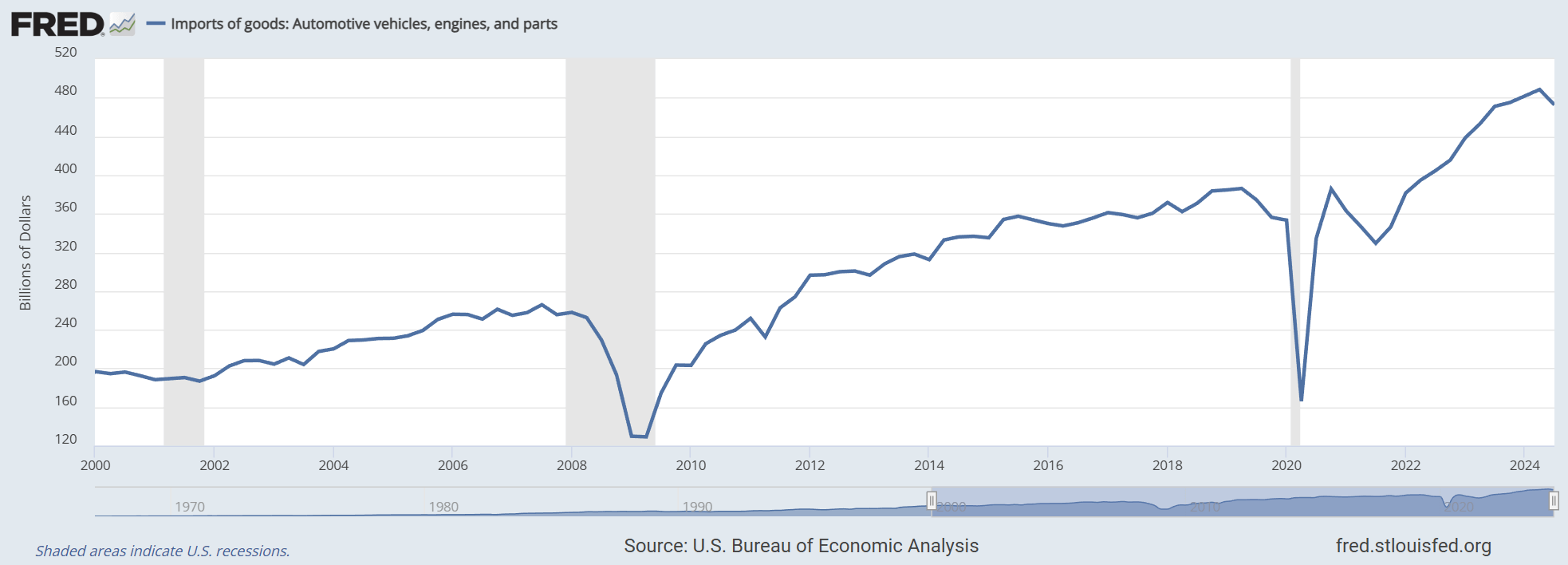
First, the total value of US imports of motor vehicles and parts is currently more than double what it was in the run-up to the Global Financial Crisis (GFC). Many charts that show this, but the steep climb post-COVID also reiterates the fact that we’re dramatically more reliant on imports than we were pre-COVID (what about supply chain resiliency??). My guess is it’s driven by strong consumption and a strong dollar.
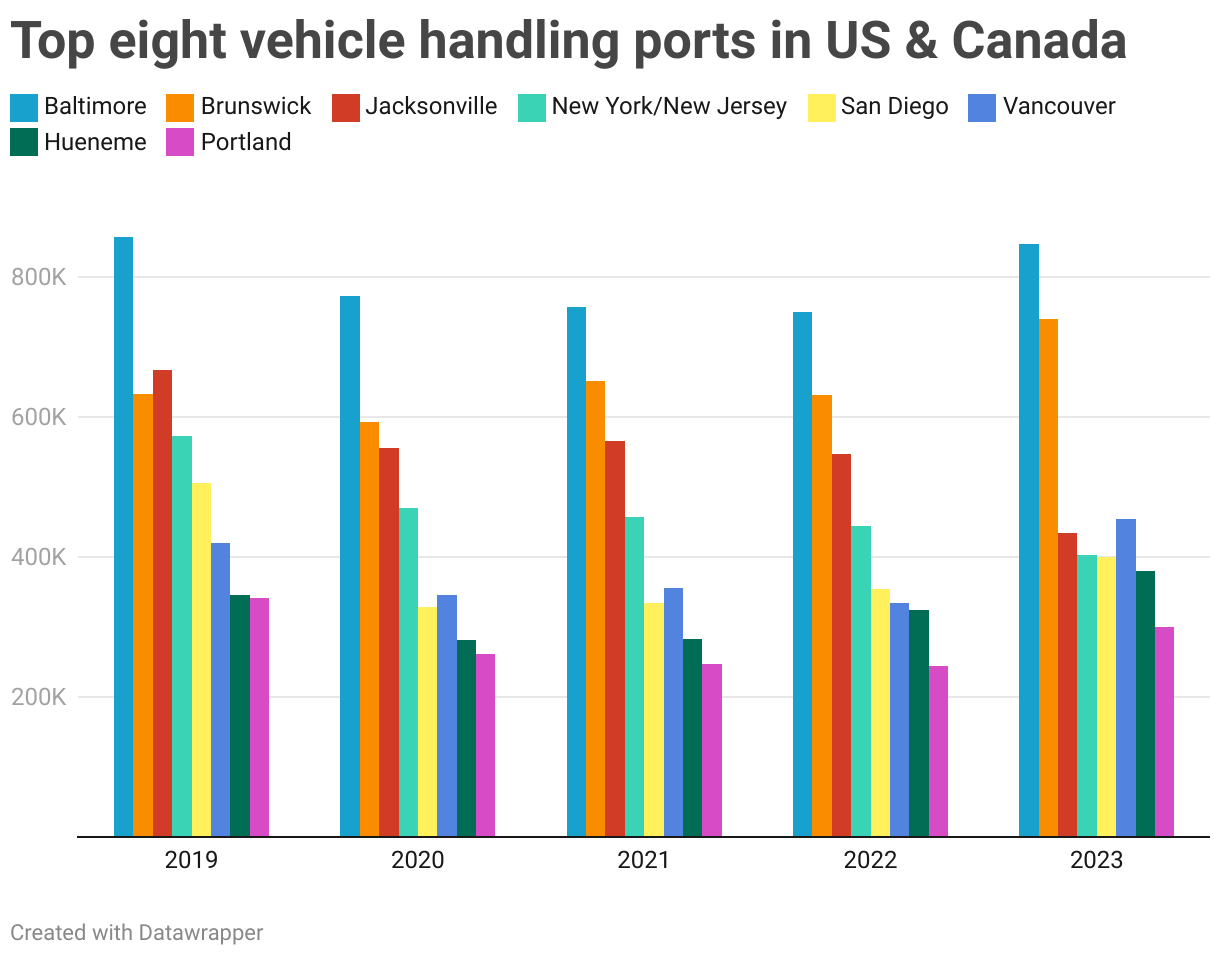
Second, the chart below from Automotive Logistics shows the ports with the most vehicles coming and going. I was surprised not to see LA/LB on the list and doubted the data because of it, but this does appear to be legit. Clear bias for the East coast which indicates a likelihood that most non-North American imports are European. Portland and Vancouver are likely Korean and Japanese imports. (I don’t know how many Japanese cars are imported vs. assembled domestically, but guessing it’s dominated by domestics).
So, how have the rails fared? This next charts shows the relative change in volume for each Class 1, along with their share of the total auto volume across the industry.
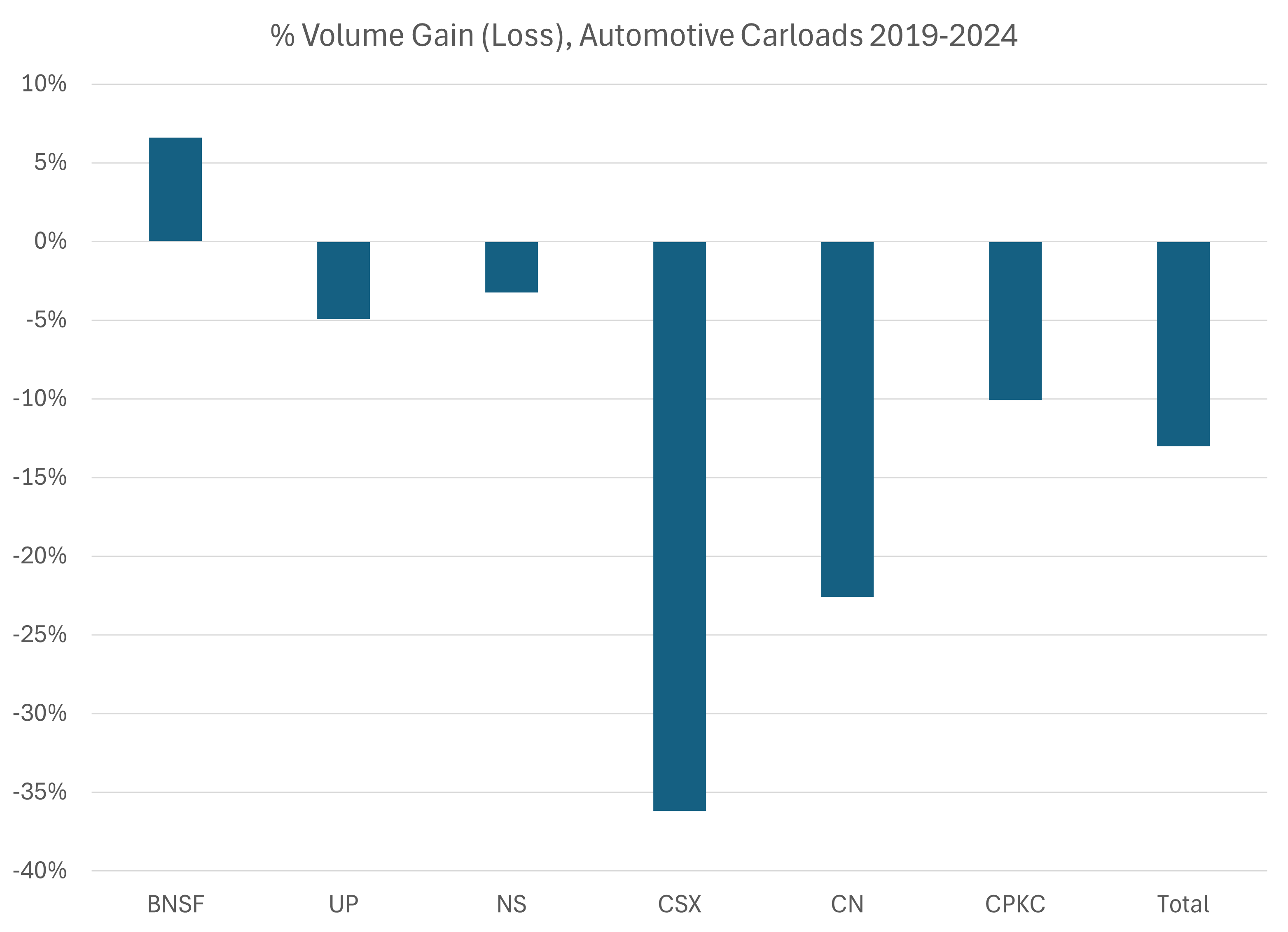
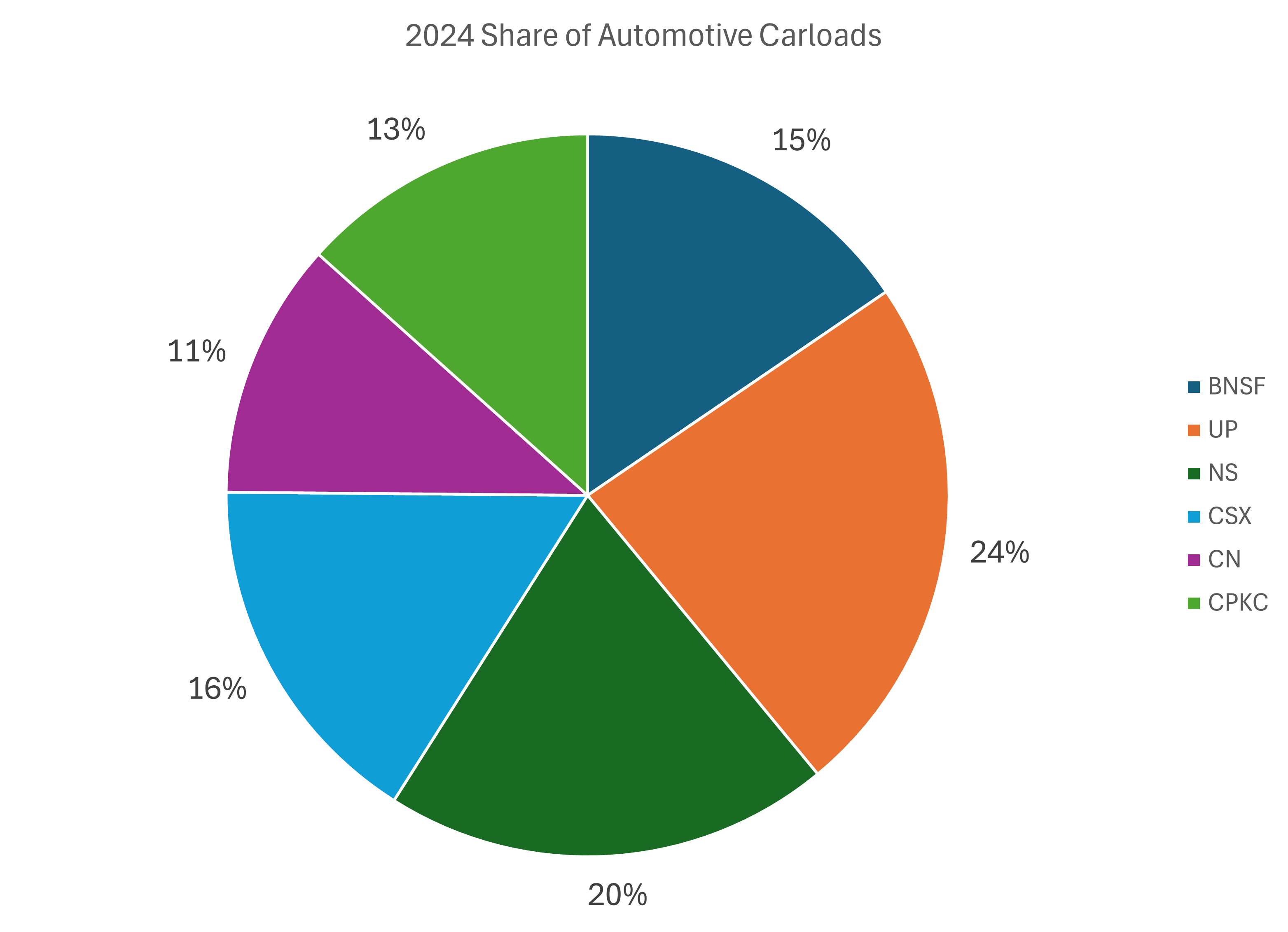
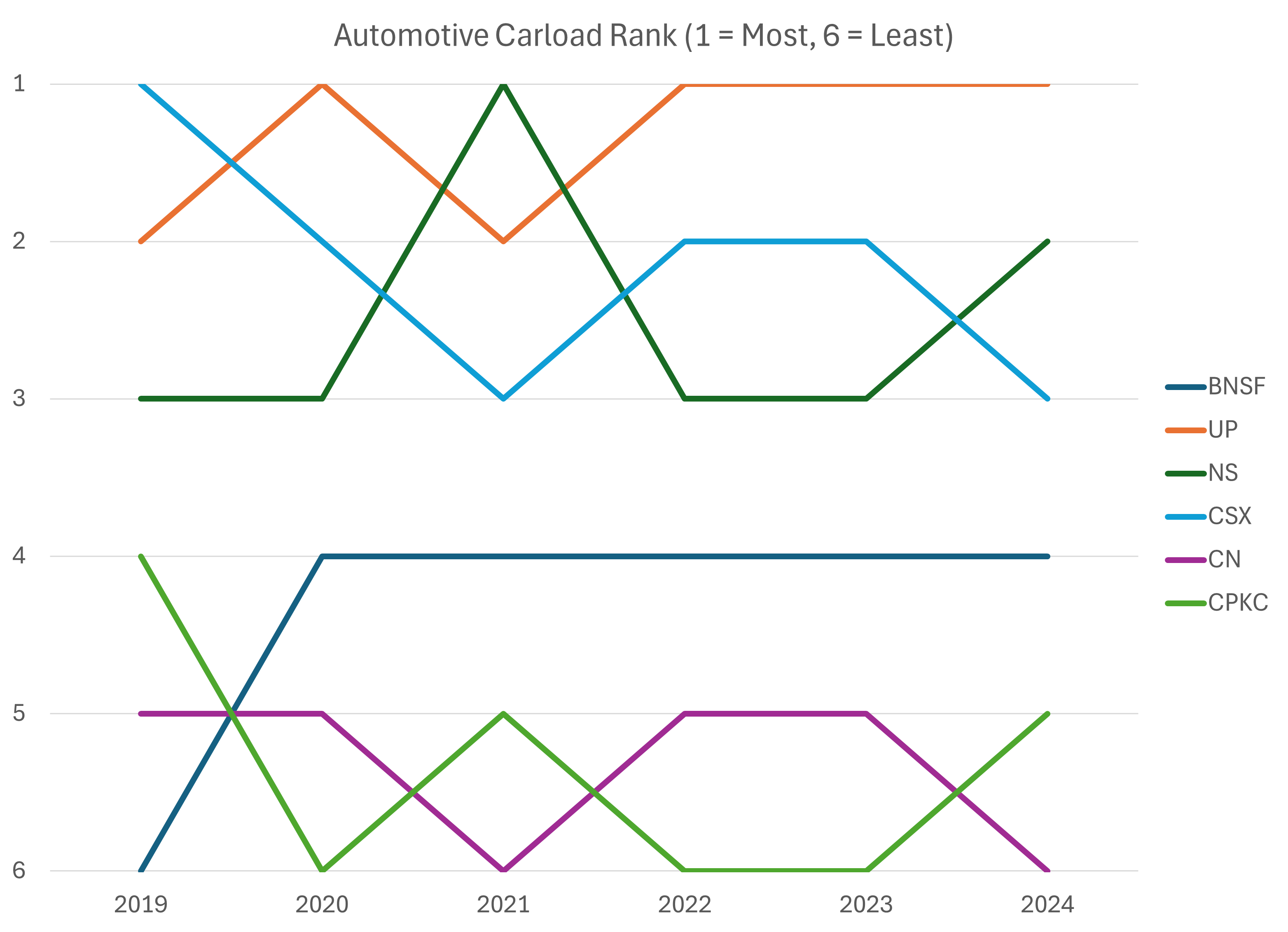
There are a few things to take from these data:
CSX has absolutely hemorrhaged auto volume. Why? With strong US import volumes and access to the top four highest volume ports (Baltimore, Brunswick GA, Jacksonville, NY/NJ), this would indicate a reshuffling of domestic demand. NS has been basically flat over the same period, so it’s not as if NS is winning share at the expense of CSX.
This isn’t all on CSX. The total number of cars produced or imported into the US fell during the same period, so some of it is related to the macro environment. Still, not good. They moved more auto carloads in 2019 than UP.
BNSF is the lone bright(ish) spot. I feel like we set a pretty low bar for volume growth in the rail industry, but let’s give BNSF their flowers for being the only Class 1 capable of growing auto volumes over this period. Could be from increased Korean imports, at least partially.
CN should be worried. We’ll see how they do in 2025, but CPKC’s driving some daylight between them and CN. The CN/UP/Ferromex Falcon Premium service may be delivering some wins, but it doesn’t appear to be in autos for CN. (Might have to study up on that next).
The auto sector is going to be a one to watch in 2025, and a challenging one for railroads to manage. I think UP and BNSF stand to benefit from West Coast imports, while we’ll see how much CPKC can win with its new Mexico footprint. Will CSX be able to arrest the decline? What can the Class 1’s control vs what is going to be forced upon them? Stay tuned…