Much Ado About Shortlines
The acquisition and divestiture of shortlines by Class 1’s is one of the more interesting aspects of M&A in the rail industry. In order to understand the strategy, it may be helpful to examine the history and underlying dynamics that drive shortline consolidation back into the mother ship.
The fundamental catalyst for all freight transportation is a producer that is looking to take their products to market. It may be raw material extraction (mining, lumber or grain harvesting, oil and gas extraction), the transportation of goods to middlemen (wholesalers, distributors, final goods producers), or from final production to retail. No matter the initiation, someone needs to move goods.
But those dynamics that create that business opportunity change over time. Northeast Ohio and Western Pennsylvania were once the center of the oil refining world. Cotton production in the Antebellum South fed the textile mills in the North. Nova Scotian pine became the newsprint in New York City, hawked by paper boys on street corners. None of these producers exist to any great degree anymore. The need for the transportation infrastructure to move those raw materials to processors and refiners and then on to distributors and retailers has been greatly diminished.
This expansion and contraction of economic industry across the world, like the breathing of some great giant, is the impetus for both entrepreneurs and established companies to go after a new opportunity. In rail, it’s the drive to lay track or refurbish all but abandoned track in order to open up a market.
(Side note: It’s not just transportation infrastructure, but all economic activity rises and falls at various times and seasons. Telecommunications have gone from the telegraph wire to the phone line to the network fiber. The Sears & Roebuck catalog became the shopping mall and then the Amazon e-commerce site. How we as human beings organize resources to generate energy, produce food, provide education, and, one day, search the stars is a fascinating study).
It's all very exciting when you’re cutting ribbons and laying track; it still has that new car smell. But what happens when those industries that rely on the railroad dry up and the carloads stop coming? Maintenance of way, equipment, and facilities all become harder to support. Especially for publicly traded or professionally managed railroads, the drive to increase productivity and improve profitability of the business begins to put a strain on running unprofitable lines. This economic contraction provides the spark for Class 1s to abandon or sell these lines.
The high capital costs required to maintain physical infrastructure necessitates a certain level of investment to sustain the quality and condition of the railroad. Shortlines often struggle with having adequate capital to invest in track and equipment maintenance and, therefore, are heavily reliant on government support to fund projects.
I wasn’t able to hone in on a good maintenance benchmark for shortline railroads. Obviously, the needs of every railroad are different depending on geographic features and grades, bridges, turnouts and switches, climate, etc. Relatively speaking, I found anywhere from $30,000/mile all the way up to $300,000/mile for track maintenance costs.
This is why federal funding programs like the FRA CRISI grant are so important to shortlines. I don’t know with any sort of definitive analysis, but I would speculate that without federal funding many shortlines would be unable to keep up with the required capital investment to even maintain a 10mph track speed. Many shortlines are federally subsidized to maintain operations. Should they be? It’s an interesting question.
History
One of the great challenges that Class 1 railroads had during the “lost century” of overregulation was the inability to reduce their network when business no longer supported it. The inability to shed unprofitable lines was one leg of a three-legged stool of the primary problems facing railroads, with the other two legs being pricing inflexibility and the unprofitability of passenger transit.
Some railroads did better than others in what was referred to as the “Weak Road, Strong Road” problem. Regulators tried their best to play matchmaker with various combinations to provide more balance and health to the nation’s rail industry, but these mergers often just lowered the overall performance of the remaining railroad and saddled the remaining entity with an immense amount of debt and deferred maintenance.
One of many examples of this outcome was the Erie Lackawanna merger. Quoting a Trains article in his book Merging Lines, Richard Saunders Jr. stated,
“The merger ‘was like a man in a leaky boat lending a hand to a man in shark-infested waters.’ Ultimately the savings that the merger promised did not amount to much. Merging one troubled railroad with another troubled railroad produced a bigger troubled railroad. The Erie Lackawanna would demonstrate why consolidation was not a panacea...”
Consolidation can increase scale economies and, possibly, open up new financing opportunities, but it is not a cure-all. If the underlying economics of a route are rotten, then the business will continue to lose money. The underlying economics that drive demand for freight transportation in certain geographies has to be there in order to sustain a rail carrier. And the nation’s freight network needs the flexibility to expand and contract to fit the changing economic situation.
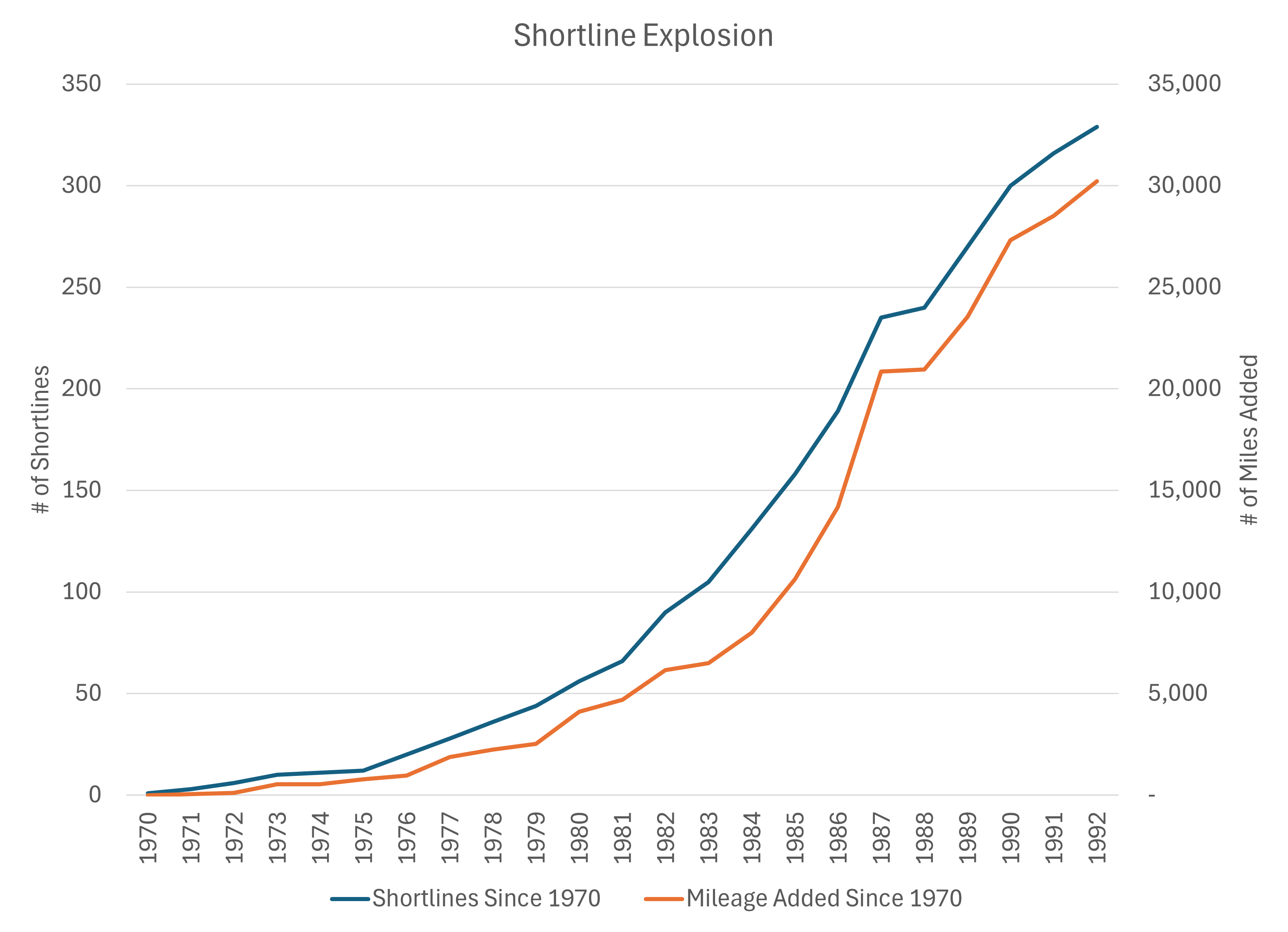
The deregulation of the railroads in the 1970’s paved the way for railroads to “right size” their operations and significantly reduced the cash burden required to maintain costly infrastructure. Deregulation also created an explosion of shortline railroads. Entrepreneurs took these unprofitable branch lines, often in a terrible state of disrepair, and slowly restored them to functional use. They knocked doors and were hungry to win over each carload from shippers who had long abandoned rail for trucks.
Nowhere is that story better represented than with Dan Sabin and the Iowa Northern Railway. The IANR started in 1984 on an abandoned line after the bankruptcy of the Rock Island railroad. It wasn’t until Dan Sabin took over the line in 1994 that the railroad slowly grew until it was generating 60,000 carloads/yr.
That doesn’t always happen, unfortunately. The Montreal, Maine, and Atlantic Railway (MM&A) was organized in 2002 and almost immediately lost a major paper mill customer. More paper mill closures saw the railroad struggle for a decade until it caused the infamous Lac-Megantic disaster in 2013.
The MM&A eventually became the Central, Maine, & Quebec Railway (CMQ) which CP acquired in 2019.
Shortline acquisitions aren’t cheap either. There’s a lot of PE money in infrastructure firms floating around to provide competition for assets that drives up prices.
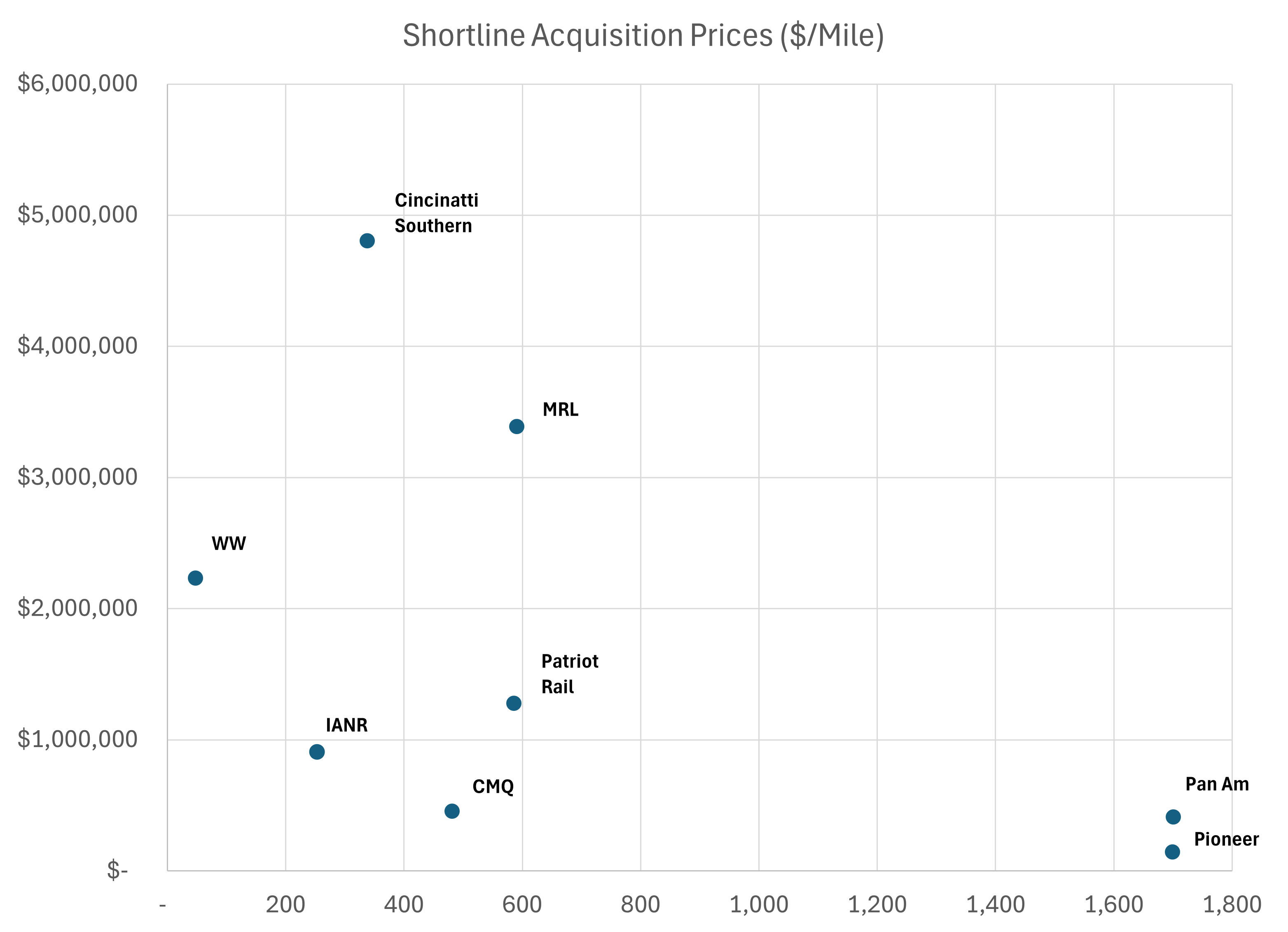
Below is a chart showing the transaction price along with any additional invested capital for notable shortline acquisitions since 2019. I don’t know if the cost/mile is the appropriate evaluation metric, but it is one lens to view these transactions through.
There’s also the fact that shortlines are generally undermaintained, at least with respect to the needs of Class 1’s who need to run higher track speeds in order to maintain network fluidity. That means that any shortline acquisition often requires substantial capital investment to bring assets back up to speed.
In the case of the $130m CP paid for the CMQ, an additional $90m was put into the network to raise track speed. When CSX acquired Pan Am Railways, most reported that Pan Am was in pretty bad shape. About $107m was put into Pan Am on top of the $600m price to acquire the railroad. These costs are additional hurdles required to justify shortline M&A by Class 1’s.
So why did CP acquire CMQ? From the press release,
“‘This strategic acquisition gives CP a true coast-to-coast network across Canada and an increased presence in the eastern U.S.,’ said CP President and CEO Keith Creel. ‘With additional port access, more dots on the map, and our proven precision scheduled railroading operating model we are confident this transaction will bring benefits to all stakeholders moving forward.’”
Line extension, particularly with access to another port, can be a strategic asset. And it seemed to work out well for CP, according to Trains:
“CP’s plans to gain transatlantic international intermodal business from Port Saint John have come to fruition. New finished vehicle traffic for the Atlantic Canada market sold out soon after launch. And growth in carload traffic, from propane to lumber, topped the railway’s forecasts. Overall, CMQ traffic volume has ramped up 50% more than what CP was predicting.”
For CSX, the Pan Am acquisition also offered a line extension, one that potentially benefited pulp and paper customers. From their recent investor day,
“The [ Pan Am ] as you know, was an acquisition we made. And quite frankly, the state of the railroad at the time that we made it was not in a good shape, and we put significant capital on it and Mike can tell you, now that railroad is up to the service levels that we expect and that our customers expect. And what we're seeing as we're increasing the velocity of that network as we're increasing the reliability, the amount of opportunities coming our way are significant…”
“So for context, [ SapiPaper ] is the largest customer on the former [ Pan Am ]. Kevin talked about the investments that we've made in hardening the infrastructure. [ Sappi ] was at a crossroads. They were in a decision cycle where they were looking to make a decision about whether or not to advance their proposition around supply chain efficiency with rail or truck. Thankfully, we were there at the right time.
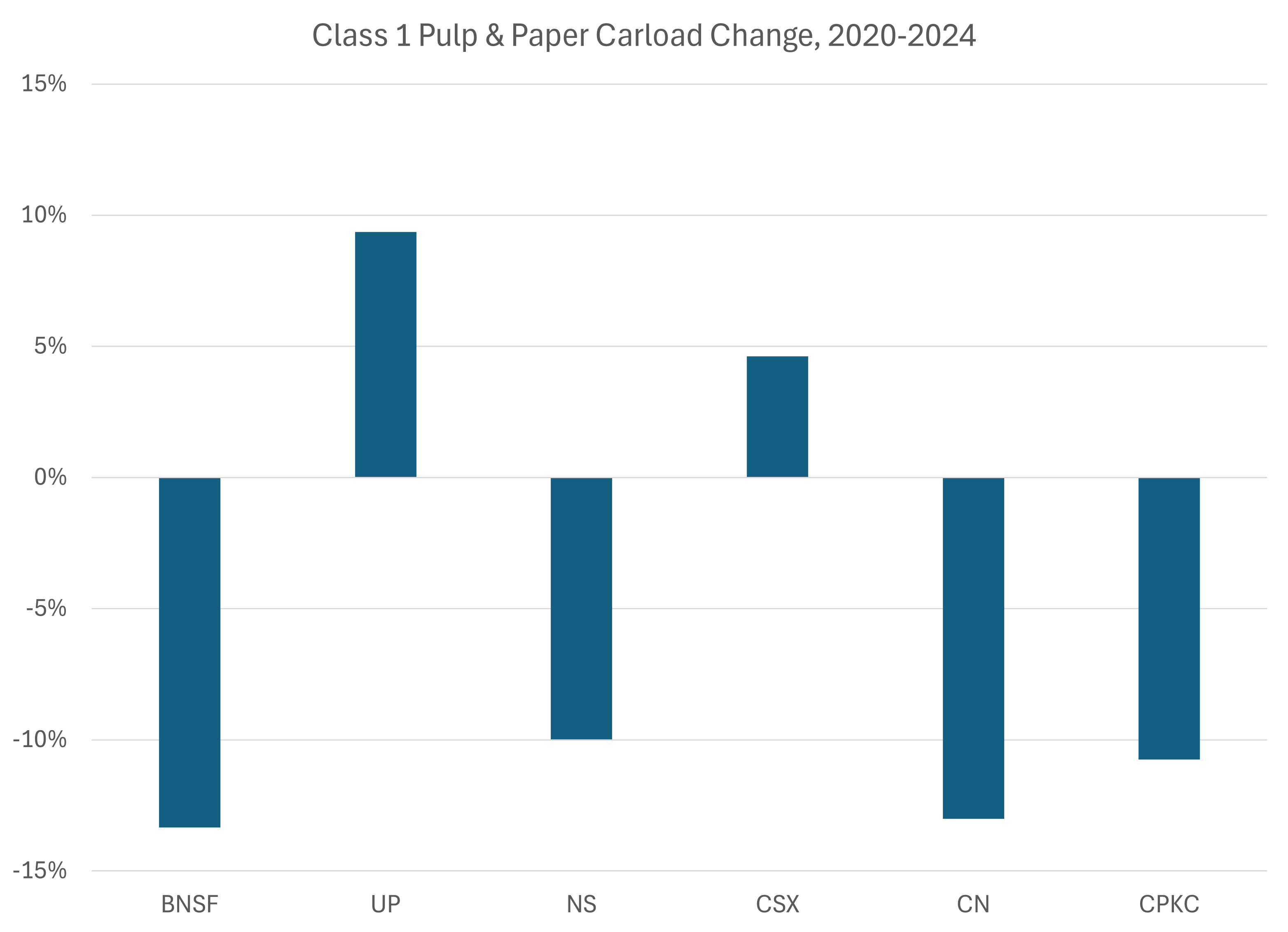
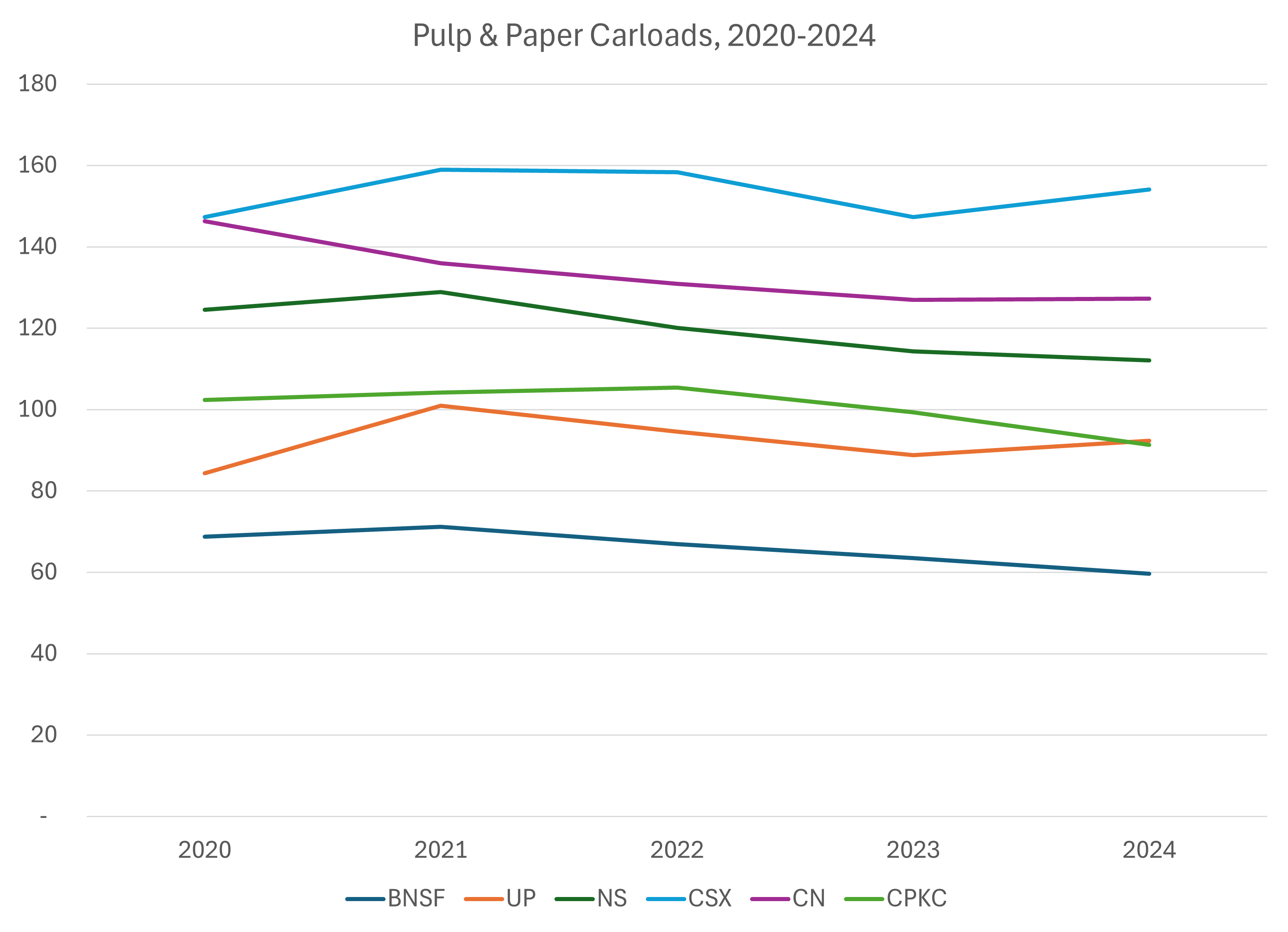
In terms of Pulp & Paper performance, CSX is a leader in the industry in at least maintaining carloads even as all but UP have seen significant declines in Pulp & Paper volumes.
This extended recounting of history is simply to illustrate some of the dynamics inherent with shortline M&A:
Lots of competition from investors to drive up asset prices.
Deferred maintenance or line upgrades to get to 40+ mph track speeds.
Strategic opportunities with access to new shippers or assets like ports
For non-strategic assets and with all the PE money out there looking for yields, I would expect Class 1’s to look at selling off lines as much as they would seek to add to them.
CN Gets IANR Acquisition Approval
This past week, the STB approved CN’s acquisition of the Iowa Northern. From the Trains article,
“The Surface Transportation Board has approved Canadian National’s acquisition of 218-mile regional Iowa Northern Railway.
“The board’s decision today (Jan. 15, 2025) also imposed several conditions to offset potential anticompetitive aspects of the $230 million deal. Among them: The development of a scheduled local service plan, keeping gateways open on commercially reasonable terms, and maintaining competitive access to locations with voluntary reciprocal switching agreements.
“The merger will become effective on Feb. 13. The board also approved a pair of related trackage-rights deals. CN gains trackage rights between Cedar Falls and Manly, Iowa; Iowa Northern gains rights from CN’s Chicago, Central & Pacific on routes out of Waterloo, Iowa.”
This was the long-awaited decision that took almost exactly a year to come down. And, I must say, reading the board’s decision is a bit of a depressing synopsis of the past 20 years of the industry. In the decision we find the following familiar elements:
Lessening of competition for IANR’s customers, even 3 options down to 1 (CN-IANR) in some cases.
A likely reduction in service currently provided by IANR.
A likely increase in rates by CN relative to IANR, which currently charges nearly double the rates that IANR does.
Cost savings, but none that are likely passed onto the customer.
Claims of significant truck diversions and new markets opened up to IANR’s customers, but none of which are substantiated.
The Board seems none too thrilled by the idea either:
“In sum, the Board finds that, as a result of the Proposed Transaction, there is likely to be a substantial lessening of competition, creation of a monopoly, or restraint of trade in freight surface transportation in the region where the carriers operate…
“Accordingly, with such modest or unsubstantiated potential benefits, the Proposed Transaction does not appear to substantially further the public interest in meeting transportation needs.”
So why would the board approve the deal in a 3-1 decision? Newly appointed STB Chairman Patrick Fuchs writing for those in favor of the acquisition,
“Though some of the Decision’s analysis and conditions do not reflect my first preferences, it includes justifiable competition-related protections for shippers while, in effect, increasing the IANR system’s financial stability, offering modest operational benefits in some circumstances, and reducing uncertainty for parties.”
And, former Chairman Primus, in the dissent:
“We all have heard the timeless adage: Never judge a book by its cover. Sage advice that, unheeded, can leave the reader disillusioned and disappointed. Such advice should be applied to the Proposed Transaction, for on the surface this appears to be a minor transaction with promises of greater access and growth for shippers along the freight rail network in east-central Iowa. And yet, just a few pages in, the small and medium-sized shippers who have come to rely on IANR for superior performance, rates, and customer service will discover that this transaction turns from a budding, feel-good romance into something resembling an Edgar Allan Poe novel.
“While I have great respect for CN and its recent network and service accomplishments, I regrettably believe this transaction will do very little to build upon the local success established and enjoyed by IANR. Instead, it will foster a lessening of competition and create haves and have-nots based on carload amounts, ultimately reducing the number of small and medium-sized shippers accessing the network. And, because its potentially adverse impact upon the network is of regional or national transportation significance, I maintain that this transaction should have been classified as significant.”
I didn’t quote the other two board members, but the same tone of reluctance seemed to carry throughout the board. Yet, with the qualification of conditions, the board has approved the transaction.
Why was CN interested in IANR?
I wrote a whole article on the CN-IANR acquisition back in December 2023, expressing my skepticism at the financial justification for the acquisition in two articles, “Why CN Bought IANR” and “CN’s Gambit and Wabtec Platforms Up”.
From “CN’s Gambit,”
“CN is right that there are 4 potential moves here [Renewable diesel value chain]. What they don’t mention, however, is that their network is not a great fit to capture the growth of this new market. There's also the little problem that the IANR doesn’t add anything at all here.”
This one still perplexes me. Adding some additional origin points for the 20 grain elevators on the IANR to allow them to ship grain on the CN network is supposedly a benefit of the acquisition. Yet, with the IANR already interchanging with CN at Waterloo and Cedar Rapids, don’t these shippers already have that option?
According to a 2017 report by the Iowa Farm Bureau, 64.3% of Iowa’s commodities are consumed in-state. The primary export markets are nearby states (8% -IL, MN, NE, MO, SD, WI), the Gulf (6%, barge), and the PNW (8%, BNSF). The balance is sent to other US states, which is primarily ethanol.
The IANR does have 2 ethanol plants on its line, but it’s hard to see CN opening up a lot of options there either. There’s not a lot of domestic consumption in Canada and other railroads have better access to larger markets like Chicago.
I did a back of the envelope valuation of IANR in 2023 and came up with $42-48m based on a 6x multiple of EBITDA for IANR. This was about 5x less than the $230m(!) CN actually ended up paying for it. (I’ll be calling the Sabin family for my next negotiation!).
Patrick Lortie, Chief Strategy Officer at CN, spoke recently at MARS about the justification for the transaction. From a Trains article,
“‘We thought Iowa’s a great place to railroad,’ Lortie said. ‘We have large operations in Iowa. We saw an option with Iowa to provide these customers and a lot of grain customers that are going to ship tomorrow, in two years, five years, a hundred years. And we want to be there for them. And that’s really important for us.’
“The transaction means customers will have ‘extended single-line access to a bunch of new destinations,’ Lortie said, as well as a greater car supply. ‘Those are important part of the value added.’
“And, he said, ‘the other thing that got us with Iowan Northern is the entrepreneurship that was in place over there. We saw Dan Sabin and the family … and the leadership over there, and we really liked that. And we think there’s a lot of opportunities for us to learn from them, and bring those [opportunities] to be successful beyond the Iowa Northern to the rest of the Iowa franchise and the rest of the network.’”
It's a summary of a conference, so not the best source of information, but there’s not a lot of meat to what was described there. Let’s give CN the benefit of the doubt and chock up the premium paid for IANR to “strategic reasons.”
The IANR acquisition still doesn’t make sense to me, but it’s done and dusted now. What I think it does say is that Class 1’s are going to continue to look for line extension opportunities, that those transactions are going to come at a premium for some of the reasons listed above, and that, likely, the low hanging fruit are gone.
I don’t think Class 1 volume growth is going to come from inorganic additions like M&A. But, at least the Class 1’s are looking to reinvest in the network and seek out growth opportunities like M&A rather than continuing to just return all excess cash to shareholders.