Leading up to its independence in 1948, India was home to nearly 600 princes and maharajahs under British rule. While an incredibly colorful bunch, one of the most peculiar was the Nizam of Hyderabad, Osman Ali Khan, reportedly the richest man in the world at the time.
The Nizam had a vast hoard of wealth as he controlled numerous assets like the Golconda mine, the only diamond mine in the market at the time. The Jacob diamond, the fifth-largest diamond on record, was part of his collection along with a vast array of other gemstones. He even appeared on the cover of Time magazine in 1937 as the world’s richest man with a reported net worth ranging anywhere from $40B to $400B in today’s dollars.
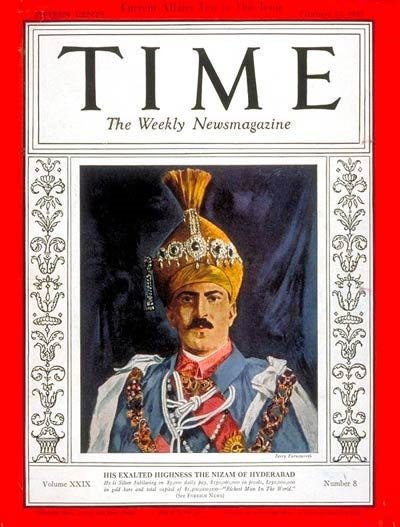
Despite his wealth, or perhaps because of it, the 5’3”, 90lb, Osman Ali Khan was an incredible miser. Firsthand accounts of him state he only wore, “a soiled fez [reportedly worn for 35 years], old slippers, dirty off-white trousers, yellow socks, and a moth-eaten muffler.” His office was a small, dirty room containing old chairs, a cupboard and tables stacked with dusty documents. Supposedly, and perhaps in that small office, the Nazim used his Jacob diamond as a paperweight, despite its reported value of $150-250m in today’s dollars.
Other colorful stories exist:
The Nazim would smoke the cigarette butts of his guests after they left.
He reportedly kept $10m in cash around his palace, rolled up in newspapers, stored in attics and cellars, and stuffed in other places.
When a doctor came to perform an ECG, the machine he brought was unable to work because the Nazim had reduced the power consumption of his palace so much that there wasn’t enough current to power the machine.
Many of his subjects would come and offer gifts, often monetary, for an audience or as a symbol of respect. During an annual ceremony, guests were expected to offer a symbolic gold coin to their ruler who would often return it. The Nazim didn’t and, in one reported case, when the coin dropped as it was being offered, he raced the giver for it, crawling on his hands and knees to get it.
Curiously, and irrespective of his incredible miserly behavior, Osman Ali Kahn was actually incredibly generous. From his time ruling the state of Hyderabad in the first half of the 20th century, he invested heavily in schools, hospitals, universities, roads, railroads, and other public infrastructure to the benefit of his people.
The Miser of Omaha
An article was published in Railway Age this week from Shane Keller, the former SVP of Operations at Union Pacific. From the article,
“During more than 30 years in the railroad industry, I’ve watched North American railroading undergo dramatic change, from distributed power and energy management systems to Precision Scheduled Railroading and major mergers.
“Nearly every change was met with skepticism. Most ultimately improved network efficiency, service and capacity. That’s why I’m puzzled by some of the opposition to the proposed Union Pacific-Norfolk Southern merger…
“Railroad leadership is ultimately about network optimization. When freight moves faster, fewer railcars are needed, capital costs decline, grade crossings are blocked less often, and infrastructure is used more effectively. Those benefits extend beyond the railroad to customers, communities and the broader economy.”
He then later weighs in on the competitive concerns raised by opponents of the merger,
“And if a UP-NS merger is approved, the industry will still feature two major western railroads and two major eastern railroads. That still feels like competition to me…
“The question is whether it will create a stronger, more efficient transportation network that benefits customers, communities and the North American economy. Based on more than three decades in railroad operations, that’s a question that should be answered with facts, performance data and customer outcomes, not assumptions.”
I’ll come back to some of the points in this article later, but I think it’s worth highlighting how a railroad operations executive is sitting back and digesting the merger and those opposed to it. For him, the merger is about “network optimization” with the downstream benefits first coming to the railroad and then later being extended to “customer, communities, and the broader economy.”
He’s not wrong. Reduced handling and interchange points means less friction in the network. Faster train speeds and more reliable cycle times give shippers access to cars that removes the need for added buffer capacity. Less trains are parked in crossings because yard congestion is down, improving fluidity on public infrastructure and in local communities.
The questionable part comes once you look outside the railroad’s bubble. The word “extend” is doing a lot of work here, as shippers haven’t felt a lot benefits extended to them from leaner faster networks, whether it be from earlier mergers or later PSR adoption. Instead, railroads often push change unilaterally (for the good of the network!) that leaves shippers scrambling when their service days are cut or when larger strings of cars are dropped off than before. Is the network better for it?
Further on, Shane states that, “If a UP-NS merger is approved, the industry will still feature two major western railroads and two major eastern railroads. That still looks like competition to me.” While a railroad may not notice the difference, a shipper who moves on UP and NS today will certainly notice the difference when the time comes for rate negotiations or dispute resolutions. One shipper told me, “I have so many issues with how aggressive UP is on accessorial fees. Will they do that on the NS once they gain control?”
That’s a statement that extends beyond the network to the monopolistic impact of reduced market share. Today, if a shipper has a problem with accessorial fees, damage claims, or even just local service problems, those can be quarantined to a particular railroad. What leverage does the shipper gain in trying to find a resolution when those problems are bundled up to an even larger entity who, for the past decade plus, has shown very little interest in offering more tools and resources to resolve customer service challenges?
In my last article, I posted a Pawn Stars meme poking fun at UP’s Committed Gateway Pricing proposal. I’ve never watched the show, but I think the meaning is self-evident.
It encapsulates the mood among shippers pretty well, which is thoroughly underwhelmed at best and downright antagonistic at worst. I remember going to lunch with a pretty decent sized shipper about this time last year and asked if UP had come calling for a letter of support. They had. Despite even being in a contract negotiation at the time, this shipper said they didn’t offer anything to try and win the shipper over to support the merger. UP just wanted them to sign the letter and, by the way, here is a rate increase. Needless to say, this wasn’t received with a lot of enthusiasm. Is it any wonder shippers are not coming out in support of the Miser of Omaha?
CGP is only one example of the “extension of benefits” that seems to be missing from UP’s merger application. As I’ve noted before, railroad shareholders have benefited tremendously from PSR and sub-60 OR’s, but shippers, arguably, have not. Like PSR, is this merger just a pretense for a further wealth transfer from shippers to shareholders?
UP CMO, Kenny Rocker, wrote an article a few months back where he suggested productivity gains would be shared with rail shippers through “competitive rates.”
This merger fixes that structural problem across the middle of the country. When freight runs longer distances between ramps and yards under one operating plan, transit time drops and cost comes out of the network. That is not theory. That is operating reality. Lower cost means competitive rates to win truckload freight that has stayed on the highway.
The thing that’s missing from UP’s concessions, and I hope the STB takes note here, is something that would force Mega UP to share its productivity gains with its customers. Kenny’s letter is all well and good, but there’s nothing UP is actually committing to in terms of rates other than CGP. (No, CGP with its extremely limited reach and fast sunset does not count). There is no forcing function today, nor has UP made any real concrete efforts to outline any plans that it would actually share its productivity gains with shippers. That would help act as a counterweight to a Mega UP’s monopolistic capabilities post-merger.
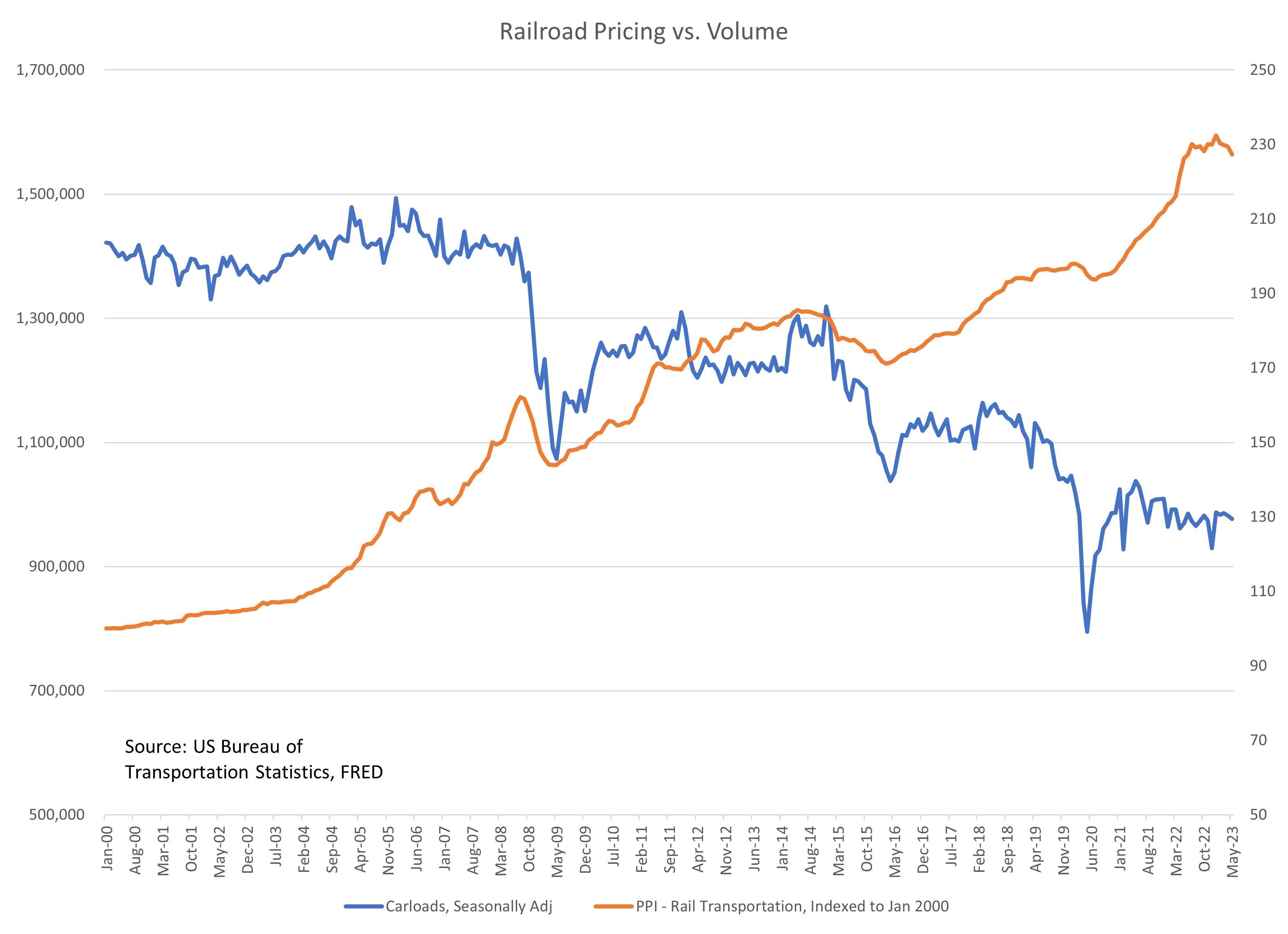
I suspect that railroad management teams are still convinced that the, “If you build it, they will come” principle works. It doesn’t. And it hasn’t for decades, arguably since the 19th century. If the railroads were so good at attracting freight to their network because it’s running like a dream, then we should have seen it show up in the volume numbers by now. Instead, other correlations are far more prevalent and compelling, like price and volume. Maybe I need to post this in every article until railroad management teams start to get the concept.
Shippers, particularly some of their most prominent trade associations such as the ACC, ACD, NGFA, and NITL, are fed up. From their joint Aug 6 filing,
“This merger will deepen that captivity, eliminate what limited competitive options remain, and leave them exposed to service deterioration and rate increases with no recourse.”
And their individual filings over the past year:
NGFA
“It does not create new competition, enhance existing competition, or adequately address the broader competitive harms that would result from the transaction.”
NITL
“Despite past promises that rail customers would benefit from mergers through more efficient service, today captive rail customers pay increasingly higher prices for unreliable and inadequate service.”
ACC
“American businesses are still paying the price for prior rail mergers. Today, just four companies control 90% of U.S. freight rail traffic. As a result, freight rail rates have soared more than 40% (inflation-adjusted) over the past two decades, while rail customers face frequent service disruptions.”
UP’s inability to meet shippers where they’re at is an indictment of how they’ve approached this merger from the start. This is not a contract negotiation. This is a political campaign. You don’t get the votes by showing up to your customer’s doorstep with a bag and a sharp object.
All Rail Service is Local
Pre-merger, I think it would have been fair to say shipper-railroad relations were “tenuous” at best. The STB had been pushing a reciprocal switching rule to give shippers some relief from poor service. The Post-COVID furlough reaction made life tough on a lot of folks. But most of all, I think any goodwill in the relationship has been burned up by PSR.
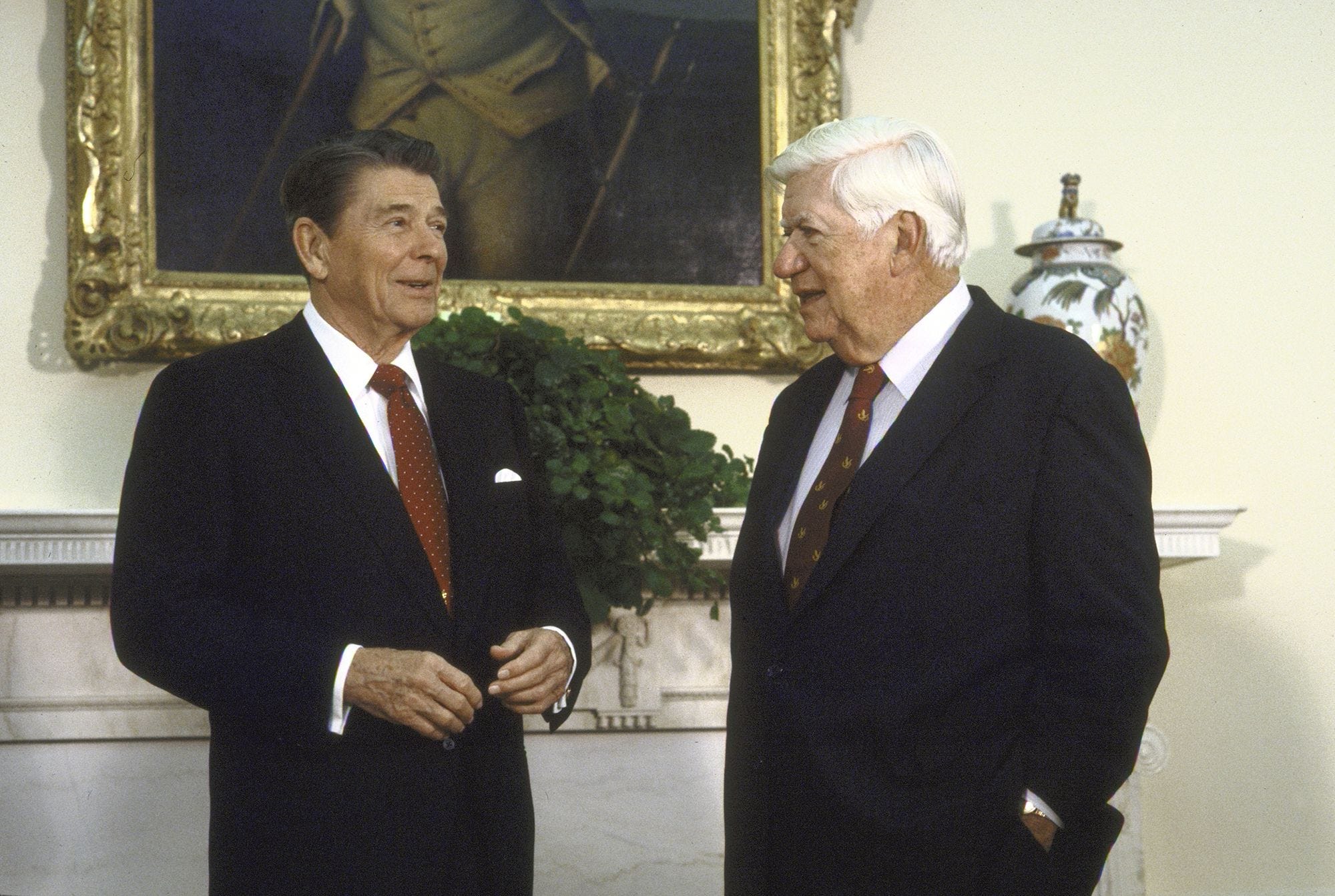
This may come as somewhat of a surprise to my Class 1 readers. “We made the network so much faster and leaner!” Sure, but to adapt former House Speaker Tip O’Neill’s famous phrase, “All rail service is local.”
A Class 1 may post the best network velocity or hit a record OR, but if a shipper in Glasgow, Montana sees their days of service shrink from 5 to 2, they’re not going to care at all about your national averages. They just want their local service to work.
That local frustration is the point that I think the Class 1’s have just never seemed to truly appreciate. The fact that so little attention is paid to it by the Class 1s, or at least so little effort appears to be made by Class 1s to meet shippers where they’re at to address these grievances, is how you get large swaths of your customers to come out in open revolt to your merger.
This insular thinking also produces things like CGP and TAG, the service remedy mechanism UP has proposed. They do so little for anyone that it’s almost an insult that UP even proposed them because it reveals just how little they understand their existing customers if they feel they are sufficient. I suspect they don’t know what would be appealing to their customers and instead have approached it with the lawyers from the mindset of, “What little bit can we get away with?”
Herein lies the tension with today’s freight rail operation. Railroads really just want to be left alone to optimize their network. I learned this at the plant in my early days when the shift supervisor training me said the railroads really only care about hook and haul, a phrase often repeated for so many years across the shipper landscape. Sometimes that means reducing service windows at shipper locations. Sometimes that means pushing more cars on a shipper than they can process. In the end, railroads pushed operational risk and inefficiency onto shippers and their facilities that had been set up to run a certain way. That requires CAPEX and investment to dig out, or, as happens quite often with an overwhelmed logistics team, they end up getting frustrated from paying higher demurrage and accessorial fees and having to rework their entire operation that they just give up and pay more for trucks.
And maybe that’s the right thing to do from a network perspective! After all, should the network be held hostage by one or two nodes? Maybe one end of the network needs to rebalance and that causes issues elsewhere. Or maybe shipper investment in their rail capacity and rail handling hasn’t kept up with what it should be for the network to be successful. A Class 1 could think, rightly, “These actions justify a more reliable service for everyone, even if we have to crack a few eggs to get there.” All plausible, but don’t get upset when a shipper tears up its track and shifts to trucks because they’re tired of dealing with the local pain.
And if you think I’m being facetious, this is exactly what Norfolk Southern did recently, according to a small lumber distributor in Baltimore, Maryland. From Grasmick Lumber’s filing with the STB,
“On July 3, 2026, Norfolk Southern notified us through its customer service case No. CS0009085572 that our service days were changing to Monday, effective July 13, 2026, reducing our facility from its scheduled twice-per-week service to one scheduled day per week. On July 16, 2026, Norfolk Southern wrote to us that it is “currently unable to consistently support twice-per-week service” at our location “given the challenges of Amtrak and its impact on crews.” The same message added that Norfolk Southern would “completely understand if you need to convert to a truck.”
Go read the full Trains article for the other nonsense that came later.
Or look at the example with Weskan Grain fighting UP’s enforcement of paper barriers on the Kansas & Oklahoma.
So, no, most rail shippers today probably don’t care about truckload conversions or even watershed traffic growth. They don’t care about corporate comms people saying tone deaf things like, “The customer assurances put forth in this application far exceed any other in rail merger history.” They’re tired of fighting never-ending rate increases, damage claims and accessorial fees that are “guilty until proven innocent',” positive placement times that get fudged, and missed service windows with no remediation.
All rail service is local and shippers are tired of listening to the politician on the TV when they can’t get ahold of them in their local office.
What UP Should Have Proposed
I really tried to avoid writing another “rip the railroads” article. I promise. So here’s some constructive feedback for UP:
You got your application in by the skin of your teeth. The STB has been pretty lenient up to this point, even allowing you to correct the take home test before resubmitting it. Past iterations of the STB may not have been so generous. So don’t take the recent acceptance as anything more than a D grade - you aren’t going to fail outright, but the odds aren’t good for you passing the class. You’ve got some makeup work to do if you want to get this over the line.
Your agreement with CN was a good thing. You helped take some risk and uncertainty off the table and you did it on your terms. Now do that again with your customers. Sit down with each trade association, especially the NGFA. Remember, this is a political campaign, not a hostage negotiation. If you win NGFA support (and other smaller Ag players like the Iowa Farm Bureau, for example), then you win the ag states. Maybe you don’t care about Congressional support for the merger or have any concerns about getting called to the carpet for Congressional hearings by a more populist-leaning political class, but you should care about knocking down political obstacles that could interfere in the STB’s process.
With the NGFA and the other shipper groups, you go to them and say something like, “Listen, we get you’re not thrilled about this merger, but we feel this is a great opportunity for you. Let’s figure out what it’s going to take to get you on our side of the table thinking the same thing. You have concerns about what life will be like on the other side. Let’s get those on the table and prioritize them so we can address them. Maybe we can’t get from here to there, but we want you to know you’re an important stakeholder and we’re going to do our best to help you see how great this is going to be for your member companies. Let’s see if we both can do something meaningful for your members.”
Every trade association is backed by a handful of really noisy constituents pushing in one direction or the other. Strategically, you have to figure out who these prime movers are and meet with every one of them directly. Eat a slice of humble pie before you do. Let them shout at you. They expect you to come in and push them around. Don’t do that. Move past emotion and get to cold hard facts as quickly as you can - Which facilities, what problems? A small amount of effort, like solving a local service issue at 1 plant, can add multiples of value if it helps to shift a key shipper at a trade group. Highlight potential benefits and opportunities you can deliver to them as part of the merger. Craft something specifically for them. Send them swag. Follow up on the issue repeatedly. At the end of the day, a personal touch means a lot. We’re all people; It’s not rocket science.
You’ve screwed up the relationship pretty good if you haven’t done anything like this by now. You can’t fix that, but you may be able to salvage something to improve your chances of a merger approval. If flipping even one group or a handful of key shippers not only gives you some positive momentum in the PR battle, it could also help take the sting out of the opposition. Do nothing and, well, you’re kind of making their point for them: This merger doesn’t benefit customers.