I’m wrapping up the biography of Jim Baker who served in a number of key roles in the Reagan and Bush administrations. He has a fascinating background starting with running multiple presidential campaigns before become President Reagan’s Chief of Staff, his Treasury Secretary, and then transitioning to Secretary of State when his friend George Bush took office.
Baker was feared and respected as a pragmatist who could get things done in Washington, including the Plaza Accords and engineering a soft landing during the fall of the Berlin Wall and the Soviet Union. The fact that the fall of the Soviet Union caused no major wars or disruptions is sign enough of his effectiveness.
Jim Baker also has a lot of similarities with the biographies of other powerful people that I’ve read over the past couple years, including:
Their differences, at least on the surface, are wide and varied. Some were born with the proverbial silver spoon (Baker, Moses) while others grew up in poverty or had working class roots (Ailes, Johnson). They came from both sides of the political spectrum with Baker as a former Democrat even being long criticized by conservatives as not being a true member of the faith. Ailes was the firebrand who created Fox News into the partisan media powerhouse that it is today.
Their personalities also varied. Some avoided confrontation while others were extremely combative. Some were able to move easily in social circles (Johnson, Ailes) while others were clearly introverts (Hoover, Baker).
But despite these differences, they all shared some important characteristics:
Incredibly prepared and detail oriented.
An ability to talk with anyone.
Longevity in power.
Understood the importance of controlling the media narrative.
I’ll break down each of these and explain why they are important.
The Most Prepared Person in the Room
Each of these powerful people knew the game. They knew all the rules of the game, including the ones they could bend or break to accomplish what they needed to. LBJ was incredibly good at this during his time in the Senate. He took the time to understand the arcane Senate rules in order to get legislation passed and he always had the most accurate vote counts so he knew where his strengths and weaknesses were. He knew who to push and who to ingratiate himself with.
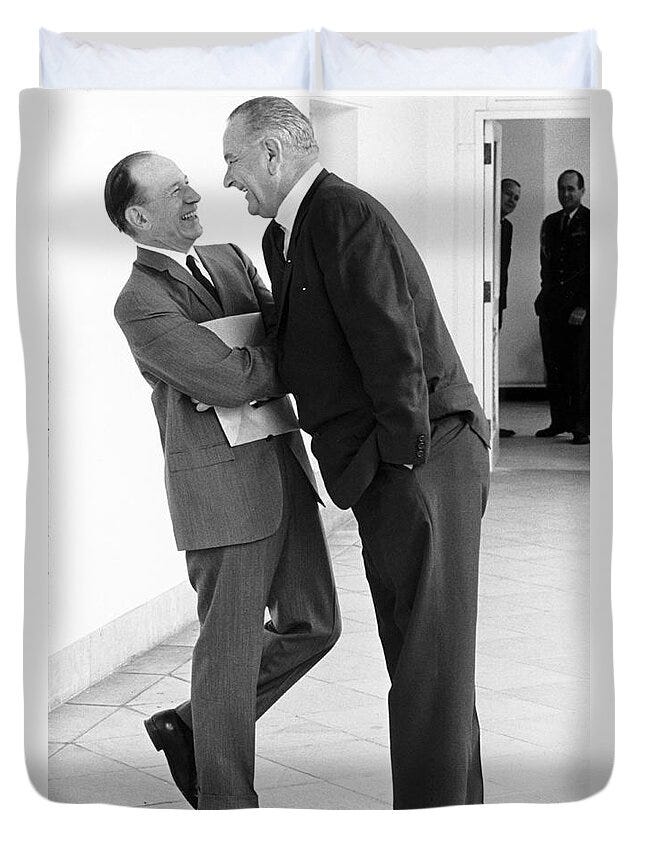
I love the stories of LBJ and how he would spend hours with aides rehearsing and preparing for an important conversation with a Senator in trying to get his vote on something. He had a big presence and would often physically impose himself on the other Senator to prove a point or to send a message, like in the famous photo below.
Another anecdote about President Johnson was his incredible ability to know everything that was happening in the Senate.
“Ask him about a minor bill, and he would tell you its contents and its number on the calendar. And he left nothing to chance. When John F. Kennedy was narrowly elected to the Senate in 1952, sure of the result only at dawn the next day, he got a telephone call at that early hour from Lyndon Johnson in Texas, where it was an hour earlier. ''He said he just wanted to congratulate me,'' Kennedy said when he put down the phone. ''The guy must never sleep.'' A few hours later Kennedy learned that the Democratic leader, Senator Ernest McFarland of Arizona, had been defeated for re-election. Kennedy realized that when he called, Johnson had just heard that result and was working to succeed McFarland.”
Robert Moses was another prime example of this ability. He rode Al Smith’s coattails into power in New York and became so famous for his ability to get what he wanted that he was nicknamed the “best bill drafter in Albany.”
An Ability to Talk With Anyone
Politicians make a career of “shaking hands and kissing babies.” Funny enough, for the one time that Jim Baker ran for office he was terrible at it. Whereas his friend President George Bush was comfortable working a crowd, Jim Baker never figured it out. He was the backroom strategist. Yet despite this personality mismatch Baker, the Texan who worked as a wildcatter in the oil fields during the summer while he attended Yale, was comfortable moving in social circles. His ability to lobby different members of Congress on both sides of the aisle, while not as prolific as LBJ who was a master of the craft, was incredibly effective.
Baker was often criticized by Reaganites as being too pragmatic and not really being a conservative. They were probably right, but prioritizing the culture wars to “stick it to the libs” is not an effective strategy for governance. Instead, Baker was able to work across the aisle with an opposition Congress to pass several tax code reform and tax cuts and immigration reform pieces of legislation. Without Baker’s effectiveness, it’s unlikely that Reagan would be revered in the way he is today by conservatives.
Although Hoover was a unique character and definitely not the easiest to get along with, he still managed to last through multiple Democratic and Republican administrations as the head of the FBI.
Longevity in Power
Each of these characters was able to stay in power for decades. Ailes got his start in politics working in the Nixon administration and continued through his time running Fox News up until his infamous resignation amid claims of sexual harassment in 2016.
Robert Moses’ first political appointment occurred when working for New York Governor Al Smith in 1919 and continued notably with his tenure from 1934 to 1960 as the New York City Parks Commissioner.
President Johnson’s political career began in 1937 in the House of Representatives, continued in the Senate in 1949, and then into the White House as VP with JFK in 1961. As president from 1963 to 1969, he was ultimately done in by the Vietnam War.
Hoover was named director of the Bureau of Investigation in 1924 by Calvin Coolidge and retained that position (renamed FBI in 1935) for 52(!) years until his death in 1972.
Jim Baker began his political career as an Undersecretary in the Commerce Department under Gerald Ford in 1975 and continued through various appointments running presidential campaigns, Reagan’s White House as Chief of Staff, Secretary of the Treasury, and Secretary of State. He also oversaw the 2000 Presidential Election recount and stayed in the 2nd Bush’s administration in various capacities.
Knew How to Control the Media
This last one is arguably the most important skill that I’ve come to appreciate. You can be the smartest person, the most effective tactician and strategist, know exactly what do and get absolutely nothing accomplished.
Hoover was obsessed with controlling both his and the FBI’s public image. So much so, in fact, that he was publicly very popular until after his death when more details came to light on how he ran the FBI and stayed in power so long. It’s even said that it was harder to get a job at the FBI than it was to get into an Ivy League school while Hoover was Director.
Ailes was a pioneer in the use of TV as a medium for swaying public opinion. His creations like CNBC and Fox News still have tremendous pull in the mainstream media at shaping discourse in markets and politics. Volumes can be written about the impact of shifting from Walter Cronkite-era news to partisan media like Fox News on society generally.
Baker was known as a prolific leaker to the media to shape public opinion. Controlling the media narrative is a matter of survival in Washington and Baker was a master at it. (Check out Jared Kushner’s book for the absolute zoo caused by serial leakers like Steve Bannon in the Trump 1.0 White House). Although he had the reputation, Baker used media leaks a key tool in controlling the narrative around policy and limiting the damage from negative media.
Where are UP and NS?
The reason I bring all this up is not to walk you through my reading list. There’s an important lesson for an industry that can accurately be criticized as insular and myopic without an appreciation for the wide world around them.
Take for example a simple Google News search for “railroad merger.” Here are the first results:
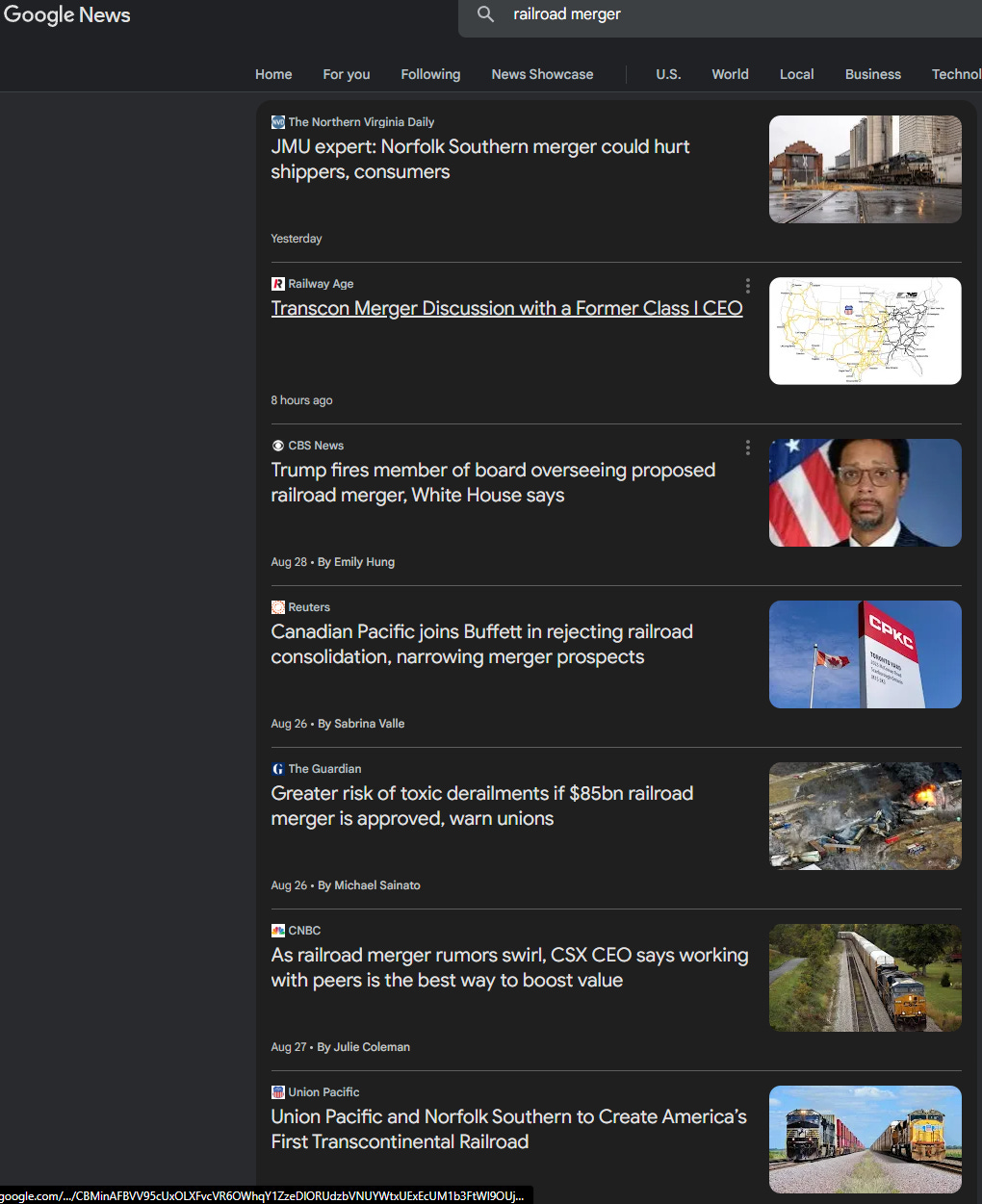
Of the first 20 articles in Google News, only 4 were favorable to the merger if you count the UP press release listed at the bottom of the above graphic. Of the other 16 articles, 10 argue against the merger and the remaining 6 are neutral. UP is losing the media battle here.
Where is the support? Who’s out there stumping the UP-NS merger outside of those two railroads? The one pocket of support that UP and NS have found has really only come from a handful of intermodal shippers, who probably would benefit from a transcon.
Moreover there are three opposition camps that have laid fortifications around their positions: Shippers (carload, primarily), Labor, and the other Class 1’s. The other Class 1’s led by Warren Buffet and Keith Creel have created a counter narrative of “collaboration, not consolidation” while the usual union and shipper group opposition led by the American Chemistry Council have just flat out opposed the merger.
What’s more is that groups like the ACC have been burning up the media trail giving multiple interviews and generating content with a negative message on the merger. As best as I can tell, UP has had Jim Vena sit down once with Bill Stephens.
Within the industry, competitors like CSX are doing far more to generate supportive PR than UP or NS. It’s clear that Joe Hinrichs frequent appearances on CNBC show that CSX understands where they need to be. When I’m in DC, Joe is often the only Class 1 CEO I ever hear about making the rounds as well.
CPKC is another Class 1 that seems to get it. See below for Exhibit A. Do you think CEO Keith Creel schlepped all the way to DC just to see his old pal, Howard Lutnick the Commerce Secretary? Absolutely not. But as Creel has come out frequently in the past couple months in opposition to further rail consolidation, simply publishing this photo shows he’s in the ear of someone who could have a say in how it proceeds.
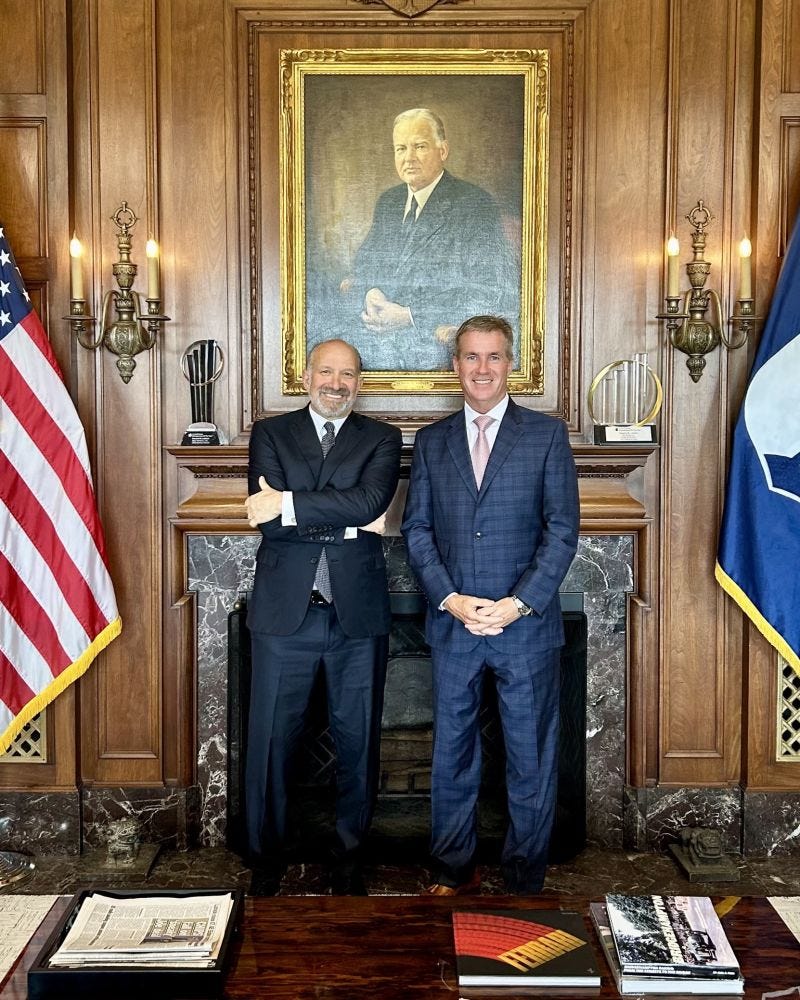
I’ve no doubt that all the Class 1’s are working DC to varying degrees, especially UP and NS. The problem is that if you didn’t document it, it didn’t happen. You’re invisible to the general public and to the broader industry and that creates a big vacuum that your rivals and opposition can fill up with whatever message they want. Just like with East Palestine, no matter how significant you think the incident was, if it can capture the imagination of the general public you might be taken for a ride in a direction that you don’t like.
I don’t know that Ma and Pa are going to sit around the kitchen table and discuss railroad mergers, but that doesn’t mean trying to court public opinion, particularly among key constituents in the rail industry, is a waste of time.
Why the Halls of Power Matter
I can’t remember if I’ve written it, but I’ve stated in the past couple months that I didn’t think the Trump administration was going to have a big impact on the rail merger. However, others have made a compelling case to me that the administration can absolutely make or break this merger.
Despite only being a couple months old, we’ve already seen the Trump administration wade into the middle of rail issues by abruptly firing former STB Chair Robert Primus (a stupid move). Some see this as a win for merger approval, but I’m not so sure. Primus certainly has a case to be made to keep his seat and has stated that he will pursue legal options to fight the dismissal. With the dismissal and possible reinstatement to be resolved, that just adds chaos into the mix.
Add to that the fact that the Senate can’t seem to approve anyone. From the WSJ just this week,
“We’re almost eight months into Mr. Trump’s second term, and the GOP Senate hasn’t approved a single nominee by voice or unanimous consent, the quickest path to confirmation. About 300 of Mr. Trump’s civilian nominees are in the Senate queue.”
So with Primus potentially being sidelined even part of the time, fellow board member Karen Hedlund’s term expiring at the end of the year, and what seems to be an indefinite delay in nominating new members, will the STB even be in a position to review the merger let alone rule on it? If there are only three board members with Primus removed and no new members appointed, due to the Sunshine Act any meetings between board members would have to be public. In other words, board members would be unable to discuss the merger informally which could significantly impact proceedings.
Does this chaos delay the merger approval process and all the distracting downstream effects that will negatively impact UP and NS? Good luck to STB Chair Patrick Fuchs with managing this circus.
So given the importance of having the Trump administration on their side, why hasn’t Jim Vena and Mark George jumped on a plane to Mar-a-Lago to kiss the ring? Why weren’t they in Lutnick’s office within a week of the merger announcement? Take a leaf out of Nippon’s playbook in their very public acquisition of US Steel. Japanese executives recognized the political hot potato during an election year and made all sorts of concessions and trips to the US to get the deal done.
Wall Street has been asking UP if they have the support of the White House in pursuing this merger. By all appearances, it seems they don’t. That’s not a good sign.
Consider this a fair warning to the comms people at UP and NS - you’re losing the PR battle. Ignore its importance at your own peril.