Last Spring while NS was in turmoil, the railroad issued a press release stating a number of aggressive initiatives to stave off Ancora prior to the proxy vote. From one of the many highlights in the press release,
“A new driver appointment system has been deployed at two of the company's major international terminals. With drayage arriving at scheduled times, terminals are prepared to quickly hand off freight, reducing driver dwell and increasing fluidity. Norfolk Southern has also launched new stack optimization technology at the terminals that manage containers, allowing the overall facility to operate cohesively. The combination enables crews to handle additional volumes and reduce ground traffic, creating the opportunity for further growth.
I was scrolling through LinkedIn recently when I noticed this interesting feedback on the new NS Appointment Program for drayage in Chicago.
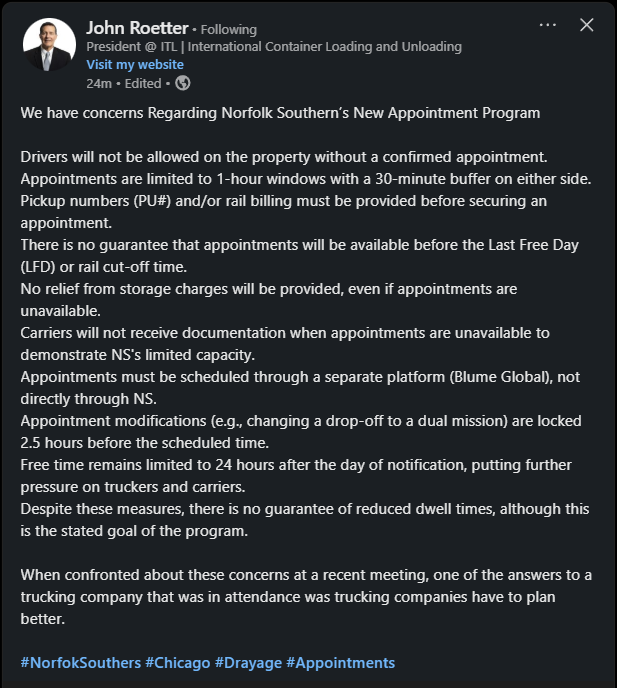
There are a few things that intrigue me about this post from a frustrated drayage operator.
To start, there’s probably not enough appreciation for just how hard it is to run a network operation, even from yours truly. Railroads are network operations – they have to run mobile assets (crews, locomotives, railcars) from one node to another while maintaining enough resources to service (switch cars, start new trains) to keep the internodal travel fluid.
Now, layer in the fact that some of those assets (crew) are people who have vacation, sick days, or simply don’t show up for work. You also have maintenance requirements on locomotives and railcars, that are often foreign owned and without any visibility into their condition until you receive them.
(HINT HINT - This is why railroads should be implementing condition-based maintenance activities using sensors like the Hum Boomerang and car inspection portals. Imagine if the most common maintenance items were known months before assets arrived).
To put the challenge of a network in perspective, imagine no one was allowed to drive at all. You may own your own car or you could use a system provided car. You also can’t take your car home. It sits in a terminal and may or may not be there when you want to use it.
You show up at the terminal and somebody, maybe the State or Federal DOT, would provide you with a driver. Try scheduling your doctors’ appointments, grocery trips, and work commute then. Absolutely nuts.
Now, in terms of modal competition, suppose your alternative is to have a driver with a car come directly to your house. They may have a smaller car, maybe only fit 1 person, but they’re easy to get a hold of, you can see where the car is and when it will arrive, and it will go wherever you want to go. That’s what point-to-point trucking can offer shippers.
(Is it any wonder rail has been losing modal share to truck when you compare the two experiences?).
I’ve been trying to think of a comparable business to a railroad network. Airlines are network businesses, but they control their assets (planes, gates to some extent, crews) and don’t interchange with other airlines. Plenty of challenges, but not a straight comparison.
Parcel carriers like FedEx also run a network business with a whole lot of assets, but those are assets that are also under their control. They’re not exchanging planes or trucks with UPS. Control (aka vertical integration) gives parcel carriers and airlines much more influence over their operations.
Standardization also plays a key role. Fortunately, the North American rail network already fought that fight years ago. Things like equipment specs and track gauge are all standardized. Europe, Australia, India, and all of Africa are all way behind in this respect. Lack of standardization in traction motors and electrical infrastructure is probably one of the biggest impediments to freight rail growth in Europe, behind the political prioritization of transit over freight.
Vertical Integration as a Solution?
Let’s explore vertical integration for a minute. Is there a way that railroads could become more vertically integrated? Should they control all the drayage coming in and out of the terminals? That would give them greater control, but it would come at a huge cost with probably very little cost savings or performance improvement. At least not substantial enough to justify destroying their ORs.
Continuing with intermodal, should the Class 1’s take back the customer relationship with BCOs (beneficial cargo owners) from the IMCs (intermodal marketing companies)? Again, that would require a huge amount of additional overhead in sales, marketing, and customer service not to mention the assets (chassis, containers, tractors, drivers) that would be a huge weight on the balance sheet. OR would tank again, at least in the short term, but the hope would be that revenue growth would exceed that loss. Would it be better for railroads to own the customer relationship? It almost always is in any market, but let’s just leave it as a “Maybe” for the time being.
In specializing on long distance line-haul, railroads have found the sweet spot in the market where they can drive the highest degree of profitability. No transportation business has margins like railroads. But, as profiled above, no other transportation business has the operational headaches of a network quite like railroads do.
It’s also hard to ignore the benefits that come from a more centralized, distributed network, if that apparent contradiction makes any sense at all. What if railroads did have the FedEX/UPS parcel network?
This is one aspect I was trying to detail when I wrote about why I felt a final industry consolidation was inevitable. From the article,
“Given the already incredible pricing power Class 1’s have over their captive shippers, break the relationship. Class 1’s would become strictly hook-and-haul wholesalers. Divest the industrial development to real estate development/PE funds. Maybe even shift system cars to TTX. Divest the first mile/last mile local service. That’s the retail business. Bring in G&W, Watco, etc. to run terminals and provide local service. Class 1’s already can’t do that at scale…
“The local would not only service local customers, but they would also build trains for the Class 1 to come in and grab. Get the train ready by 4pm and the Class 1 picks it up. Train composition would be built according to agreed upon standards given to the local. Class 1 just hooks and hauls. This is comparative advantage at its finest…
“Would this solve all the industry’s problems? No, and it may just prolong the inevitable. Restructuring the existing organizations to grow organically would be far healthier. But getting rid of or severely reducing interchange at Chicago would be a boon to rail service and reliability for rail customers.”
Consolidating the industry once more into 2-3 mega railroads that span North America would provide a stronger operating basis that should improve service. There’s obviously a lot of market dynamic issues with granting even more solidified monopolies to railroads, which is why splitting into a Wholesale vs. Retail model may provide some counterbalance to that concentration.
PSR Is Done To You, Not With You
We touched on the challenge of network operations during my recent conversation with Paul Tonsager.
From the podcast [21:51-25:16],
Byron: I mean, you say, I mean, what was, what was Hunter's perspective on the marketing side? Because you read some of what he, what he kind of put out there is, is we need to get the customer more involved. at least on an operational standpoint, right?
We need to basically push off some of our challenges and what we're juggling with down to the customer level, let them figure it out, and we can run a cleaner railroad. Now, the cynical shipper like me is, you're trying to give us your problems And you're trying to push all this to us.
But there are a lot of benefits, too, from railroading aspect, right? Don't just throw stuff over the fence, Mr. Shipper. You know, make sure that you got everything checked. You know, you got everything lined up. And I don't know if anybody ever tried to do actual pre-blocking in the yard or certainly for maybe
The larger shippers, you know, and unit trains as they grew into that, maybe. But, you know, aside from that, like what was, if that's even correct, what was Hunter's take on how you market and sell a railroad? I guess pricing too. Jack up the prices.
Paul: Well, you know, and listen, I was a humble salesperson then. Yeah. And of course, Mr. Harrison and the rest of them were CEOs. So, you know, I was not in any kind of day-to-day conversation, but I do know from being a salesperson,
it does kind of fall down to you because you're the face of everything you got to do to your customer.
And, you know, and I was more focused back then on the intermodal side of the business, which, you know, back then was the, you know, I've apologies to any redheaded people out there, but it was the redheaded stepchild. It's still kind of is of the railroad business, right? Yeah, absolutely.
And so, and so he didn't have a lot of time for that anyway. But what I will tell you though, is, you know, and I was actually just telling my wife this the other day, cause we were talking about, you know, customers and, and, and, and, um, congestion surcharge in New York and all that.
And I said, the thing is, railroads run 24-7. Steamship lines run 24-7. But your customer, well, we're only going to be open from 6.30 to 5 for deliveries. I get it. You don't want to pay overtime. You don't want to do open at night.
You don't want lights, all these other things you have to do that cause more expense. But But why does the railroad have to pick that up? Why are you in my yard? Why are you on my chassis? All of these things, I think, was in his mind.
And so, you know, I always...
Byron: Yeah, I mean, that's a fair argument, right?
If this is a 24-7 operation, but you guys are only going to give us gate time eight hours a day, that becomes tough if we want to move heaven and earth to serve you, right? We need a little bit more help in you guys being there to catch what we're throwing at you.
Paul: Yeah. I mean, you look at LA with their Nighthawk or Hoot Owl or whatever they said opened the gates at night during the crisis and also before that. And You know, people wouldn't use it because my warehouse isn't open at two o'clock in the morning.
Byron: I mean, isn't that still an issue?
Paul: Oh, for sure. For sure, for sure, for sure. And, you know, and I think that that played part into this is that, you know, we'll service you like crazy, but I can't just do it six hours a day. I've got a plant that I've got to operate. My plant operates 24 seven.
Technology Implementation
This in no way excuses railroads from avoiding communication and collaboration with drayage operators or shippers. Yes, the need is there for railroads to run tight controls on freight that enters and exits the network. But why can’t railroads do a better job of reaching out to customers, drayage operators in this case, and sit down with them to walk them through issues and possible solutions? It takes an immense amount of time and effort to do that outreach, but everything goes far, far smoother upon implementation (having done that very thing in a past life).
The final point I want to highlight is the fact that NS is using Blume as their technology provider to schedule this system. You may recall that in September 2023 NS invested in a company called DrayNow.
From the article I wrote at the time,
“DrayNow is a digital freight broker that has created a modern mobile platform for matching loads with carriers. A RR would be interested in more efficient drayage operations to allow it to keep its intermodal trains running fully stocked and on time. I don't know that there's anything remarkable about DrayNow (there are a lot of digital freight brokers) other than the price was probably right given the poor intermodal market and they appear to be heavily concentrated around NS' network.”
Now, maybe there’s more going on behind the scenes, but where is DrayNow with this system and why doesn’t it seem to be a factor in Chicago?
I’ll close with a recollection from about 10-12 years ago when I experienced an NS technology deployment firsthand. At ADM, we would call or email the local NS trainmaster to order cars for the shift. NS decided to roll out a new system (Pacesetter maybe?) which centralized those orders in Atlanta. Instead of talking with the local trainmaster we had to call/email Atlanta with our needs. It was a disaster.
Because almost no two days were alike, we often had specific needs to communicate to the local crew. We would get on the phone to Atlanta to communicate those needs about our plant to someone who, not only didn’t know the plant at all, but didn’t even seem to understand rail operations. Inevitably, any changes or orders we requested were ignored and we ran into issues, as did the local crew.
It took all of two days before one of the Foreman at the plant found the new phone number for the NS Trainmaster and we resumed communication as had done before the rollout.
Technology is tough and implementation is even tougher. But, speaking as a technologist, if you don’t design the system with the end user in mind and instead just foist it upon them (as railroads tend to do), it will not work for you or for your end user.