I wanted to comment on Bill Stephens’ recent article on mergers. From the article,
“‘We haven’t seen any growth – any growth in market share, any growth in volumes, any growth in market capitalization,’ [analyst Tony] Hatch says. Some see a U.S. transcontinental merger as a way to jumpstart volume and earnings growth…
“The Class I railroads regularly analyze the merger landscape and produce internal studies that cover potential merger partners and scenarios. What’s different now, according to Hatch and multiple other people in the industry, is that at least three railroads’ boards are being asked to weigh in. Plus, at least two of the Class I railroads have beefed up their legal and lobbying teams in Washington.”
Bill also quotes UP CEO Jim Vena about the benefits that a transcon would have on service by eliminating the ridiculous Chicago interchange delays. He’s absolutely right.
Merger talk should come as no surprise to anyone. As I wrote 6 months ago, it was always inevitable. From “Why Two More Transcons are Inevitable,”
“From a market fundamentals perspective, markets evolve over time. Companies must also change and evolve to match the market’s needs. In a new market, like railcar telematics for example, many entrants pop up. Too many, in fact, for the market to sustain them all (i.e., there are not enough profits to sustain these companies). Eventually competing solutions either consolidate with the winners eating the losers or they exit. As technology or the underlying market principles change, the number of firms competing in the market grows or shrinks. This is how a normal, healthy market should work.
“For an industry in decline like freight rail transportation, the same number of railroads fight over a shrinking amount of available freight. Eventually this leads to more providers than the market can sustain and firms will exit or consolidate. That’s the theory, at least."
As I wrote in that article, it’s my belief that because of the way the railroads are currently run with profitability prioritized over growth, the industry will naturally gravitate towards the next possible step change in profitability: consolidation. Unless something changes dramatically at the Class 1’s - I’m talking about a full-on cultural revolution similar to the adoption of PSR - railroads will continue to flounder in their attempts to grow volume.
As such, the natural thing to do is to increase their scale economies once more by triggering a final consolidation of the industry. This will increase profitability, may result in some growth, and in about 5-10 years time we’ll be right back to where we are.
“NO!” you may say, “Railroads do care about growth. Why, they talk about it every chance they can get!” Here’s why all that talk is meaningless:
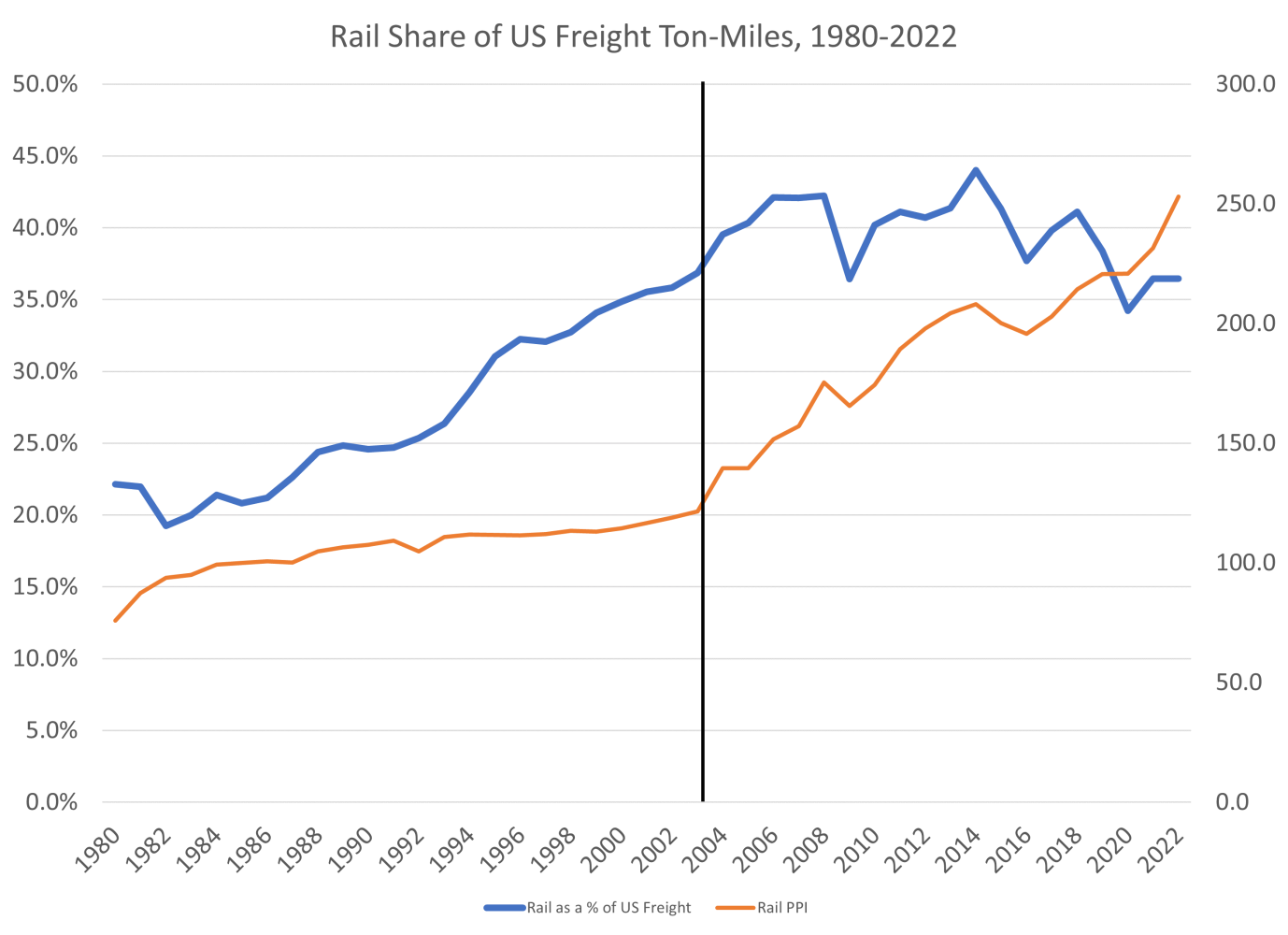
Railroads are unwilling to trade margin for volume. Talk with any shortline and they’ll confirm this. Or just check out the table below that shows the rather conspicuous switch that was flipped in 2004 that swapped volume for increased margins. Absolute shocker volume has flatlined/declined since that time. (It’s not).
Railroads do not invest in business development. Their entire sales org is structured around managing mature accounts, not growing new ones.
Railroads persist in erecting barriers that prevent more carloads coming onto the network if they don’t personally benefit in the near term.
There are a number of reasons why railroads choose profitability over growth, but make no mistake that it is a choice. When a railroad targets even just one of the things listed above, then you’ll know that they’re serious.
But they won’t because their organizational inertia and muscle memory, the behaviors and culture that have been rewarded for the past 20 years, all pushes them to continue to prioritize profitability over growth. The real reason that further industry consolidation is inevitable, contingent upon a favorable regulatory environment which the Class 1’s have for the next 4 years, is because it is the only way to achieve earnings growth.
I spoke with a Wall Street analyst a couple months ago. I asked him how the Street views the railroads and he said, “Railroads say they can continue to deliver inflation-plus pricing, but it feels that the pricing story has just about run its course.” With the exception of CPKC that is still filling its newly merged boots, railroad earnings growth is dependent upon some combination of three things:
Increased pricing (ARPU growth)
Reduced OPEX
Share buybacks
At this point in the post-PSR landscape, #2 is pretty much gone. There’s not a lot of fat left to cut on any railroad. #3 is also less of an option than it was during the 2010’s zero interest rate free money age. That leaves the railroads even more dependent on #1. If that runs out, earnings growth is going to be tough to maintain.
So what does the recent ARPU performance look like from the Class 1’s? Let’s take a look.
Q1 Earnings Review
I wrote about CSX’s Q1 earnings in an earlier post here. I’ll follow that up with some analysis and comments for the rest of the bunch. (Sorry CSX, you went first and got a deeper dive).
Here’s what the total ARPU as reported by the Class 1’s was since 2024 Q1.
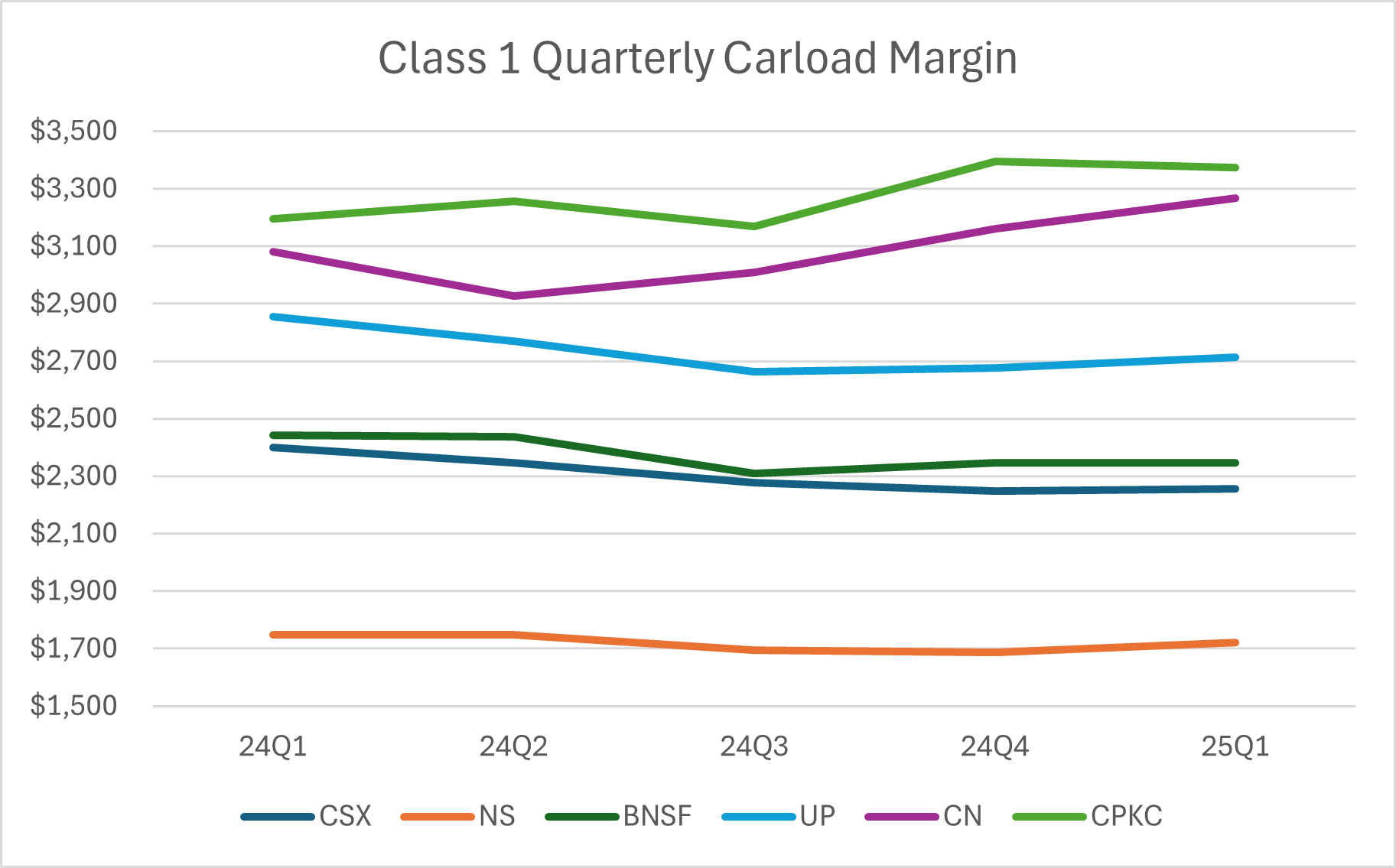
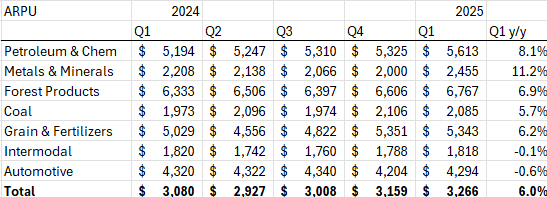
There’s a couple things to pull from this chart. First, the Canadians are doing very well. The US roads are flat or declining. CPKC seems to be collecting improved margins from longer routes/more RTMs. CN’s numbers are the ones that surprised me. As the table below shows, they had pretty steady, consistent growth across most business units.
You could, of course, dig up any number of caveats for these numbers. A weak freight market is going to soften up prices is probably the biggest alternative to a “Railroads can no longer drive pricing power!” narrative. That may be true and it should certainly be in the back of the mind when considering it. Still, the trend isn’t friendly to the US railroads.
Now, let’s take a look at the relative performance of each railroad from some standard commercial and operating metrics along with the response from Wall Street to the news in the table below.
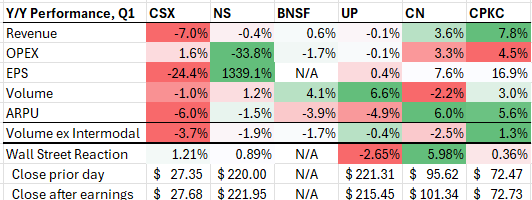
There’s a lot to unpack here, but the way to read this table is row by row. I’ve highlighted the best and worst performing railroads for each metric in the far left column. For example, CSX with a 7% decline in revenue has the darkest red cell (worst) while CPKC with a 7.8% revenue increase has the darkest green cell (best).
Here are my takeaways.
Takeaway #1 - CSX is not in a good spot
I won’t spend a lot of time here (you can read about it in this article). But as the table shows, CSX was far and away the worst performing railroad year over year. As I tried to highlight in my earlier analysis, CSX - at the very least - has a messaging problem. I am all for them forging a new path and trying to right the wrongs of the past. Especially after some solid numbers in 2022 and 2023, I think the bulk of the industry is more than happy to do so. (You can see Wall Street in gave them a passing grade by keeping the stock price flat).
But it’s not working now and they need to change the messaging, change the strategy, or both. If the current OneCSX strategy is the right way to deliver growth, then they need to focus Wall Street and the rest of the industry on the metrics that prove that story. Don’t look at OR, cool cool. Then what signs of life are there that the railroad is on the right track towards revenue, volume, EPS, etc. growth? So far, that alternative message isn’t there which leaves them open to distracting criticisms.
Or the strategy isn’t the right one and it needs a refresh. OneCSX was a smart, pro-labor move in the wake of the acrimonious labor negotiations in 2022. Now CSX has led the way in preemptively signing labor agreements (they just announced one with BLET this week, the first Class 1 to do so) and employees rave about the culture change. But if that’s not delivering on volume growth then there needs to be more. Service has also tanked over the last few quarters, so it’s not cutting it there either. Build on the positive culture with something more tangible, like any of the pro-growth moves a Class 1 could make that I highlighted above. Something, because it just doesn’t seem to be working.
Takeaway #2 - The volume decline continues
After listening to this past round of earnings calls, you could be forgiven if you thought the railroads were performing well. By and large they did perform well in Q1 in terms of fighting weather issues and maintaining minimal OPEX and relatively good service. But the pre-tariff frontrunning in intermodal volumes covered up the underlying weakness in the other commodities. Every railroad, with the exception of CPKC, showed volume declines with the intermodal volume stripped out with UP taking the top spot with a 7% volume swing.
Yes, the freight market has been in a recession for some time now. Yes, the trucking market remains oversupplied. But an unwillingness to deal with the field of play isn’t going to move the needle. Instead, it’s a persistent pattern of the Class 1’s refusing to loosen the margin limits and go after more share (i.e., growth).
Yes, that would dilute ARPU but the US railroads are already being diluted!! Why not go all in and really compete for market share. If customers are used to giving you the business because they’ve seen a willingness to meet them where they are, the odds of retaining that business when the freight market turns are much better when they have less options. Instead, the railroads will (likely) continue to batten down the hatches and then come back with rate increases when demand starts outstripping supply. Because what else would you do when that’s all you’ve done for 2 decades now?
Moreover, maxing out capacity on your fixed infrastructure spreads those fixed costs over more volume. That’s a win-win for ops and sales.
Takeaway #3 - The Canadians are doing surprisingly well, sort of
Especially with the doom and gloom of tariff talk, it seemed that the Canadian railroads were in line for a hit on Q1 earnings. Not so fast my friends! As I highlighted above, CN did well in boosting margins year over year, especially in categories like Metals & Minerals (+11.2%), Petroleum & Chemicals (+8.1%), and their most profitable segment, Forest Products (+6.9%).
Although there are several segments that showed marginal gains, grain really performed well over the past year which was a big boost for CN.
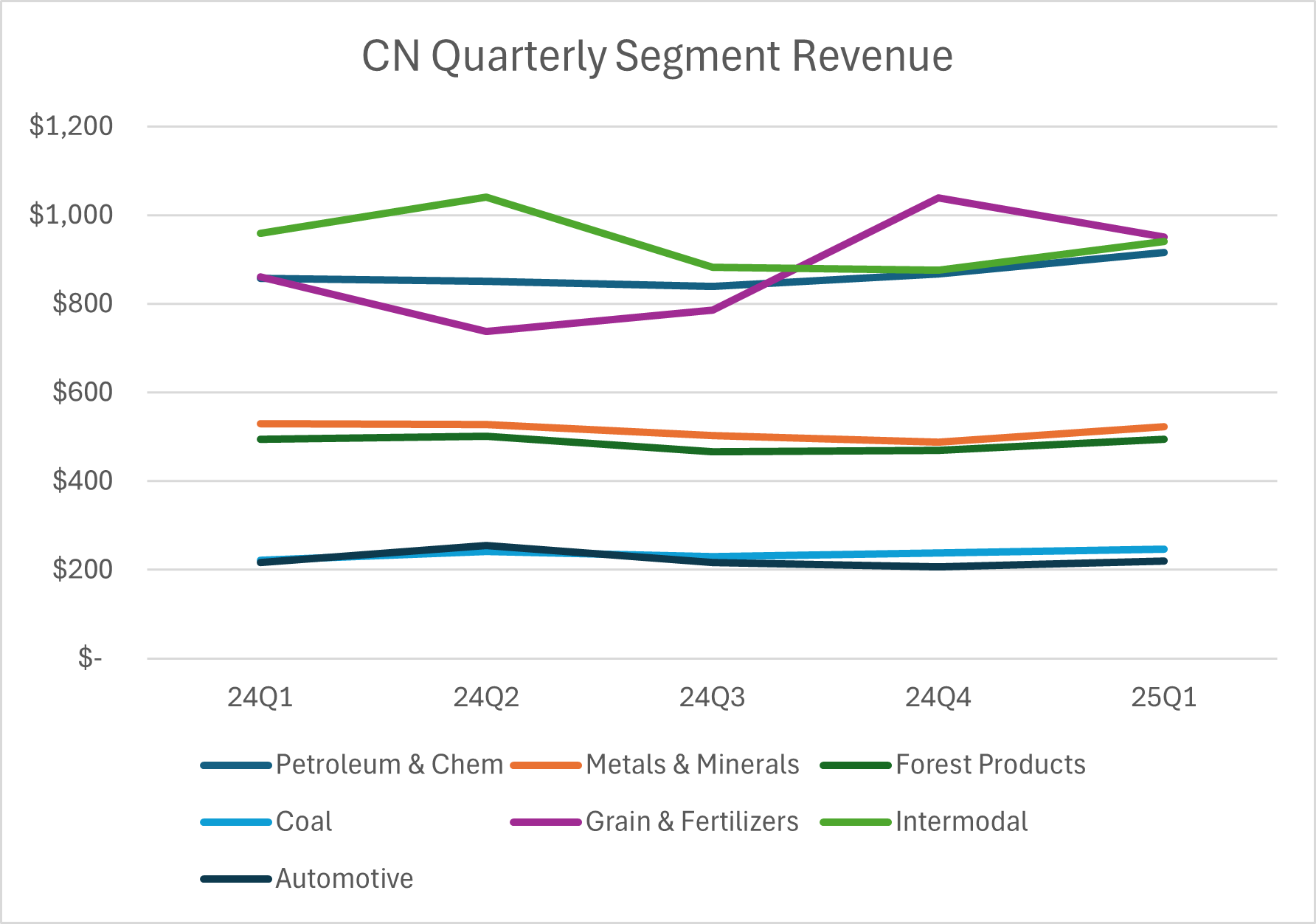
Coal continues to be strong for them with positive revenue and volume growth (+11.3% and +5.4%, respectively). Quite the contrast with CSX where strong export coal has now become a headwind for them (-27.1% revenue and -8.5% volume). CPKC’s coal business was also strong year over year.
CPKC had strong performance from a number of categories, growing volumes in nearly all of them year over year. They also benefited from a strong grain harvest nearly hitting $1B in quarterly revenue in Q4. The biggest gainers continue to be Coal and Automotive.
Despite the solid numbers out of CN, overall volume continued to decline 2.2% with Metals & Minerals dropping 11.3% year over year. While the CP-KCS merger was largely centered on the auto trade, they now are heavily exposed to any supply chain reorientation that moves auto production out of Canada and Mexico and into the US. They may still have exposure to some of those moves, but they’ll be far shorter and more susceptible to competition from trucks.
Overall, not a whole lot exciting in terms of any railroad actually unlocking the growth puzzle, but then again none of them are doing anything that would make me think otherwise. CSX is probably the most in trouble, but they’re not in a terrible place. The industry continues to muddle along…