Just as soon as I think the merger talk has died down and I can get back to some of the other topics I want to write about (car hire rates and passenger rail coming…sometime), someone has to go and stir it all up again.
BNSF was the main culprit recently with two notable press pieces. Starting with the more recent one, Warren Buffet spoke with CNBC about the potential for BNSF to bid for NS or CSX. From the article,
“Warren Buffett is not in the market to buy another railroad but he met with the CEO of CSX earlier this month and discussed cooperation to make freight rail more efficient, he told CNBC’s Becky Quick on Monday.
“Berkshire Hathaway Chairman Buffett and CEO-designate Greg Abel met with CSX CEO Joseph Hinrichs in Omaha, Nebraska, on Aug. 3 in his office alone without any advisors present. They made clear to Hinrichs that they would not make a bid for CSX, but believed they could cooperate more to gain some of the same benefits that would come from combining the two companies.”
This follows an announcement made by BNSF and CSX late last week where they introduced several new intermodal service offerings. From the announcement,
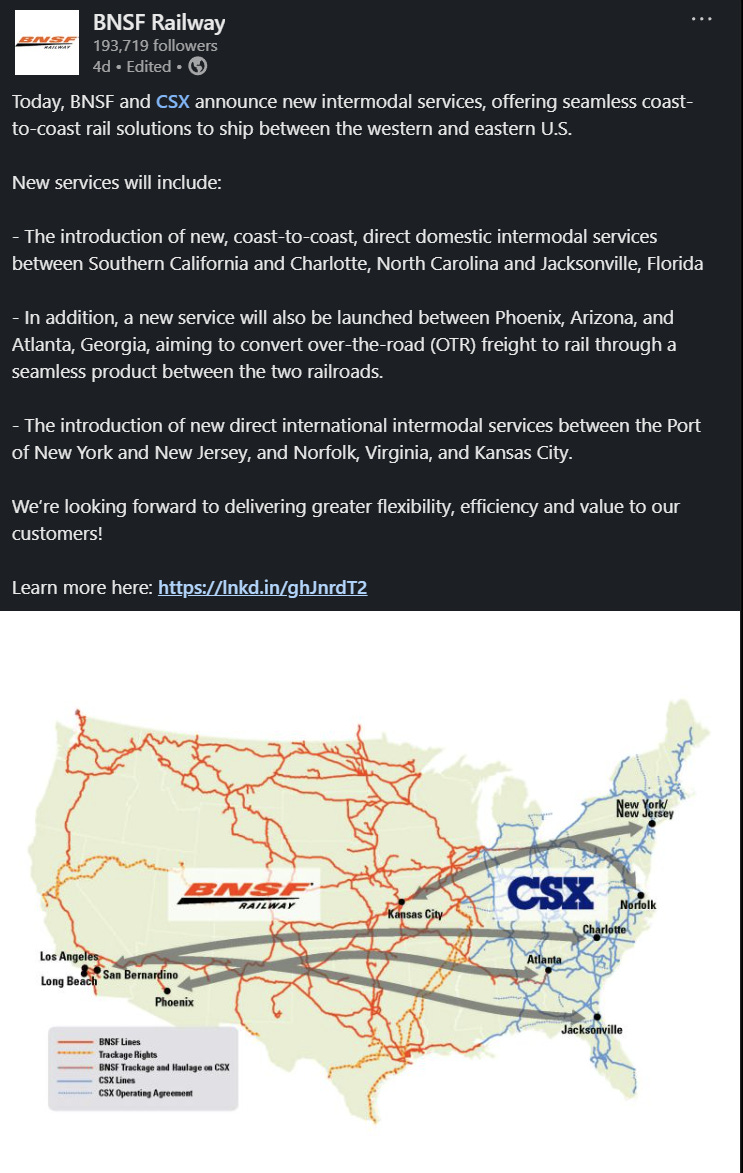
There are a number of things to highlight with this announcement.
First, I think this is a great strategic move by BNSF and CSX. I don’t think they intended for it this way, but we’ll give them the credit.
Why this is such a brilliant strategic move is because it puts more pressure on the UP and NS to prove to the STB that a transcon merger, not just alliances, is how to unlock better/cheaper/faster rail service. And it still leaves all the other options on the table, which I’ll come back to in a minute.
By breaking the glass on transcon mergers, Jim Vena has staked a claim on the ideological throne that was vacated by the death of Hunter Harrison. The commercial CEOs (Joe Hinrichs, Tracey Robinson, Alan Shaw, and Katie Farmer) were supposed to do that. PSR 2.0! PSR, the Sequel! Novel phrases like “We’re going to grow with our customers!” None of that has amounted to anything.
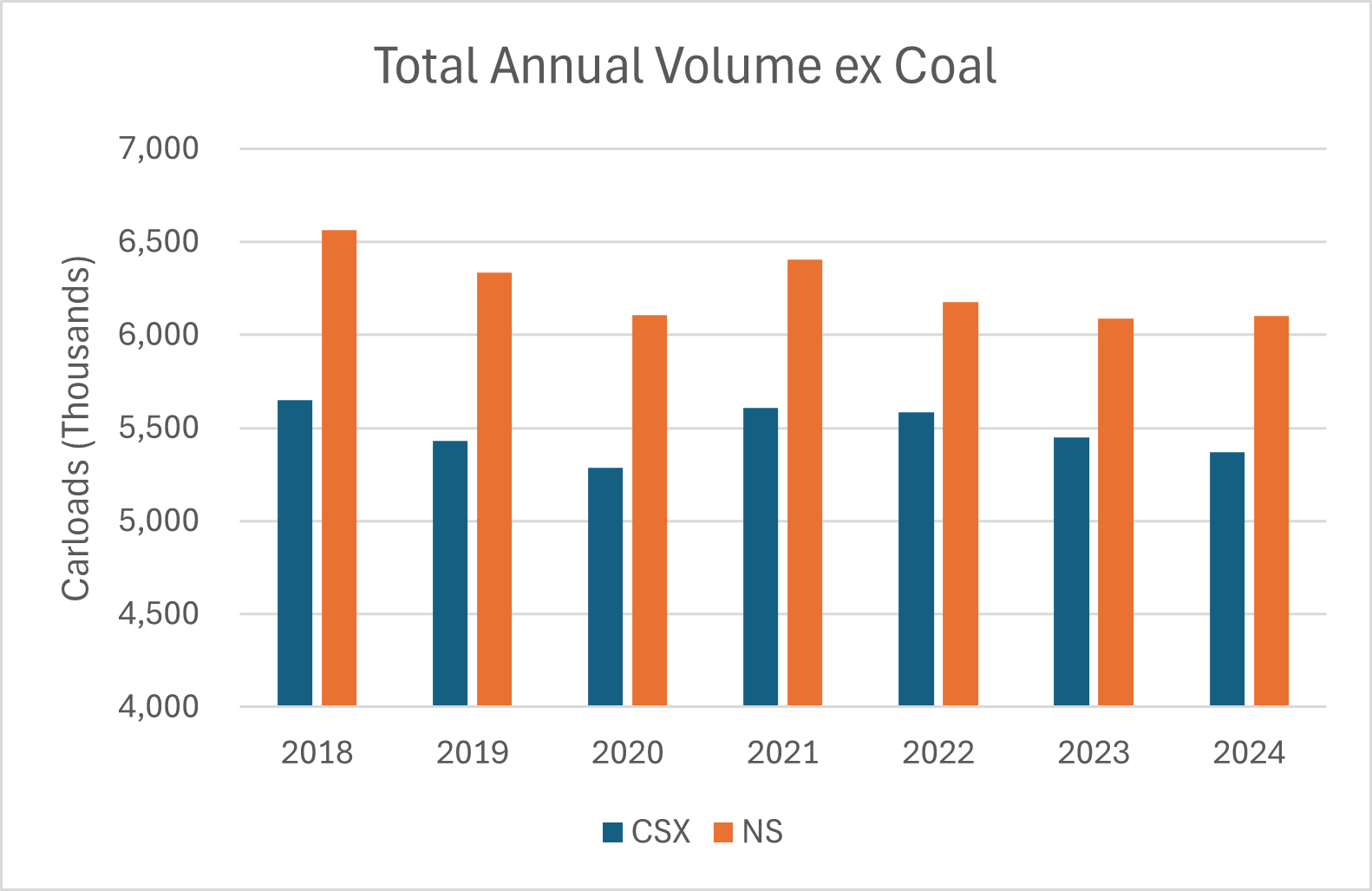
Their reign started more than three years ago and what little strategic direction that’s been articulated has done very little to solve the core issue in rail for the past two decades: Growth. CSX’s Joe Hinrichs has carried the banner with the exit of NS’ Alan Shaw, but neither have been successful in growing volumes as the chart below shows.
So what’s the plan? What’s the next move? Up to this point it’s been to double down on PSR cost savings while continuing to push pricing above inflation. It’s not going to grow the industry but it’s a safe bet to stay in the warmth of the pack.
Now Jim Vena has staked his claim to the Hunter throne by saying in essence, “Transcons are the only way to get out of this industry-wide malaise.”
In response to UP, the other Class 1’s have found their voice in opposition and rallied around the banner of “Mergers? We don’t need no stinking mergers!” (to paraphrase the excellent 1948 film, The Treasure of the Sierra Madre).
Now, I think they’re probably less ideologically married to the anti-merger notion than they are just trying to get their pound of flesh in concessions out of the STB during the merger review, but nonetheless this new intermodal service offering is an effective counterweight to the UP-NS narrative of needing a transcon to grow.
And at the end of the day, can BNSF and CSX still merge? Absolutely. I don’t buy for one second that Buffet, who will likely not be around by the time the STB rules on the UP-NS merger application, or Greg Abel are going to sit back and run BNSF against a transcon UP. They talked a long time about not being a PSR railroad before pretty much adopting every bit of PSR that the other Class 1’s had done years before. There’s no better strategic direction coming out of Fort Worth or Berkshire when it comes to running a railroad. They don’t have any new ideas.
Second, why didn’t they do this sooner? Producing new services only after your competitor does something is such an indictment of all the anti-growth behaviors that the railroads are guilty of today. It reminds me of the famous Churchill quote, “The Americans will do the right thing after they’ve exhausted all other options.” If alliances were pro-growth and unlocked new business, then they should have pursued these actions regardless of external competitive factors.
But they didn’t and they won’t for as long as the Ops guys are running the railroads. In fact, one could argue that the current crop of Commercial CEOs was more akin to changing the paint color rather than a full remodel of the strategic direction of railroading. Ancora came after Alan Shaw and successfully pushed out Paul Duncan for John Orr. CSX’s Joe Hinrichs got his hand slapped by Wall Street when he fired COO Jamie Boychuk. More recently, Greg Abel brought CN’s Ed Harris into BNSF as a “consultant” which has resulted, I’m told, in sidelining Matt Igoe and giving Ed a blank check to rework large swaths of the organization, including commercial.
My main critique of the Class 1’s has always been that there’s this sense that they live in this walled garden without any real understanding, interest, or appreciation for the wide world outside of just running their trains. Yes, running a network operation is hard, but when organizations allow the ops folks to overpower the commercial ones for too long, you end up in a no-growth dead end. Healthy organizations should flip control from commercial to ops and back again as needed to both plant the seeds and harvest them.
Remedying this myopic insularism through such means as integrating more deeply with their customers, completely reorganizing their sales organizations, or actually listening to their customers on just about anything (operational transparency, customer experience, technology integrations) is so foreign to them, you have to wonder if they’ll ever get there.
Third, Class 1 strategy teams need to wake up. I’m told that BNSF was caught completely unaware by UP’s bid for NS. If you’re working corporate strategy at a Class 1 and you didn’t think a transcon merger was going to happen, then what on earth have you been doing?
This brings up my #1 rule on competitive strategy: Your competition is as dumb as a hot box of rocks. They can still burn you if you don’t respect them, but they are dumb as a hot box of rocks.
When I started Hum I spent the first few years giving way too much credit to our competitors. I thought, “Surely they’re going to do X because that’s so obvious.” Nope. I couldn’t believe that our little operation was absolutely miles ahead of them in how we thought about customers or in understanding how different events in the market would unfold. I’ve learned that companies generally are much dumber than the general industry gives them credit for. And the larger the company, the worse they are at execution and capital allocation.
For a Class 1 strategy team working in an industry that only has 5 competitors, has been unable to grow volume in 20 years, is relentlessly pressured to show margin expansion, and is entering one of the most favorable regulatory windows that they will probably exist for the next decade or two, I don’t know how you couldn’t have merger on your bingo card in 2025.
Now, you may not believe a merger would have a snowball’s chance in hell of actually getting approved. That’s fine and you may very well be right. But to be completely blindsided?
Lastly, someone, anyone, needs to craft a vision for a post-PSR rail industry and execute on it. This isn’t just the Class 1 C-suite. This is up and down the organization. No one wants to stick a toe out of line for fear of upsetting others or getting passed over for the next promotion. Yes, you do need to have a certain political sensibility to accomplish anything in a large organization, but if you’re not willing to progress anything then why show up for work anymore?
For a vision creating exercise, a good friend and mentor of mine would walk into a company, pull the mission statement from the website, and hold it up to the room while asking, “Who’s willing to die for this?” Not one hand would raise because who is willing to die for the corporatespeak, sanitized garbage that public companies are so fond of? Instead, raise the Jolly Roger and rock the boat.
In the 1980’s, Steve Jobs took his Macintosh dev team and isolated them from the rest of the Apple organization. They even hoisted a Jolly Roger flag on the building in honor of something Jobs had said: “It’s better to be a pirate than to join the Navy.” If I recall correctly, Jobs was fighting internally against the rest of the company that had grown and changed dramatically since he had first founded it with Steve Wozniak years before. About a year later, Apple’s famous 1984 ad announcing the Macintosh aired during the Super Bowl and an important company culture was created.

If I’m really to believe the anti-merger crowd counting BNSF, CSX, and the Canadians, then they need to show a more clear path towards how joint service offerings will actually put more carloads and containers onto the network. They can want an alliance approach to provide faster/cheaper/better service to rail shippers, but I don’t see how it will ever beat a fully integrated UP-NS single line service just purely on operational merits alone. Who’s willing to die for this strategy?
As ADM CEO Juan Luciano would say, “Results do not equal no results plus another good story.” If shipping alliances are the future, show it. No more of this knee jerk reaction crap. Go all in. Build the organization around it. Build the operation around it. Own it. Going halfway or just paying lip service to it is such a waste of time.