If you were surprised by the replacement of Joe Hinrichs as CEO of CSX, then you weren’t paying attention.
BY BYRON PORTER · October 9, 2025 · 8 MIN READ
On September 29, CSX abruptly announced a new CEO, Steve Angel, to take over for Joe. From the press release,
“CSX Corp. (NASDAQ: CSX) today announced that its Board of Directors has named Steve Angel as President and Chief Executive Officer, and a member of the Board, effective September 28. He succeeds Joe Hinrichs, who has departed from the company as President, CEO, and Board member…
“Angel is an accomplished executive with over 45 years of experience leading large, public companies and generating strong shareholder returns. He has a long and proven track record of leading high-performing teams, fostering a collaborative culture, and driving operational excellence and growth, while maintaining disciplined capital allocation and attractive returns on capital.”
If you were surprised by the replacement of Joe Hinrichs as CEO of CSX, then you weren’t paying attention. Why did the board make the change, is there any significance in the timing, and what have they signaled with their intent in hiring Steve Angel as a replacement?
I wrote about why Joe’s tenure was likely going to be challenged in 2025 at the beginning of the year. From “The End of the Commercial Crusade” back in March,
“I get the sense that Wall Street’s patience is starting to run thin with CSX, CN, and BNSF. (Obvious substitution of Berkshire/Greg Abel in the case of BNSF). All three named new CEOs 2.5, 3, and 4 years ago respectively. Along with Alan Shaw at NS, these commercially oriented CEOs were supposed to reverse the declining modal share and volume loss that had stuck in the industry. It’s safe to say that hasn’t happened. Even with the recovery in 2024, there is no clear indication that the railroads have done anything different to either drive truck conversion to rail or to generate carload volume to any significant degree.
“CSX’s Joe Hinrichs has probably taken the most prominent role in the Commercial Crusade with the departure of Shaw from NS in 2024. I think there was a universal belief in the industry that, “Now this guy knows how to grow because he’s a customer.” CSX was also running strong operating metrics with an industry leading OR, so if anyone had the flexibility to make some moves it was CSX.
“Less than 12 months later, Jamie Boychuk was out as COO. But Wall Street is married to a strong operating railroad as highlighted by the requirement that operations are led by someone touching Hunter Harrison’s CN brain trust. CSX’s stock tanked on the announcement and didn’t pick back up until about a month later when they announced the hire of Mike Cory.
“I don’t know what CSX’s plan would have been had Wall Street not reacted so negatively to Boychuk’s departure, maybe an internal promotion, but it appears that CSX’s hands were tied and they had to bring in Mike Cory.
“The message from Wall Street to me at least, was “Don’t you dare change the channel.” Ancora then reiterated that message by going after Alan Shaw and Paul Duncan at NS, claiming to rein in the excesses of Shaw’s “fatter for longer” strategy…
“The Boards of these railroads haven’t publicly altered course, with the exception of NS who promoted CFO Mark George to CEO after Shaw’s exit, but Wall Street has made clear that there is only one playbook in the industry: Strong operating results minimizing OPEX, keeping OR’s down to a minimum, and pricing above inflation.
“Thou shalt not raise thine OR.
“…In 2025, I think we might start to see the pressure turned up a couple more clicks on these three railroads to shift towards an “ops first, everything else second” UP strategy. BNSF already started taking several steps that way last year from multiple layoffs to hiring Ed Harris as a consultant.
By the time July rolled around and UP proposed to NS, it really didn’t matter what the volume growth at CSX was this year. Joe went to Omaha to talk merger with the Oracle and came back empty handed. That’s when he was done.
There’s been some lazy speculation in the media that this was driven by hedge funds, namely the infamous Ancora. While I think hedge funds definitely played a part in it, I’m fairly confident that Ancora played absolutely no part in it. Having been unsuccessful in every single activist attempt they’ve ever made and wielding a pittance of shares, I don’t know that anyone cares at all what Ancora is doing anymore.
Instead, other, far more credible hedge funds such as Elliott and Third Point were all linked with meeting with CSX’s board. It seems pretty clear that investor pressure and the inability for Joe to get BNSF on board with a merger were his undoing.
So why make the change now? I’ve written in the past that it doesn’t make much sense for the leftover Class 1’s to pursue their own merger at this point - let UP take the brunt, learn from their mistakes, and then be a fast follower if the STB approves the deal.
I think the timing may just be due to the end of Joe’s contract, maybe. The change came almost 3 years to the day from when he started at CSX. Moreover, if as a board you’ve already decided that its merger or bust and your lead man isn’t the guy to get it done, why not cut your losses and make the change now? Probably more to the story, but that’s at least a couple of indicators.
So who’s this Steve Angel guy? I don’t know if you can signal any stronger than CSX just has that it’s merger all day for them. From the press release,
“Angel was CEO of Praxair from 2007-2018. After its merger with Linde in 2018, he became CEO of the combined company until 2022, when he was named Chair. He plans to retire from Linde’s Board in January 2026. He began his career at General Electric where he held a variety of management positions for over 22 years and worked directly with locomotive and rail operations.”
Nothing screams M&A more than a GE guy, plus his experience having already taken charge of a newly merged company in a static, mature industry. The CSX Board is clearly stating it’s after a merger as priority numero uno. At an age of 70, Angel isn’t going to be around for the long haul anyway. This is a fix it up to sell it move. Pretty safe and, really, maybe the best thing CSX can do.
Was ONECSX the right strategy?
I have a lot of respect for Joe. Of all the Class 1’s I’ve interacted with, Joe was the one who seemed the most open to some of my poking and prodding, even going so far as to take one of my articles to his board for discussion. He also sought me out at a conference to discuss an article I had just published on railcar maintenance and safety. Not being a railroader and often being very critical of Class 1 operating practices, he could have very easily dismissed me.
CSX was one of the first railroads that we began working with on bearing and wheel condition monitoring. As he would tell me, “We want to be part of the solution.” On my many trips to DC, Joe was the only one who came up in conversation outside of the normal STB visits that the Class 1’s make. At a time when the AAR was putting its fingers in its ears at any mention of rail safety legislation, I would hear that Joe was open to exploring what that may look like.
“Hinrichs’ strategy has been “OneCSX,” an inclusive (if we’re still allowed to use that word) and unifying effort meant to tackle the bitter animosity that the 2022 labor negotiations had generated. It worked. Today, CSX is a brighter and happier place where I continue to hear great things both internally and externally about its great culture.
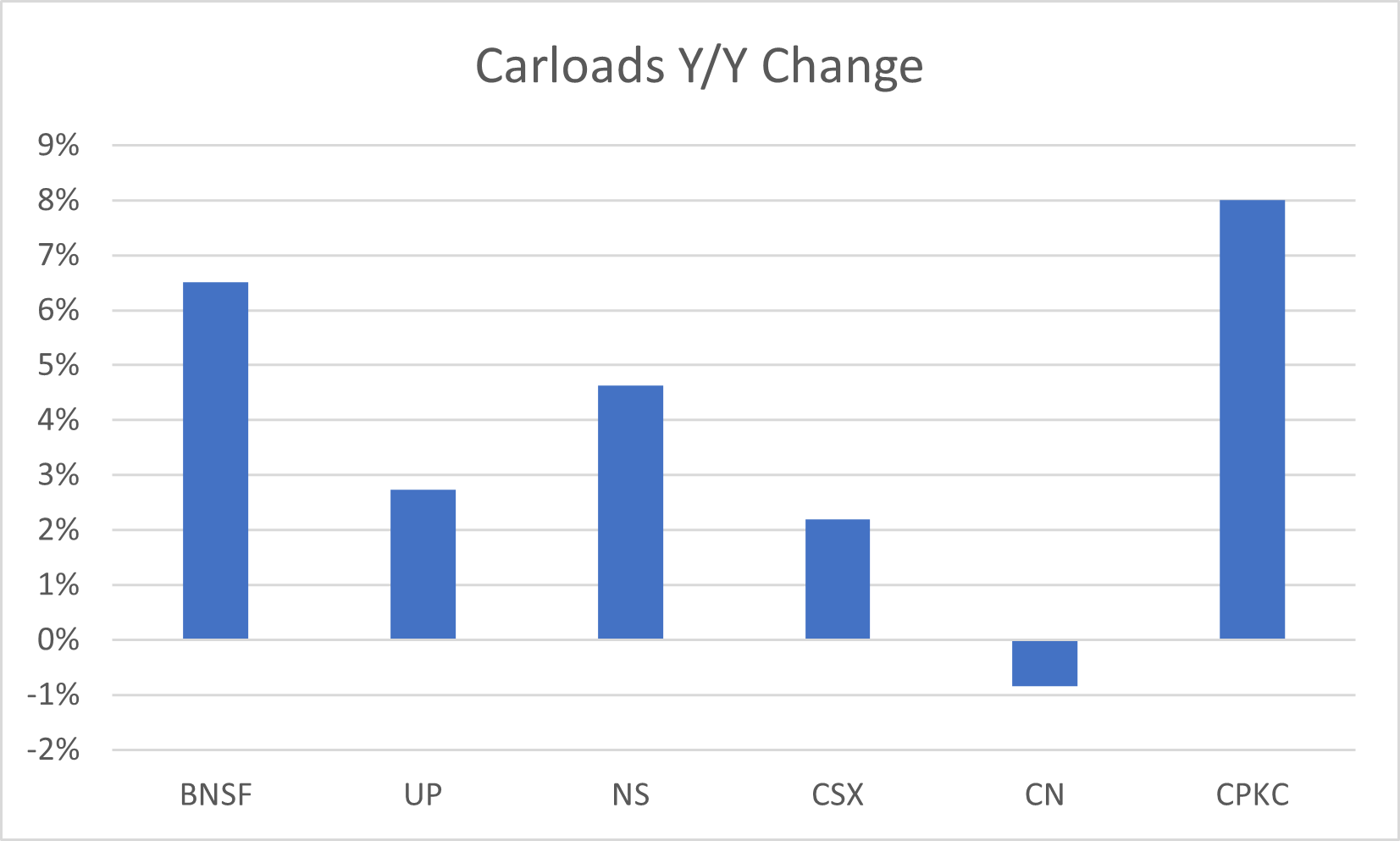
“The other aspect of the OneCSX strategy was that happy employees would make happy customers. During their last earnings call, CSX reported a best ever NPS (net promoter score, a measure of customer satisfaction). How has that played out in the numbers?
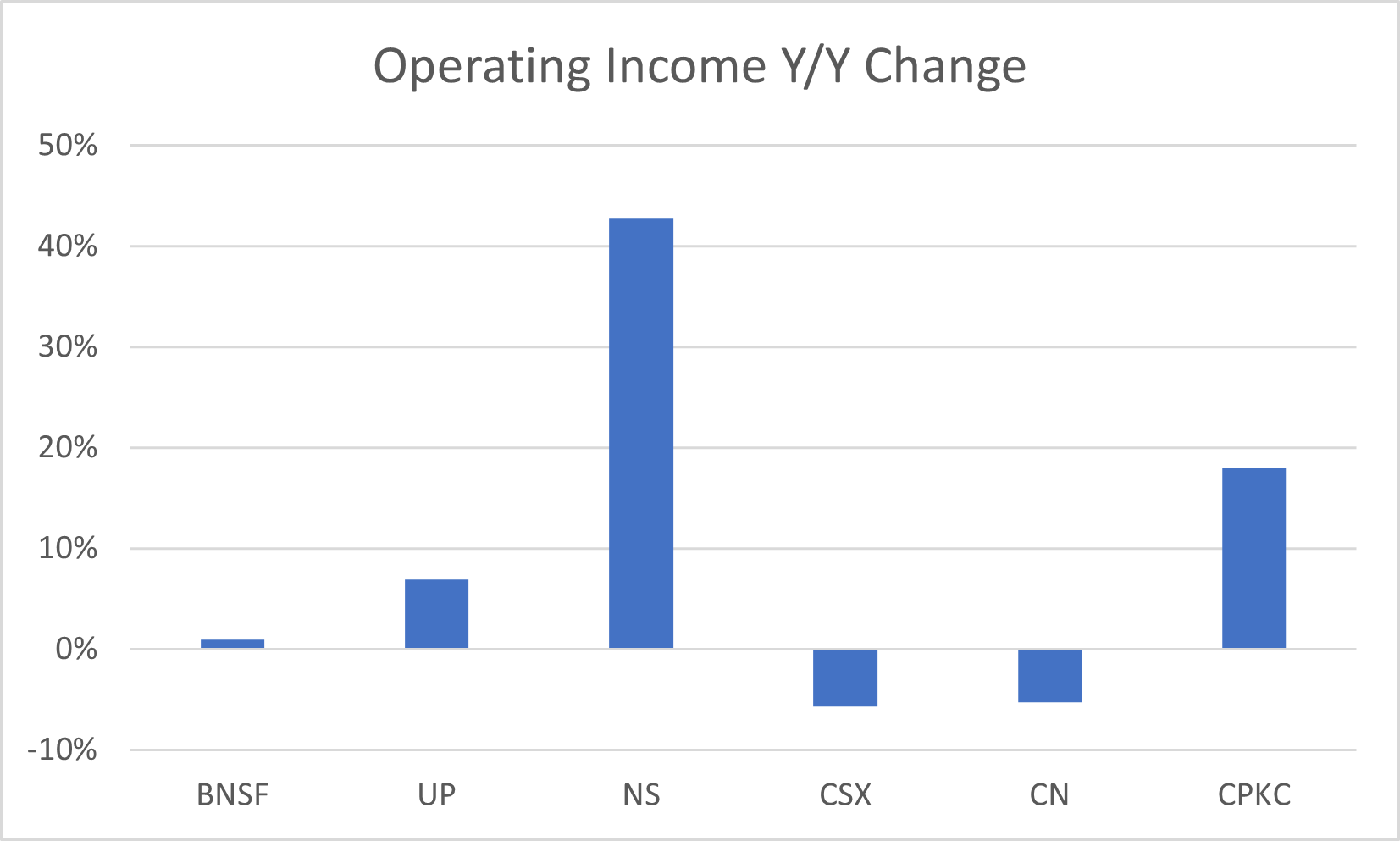
I selected two charts for this comparison. The first is a financial check looking at the change in operating income for each of the Class 1’s from 2023 to 2024. NS is at 40%+ because 2023 was so bad for them. What is notable is that the 3 laggards I highlighted above (BNSF, CSX, CN) all struggled to grow OpInc.
“These results don’t bode well for CSX, CN, and BNSF. I think we’re a ways from anyone’s Board pressing the eject button right now, but the growth and results just aren’t there. We are in a freight recession, that’s important, but where is the vision? Where’s the counter-narrative to the ops-only focus that Wall Street has? Can you blame Wall Street for wanting to stick with the tried and true when there really just hasn’t been a different story or example to run with?
“CSX really needs to add volume this year if it’s “Customers love us, employees love us, therefore volume will come” strategy is going to hold up. The concerning part is that they had NS on the ropes and could have gone after their customers aggressively, but either didn’t or didn’t succeed. Now NS is back on its feet and those comparisons are going to be a much tougher sell. Not that rail-on-rail competition is where the growth is, but that was a missed opportunity.
With the announcement of Joe’s departure, there was an outpouring of support and appreciation for his time at CSX. It was a bold move by a board (in an industry not known for making bold moves) to select an outsider on the back of a PSR transformation. Joe’s ONECSX strategy helped improve labor relations and the culture at CSX and there was plenty of evidence to show that customers generally were positive on the service.
But it never resulted in the kind of change in trajectory that the industry has been on since Hunter Harrison took over as CEO of CN. Growth still remains elusive. Truckload conversions are still a mystery. Wall Street hasn’t been given anything to believe that a change in a “ops first, everything else second” strategy is worth it. The Commercial CEO experiment has failed and now we’re on the merger train for the next few years.
And then what? Will UP prove that the existing bifurcated network is a significant constraint on volume growth? Or will operating a railroad in the same way (just a bit longer at that point) and expecting different results prove true? Either way, Mr. Angel will be tasked with making sure CSX isn’t going to be around to find out.
Figures are the public tape: AAR via FRED, STB EP 724 via USDA, EIA diesel via FRED. Equity prices are not on this desk. Signal compares dwell with the system average.
So Long Joe, and Thanks for All the Fish — The Pacific