Probably for the first time in several years, the industry is stable. The COVID-driven supply disruption, furloughed crews that didn’t come back, UP’s embargo bonanza, STB hearings, Management turnover, East Palestine followed by Ancora’s proxy battle, and finally a Presidential election are all over. Tariffs and a maverick president in the White House who is keeping everyone guessing means there are plenty of fun surprises left for 2025+, but for the most part the industry is on a stable ground right now.
Or, we’re just back to where we were at in 2019, as the carload volume chart below shows. Since 2018-2019, we’ve been in a general freight recession in North America. That’s important context for what I’m about to get into.
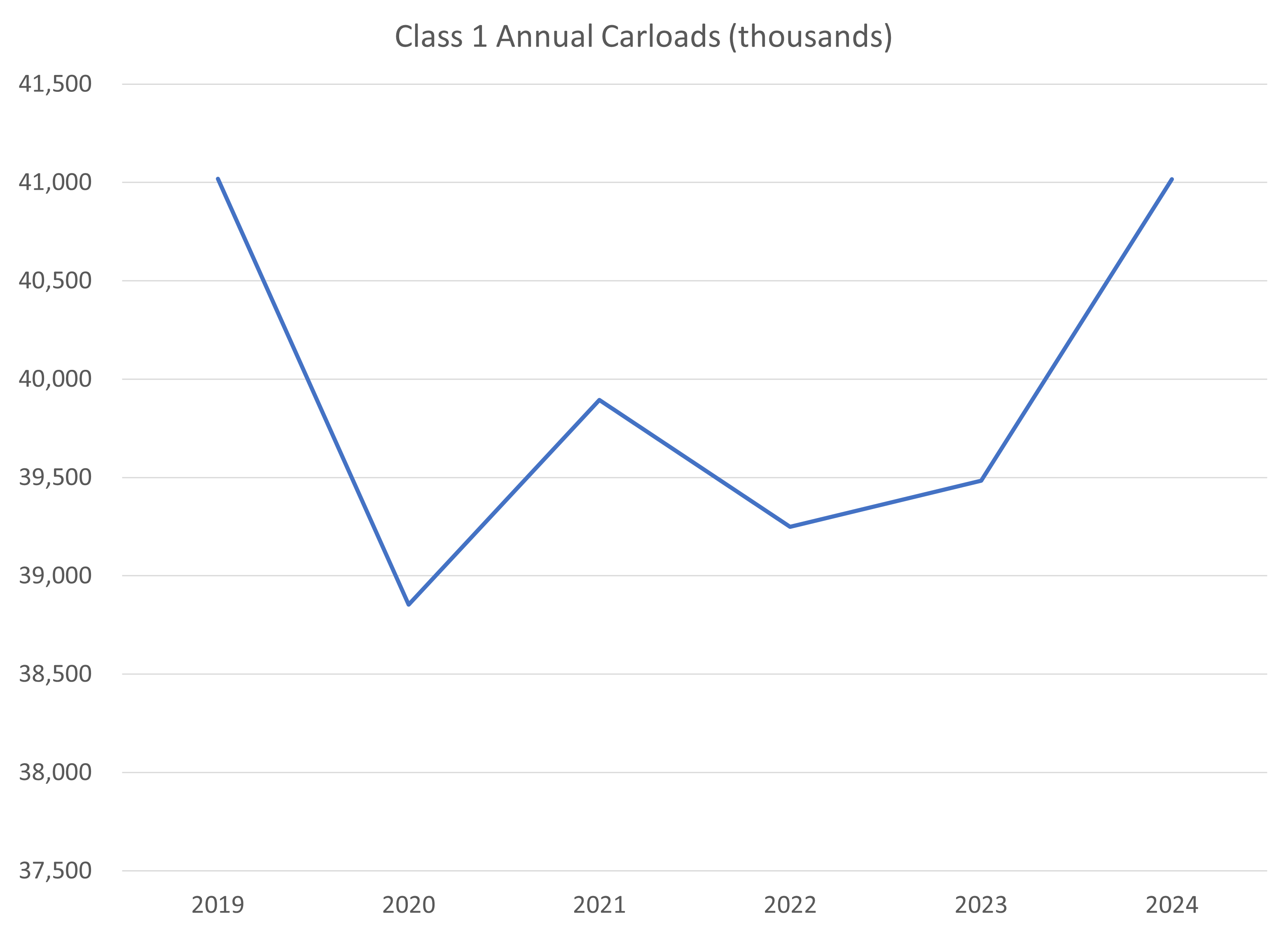
I get the sense that Wall Street’s patience is starting to run thin with CSX, CN, and BNSF. (Obvious substitution of Berkshire/Greg Abel in the case of BNSF). All three named new CEOs 2.5, 3, and 4 years ago respectively. Along with Alan Shaw at NS, these commercially oriented CEOs were supposed to reverse the declining modal share and volume loss that had stuck in the industry. It’s safe to say that hasn’t happened. Even with the recovery in 2024, there is no clear indication that the railroads have done anything different to either drive truck conversion to rail or to generate carload volume to any significant degree.
CSX’s Joe Hinrichs has probably taken the most prominent role in the Commercial Crusade with the departure of Shaw from NS in 2024. I think there was a universal belief in the industry that, “Now this guy knows how to grow because he’s a customer.” CSX was also running strong operating metrics with an industry leading OR, so if anyone had the flexibility to make some moves it was CSX.
Less than 12 months later, Jamie Boychuk was out as COO. But Wall Street is married to a strong operating railroad as highlighted by the requirement that operations are led by someone touching Hunter Harrison’s CN brain trust. CSX’s stock tanked on the announcement and didn’t pick back up until about a month later when they announced the hire of Mike Cory.
I don’t know what CSX’s plan would have been had Wall Street not reacted so negatively to Boychuk’s departure, maybe an internal promotion, but it appears that CSX’s hands were tied and they had to bring in Mike Cory.
The message from Wall Street to me at least, was “Don’t you dare change the channel.” Ancora then reiterated that message by going after Alan Shaw and Paul Duncan at NS, claiming to rein in the excesses of Shaw’s “fatter for longer” strategy.
(Sidenote: One of the many complaints about Shaw at NS was the fact that he ran hotter on OPEX due in part to keeping more crew on staff than what traditional PSR might call for. It’s important to note that Jim Vena at UP has said they’re running a buffer as well, but he’s doing so while keeping OPEX in check. Was NS’ strategy just poorly managed? Did they have more crews than needed or is Vena’s buffer not quite the same magnitude as Shaw was attempting?
Given Wall Street’s happiness with Vena and UP at the moment, I think this juxtaposition shows that there is latitude to run with some excess so long as it appears directionally correct (i.e. the OR doesn’t get out of whack).
The Boards of these railroads haven’t publicly altered course, with the exception of NS who promoted CFO Mark George to CEO after Shaw’s exit, but Wall Street has made clear that there is only one playbook in the industry: Strong operating results minimizing OPEX, keeping OR’s down to a minimum, and pricing above inflation.
Thou shalt not raise thine OR.
Hinrichs’ strategy has been “OneCSX,” an inclusive (if we’re still allowed to use that word) and unifying effort meant to tackle the bitter animosity that the 2022 labor negotiations had generated. It worked. Today, CSX is a brighter and happier place where I continue to hear great things both internally and externally about its great culture.
The other aspect of the OneCSX strategy was that happy employees would make happy customers. During their last earnings call, CSX reported a best ever NPS (net promoter score, a measure of customer satisfaction). How has that played out in the numbers?
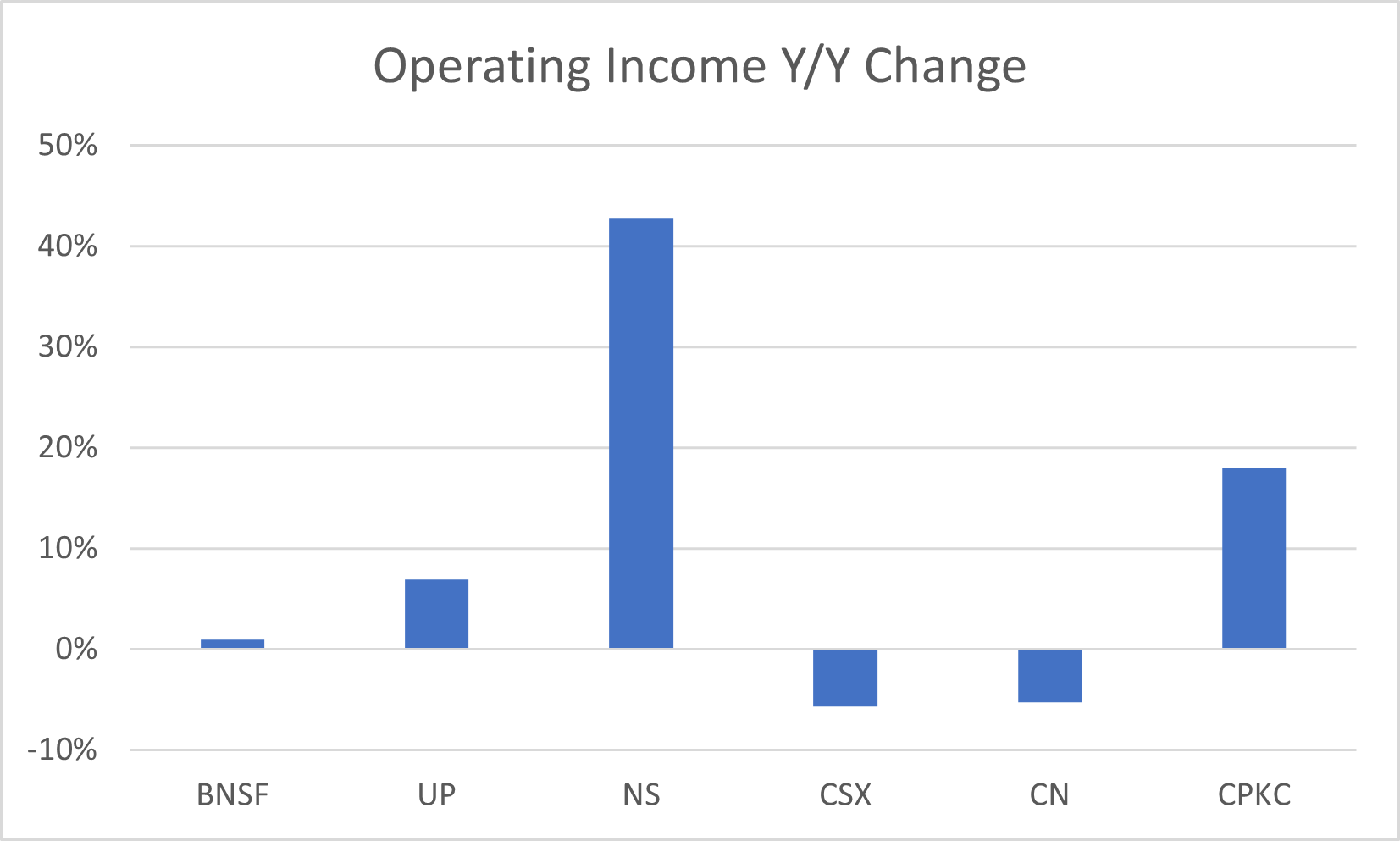
I selected two charts for this comparison. The first is a financial check looking at the change in operating income for each of the Class 1’s from 2023 to 2024. NS is at 40%+ because 2023 was so bad for them. What is notable is that the 3 laggards I highlighted above (BNSF, CSX, CN) all struggled to grow OpInc.
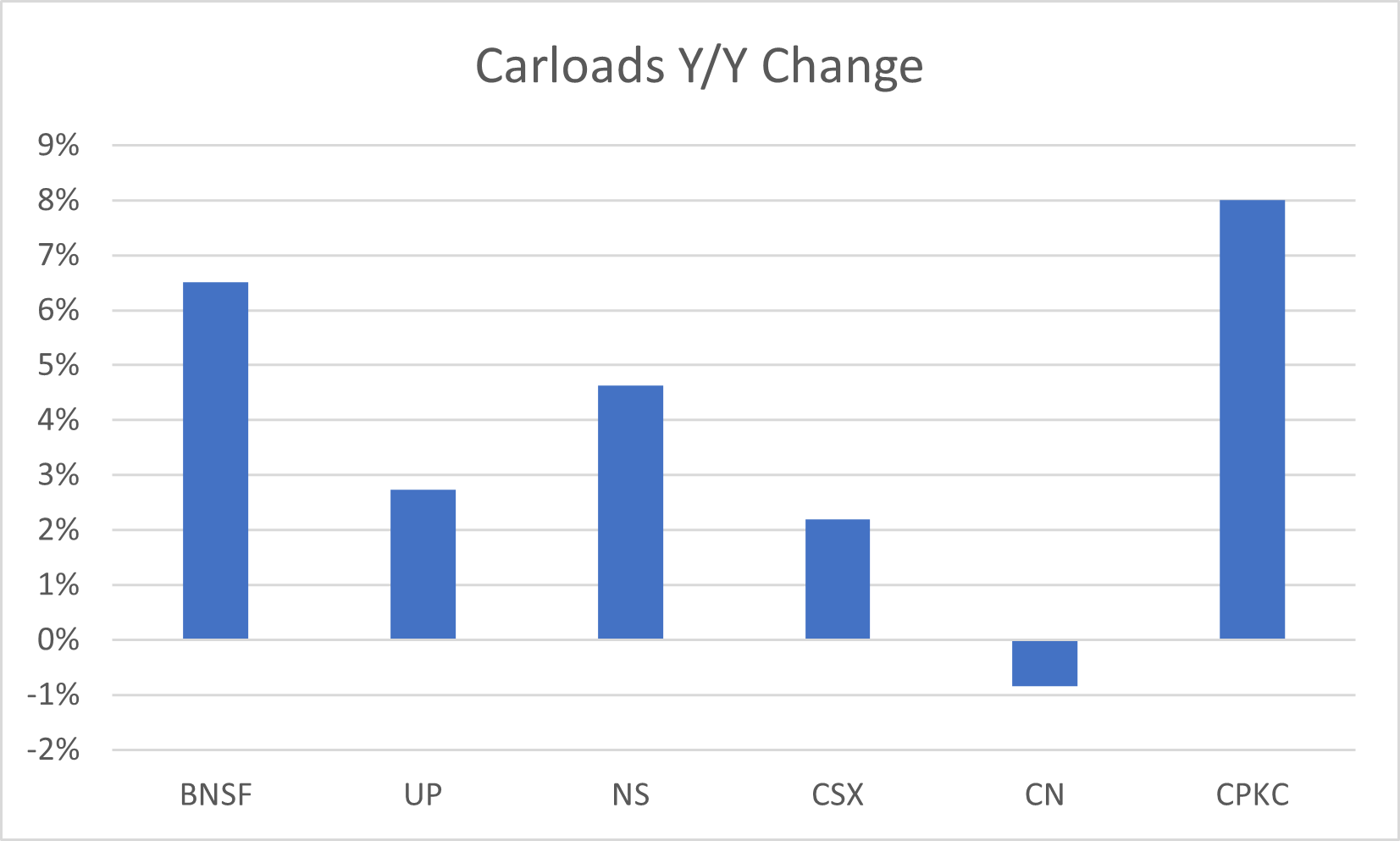
The second chart is the change in carload volumes from 2023 to 2024. CPKC and NS results are skewed due to the merger and an easy comp from the prior year, respectively. BNSF looks really good, except that when you peel back the layers you’ll find that strong intermodal performance (+817k units) really covered for a slight decline (-195k units) in their non-intermodal traffic. But good for BNSF for their best intermodal year maybe ever.
These results don’t bode well for CSX, CN, and BNSF. I think we’re a ways from anyone’s Board pressing the eject button right now, but the growth and results just aren’t there. We are in a freight recession, that’s important, but where is the vision? Where’s the counter-narrative to the ops-only focus that Wall Street has? Can you blame Wall Street for wanting to stick with the tried and true when there really just hasn’t been a different story or example to run with?
CSX really needs to add volume this year if it’s “Customers love us, employees love us, therefore volume will come” strategy is going to hold up. The concerning part is that they had NS on the ropes and could have gone after their customers aggressively, but either didn’t or didn’t succeed. Now NS is back on its feet and those comparisons are going to be a much tougher sell. Not that rail-on-rail competition is where the growth is, but that was a missed opportunity.
In 2025, I think we might start to see the pressure turned up a couple more clicks on these three railroads to shift towards an “ops first, everything else second” UP strategy. BNSF already started taking several steps that way last year from multiple layoffs to hiring Ed Harris as a consultant.
Time to Get Real About Shortlines
Ultimately, I don’t see any road to growth, real growth for the railroads, without taking a hit to margins. I also no longer buy into the narrative that there is no low hanging fruit out there. There is: Shortlines. We can debate about how much volume Shortlines can actually bring and if that moves the needle, but from an ROI standpoint, this is such a no-brainer. The more I dig into this part of the industry the more this looks like a major botched opportunity by the Class 1’s.
Why should Class 1’s love shortlines? Let me count the ways:
Shortlines are already rail savvy. They know how to work with Class 1’s. Most of them came from Class 1’s. There’s no learning curve here. That’s less investment of resources by the Class 1’s to bring new business online.
Shortlines are connected to many customers, particularly the mom and pop’s that Class 1’s just can’t reach at scale. That’s outsourced biz dev that is already knocking on your door to bring you more business. Again, no dollars were harmed in the making of this business.
Shortlines carry high levels of customer satisfaction. Their business is sticky business. When there’s a customer complaint, the short line, presumably, is already on the phone with the customer working to resolve it. Outsourced biz dev AND customer support.
Wait wait wait. Aren’t Class 1’s fully engaged with shortlines? What about their shortline conferences? Special programs? Don’t they have dedicated teams that do nothing but work with shortlines?
All true and it sounds like there are pockets of excellence in different railroads. But by and large Class 1 shortline initiatives are largely smoke and mirrors. NS is probably a notable exception given Stefan Loeb’s role and his group’s focus.
How can you tell shortline programs are Potemkin villages? Look at business that’s competitive. That’s when the conversation stops. Clay Gambill and I walked through that very instance:
“We just, we want to help. And I think that message it's lost because so many folks are so worried about losing a little business or having to compete for some business because that's what they've been trained to do for their entire career.
“I mean, like I said, Plainview, Texas. I had a facility in Plainview, Texas that a customer almost leased from me. They got really close. Even my economic development person didn't catch it until the 11th hour. We saw that We caught that that was a location that was in the BN Santa Fe merger.
“That was if we leased a new facility that the UP would get access to that location and caught the 11th hour. And of course we stopped it. I'm not going to let the UP come in here and compete against me. We drug it to a halt. We fought back to the customer.
“It was a hard conversation to have with the customer too. It's like, no, no, no, we're not. Actually, we're not going to lease this to you. Sorry. We've been working on it for a few months. But it was the right thing to do.
“I went to work for that company and had to explain it on my first day to the owner. And I said, listen, it was the right thing to do for my job. I said, I work for you now. So I'm going to go try and find ways to do it.
“But yeah, you spend so much time defending your franchise, protecting your own paycheck. And that's the right thing to do. But we just have to change the narrative to say, we've got to work together in this. This is more coopetition than competition. We're not trying to collaborate and cooperate on everything, but where it makes sense, let us help.”
But railroads can’t depart from this OR minimalization mindset. This is why all roads lead back to the fact that railroads will not grow until they shed the profitability mindset and adopt a growth one. That cannot happen until there’s almost a full-blown revolution inside these organizations that changes the culture, incentive structure, organizational structure, CAPEX plan, messaging to Wall Street, and much more.
The Commercial Crusade that started brightly with 4 new sales & marketing oriented CEOs is dead.