This past week was a classic Trump week. Chaos, mystery, intrigue, drama – it had it all. First, tariffs were levied on Canadian and Mexican imports. Then, the market crashed and President Trump, who was particularly sensitive to the stock market during his first term, decided to at least partially walk back those tariffs. The market didn’t respond and has been cratering ever since.
If there’s one thing that repels business investment and growth its uncertainty. Why would you invest in a factory in the US if you can do things like tap into lower cost labor in a country like Mexico? Why would you invest in a factory in Mexico if you’re going to get hit with tariffs for goods you plan to bring back in the US? What do you do?
You sit on your hands and wait for the risk premium to come down. Or you make a big bet and pray it works out in the long-term. I don’t know a lot of risk takers at large multi-nationals willing to do the latter. “No one got fired for buying IBM.”
I read a lot. Over the past 6ish months, I started reading everything I could find on economic history. I’m a firm believer that the closest one can come to predicting the future accurately is by thoroughly understanding history.
For example, my foray into economic history taught me that context is important, such as the popular press’ narrative of “Tariffs = Bad because Smoot-Hawley” was both wrong (the US became the US because of tariffs) and right (Smoot-Hawley really did exacerbate the Great Depression).
I also learned that the US gave away its industrial base starting in the 1950’s to countries like Japan and Germany in the name of creating stronger allies to counter the Soviet Union. These countries industrialized with protectionist policies that incentivized US manufacturers to invest overseas while at the same time the US did nothing to prevent cheap imports from displacing domestic production. This may have paid geopolitical dividends, but it weakened unions, eroded wages, and set off a decades long shift into a services economy with an outsourced industrial base.
During the 1970’s and 1980’s, financial services restrictions that were enacted by FDR’s New Deal coalition were rolled back and Wall Street drove things like further outsourcing and greater industry consolidation. Wall Street is an objective function solving for maximum profitability, not maximum social welfare. It’s the job of regulators to put the necessary guardrails up to prevent Wall Street from marauding through society leaving a wake of negative outcomes (environmental, social, political) that aren’t prioritized in that objective function.
I heard whispers of $50 oil a couple months ago. I didn’t think much of it until some recent actions that occurred just this past week:
Trump’s tariff announcement on Canada and Mexico, including on Canadian crude.
Energy Secretary Chris Wright says the industry can survive even at $50/barrel
Treasury Secretary Scott Bessent - We’re going to focus on Main Street at the expense of Wall Street to rebalance the economy.
There’s also the emerging triumvirate of large oil producers – the US, Saudia Arabia, and Russia that control 40% of the world’s oil production. The excellent Javier Blas makes the case that these three countries could drive oil production and price stability during the Trump administration. From the article,
“…As a percentage of US gross domestic product, the oil sector has the largest share in 35 years, according to World Bank estimates.
“Can America work together with the Saudis and the Russians? Call it the ‘oil grand bargain’ — a pact to keep energy prices within a range that works for three countries that, historically, were antagonistic.
“It may be fantasy geopolitics, but it isn’t mere science fiction. In a world where the White House is — or, at the very least, sounds — closer to the positions of the Kremlin than at any other time, thinking the unthinkable is useful, including in oil.
“Russian President Vladimir Putin clearly thinks the trio should work together, pointing to historical precedent. ‘I still remember the conversation by phone between three of us: Your humble servant, the US President Trump and the King of Saudi Arabia participated,’ Putin told state television in February. He advocated for a repeat of those talks, which took place in April 2020. ‘The three of us talked on the phone and discussed the global energy market. Discussing these issues in such format is still in demand today.’”
Should this loose coalition prove sticky, that gives the Trump administration an important control in managing domestic demand, keeping inflation in check, and, ultimately, driving down long-term interest rates to improve the US’ fiscal outlook.
You can already see how this witches brew of actions has impacted markets. Below are charts showing the steep drop off in the dollar index (DXY), the price of crude oil, and the US 10yr Tbill.
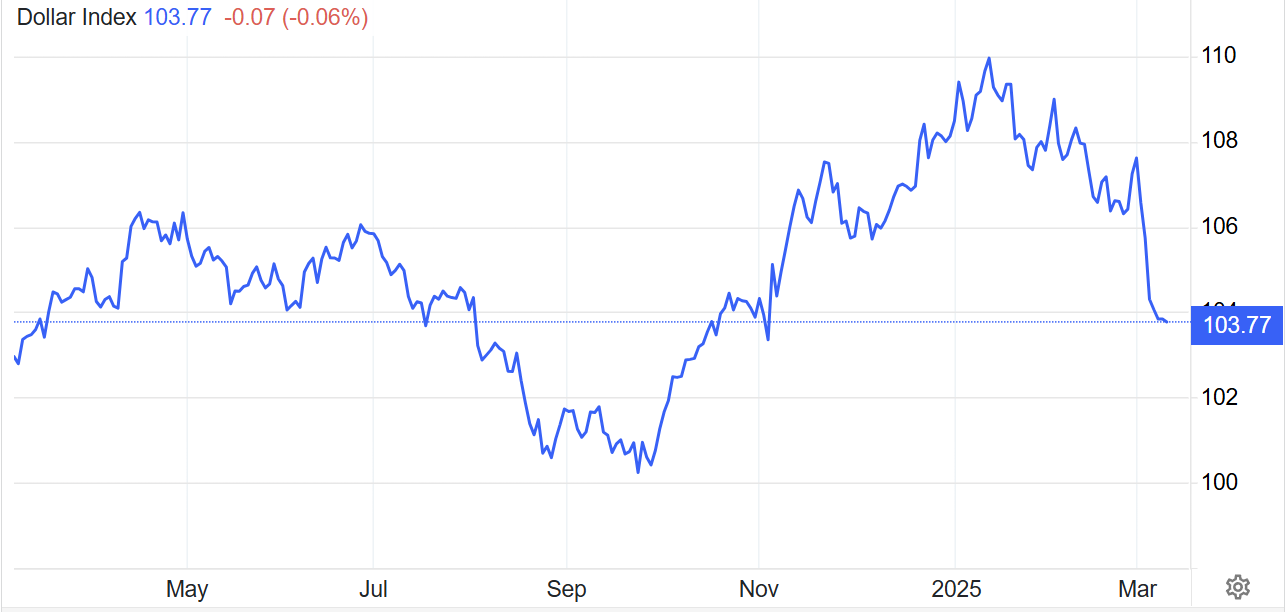
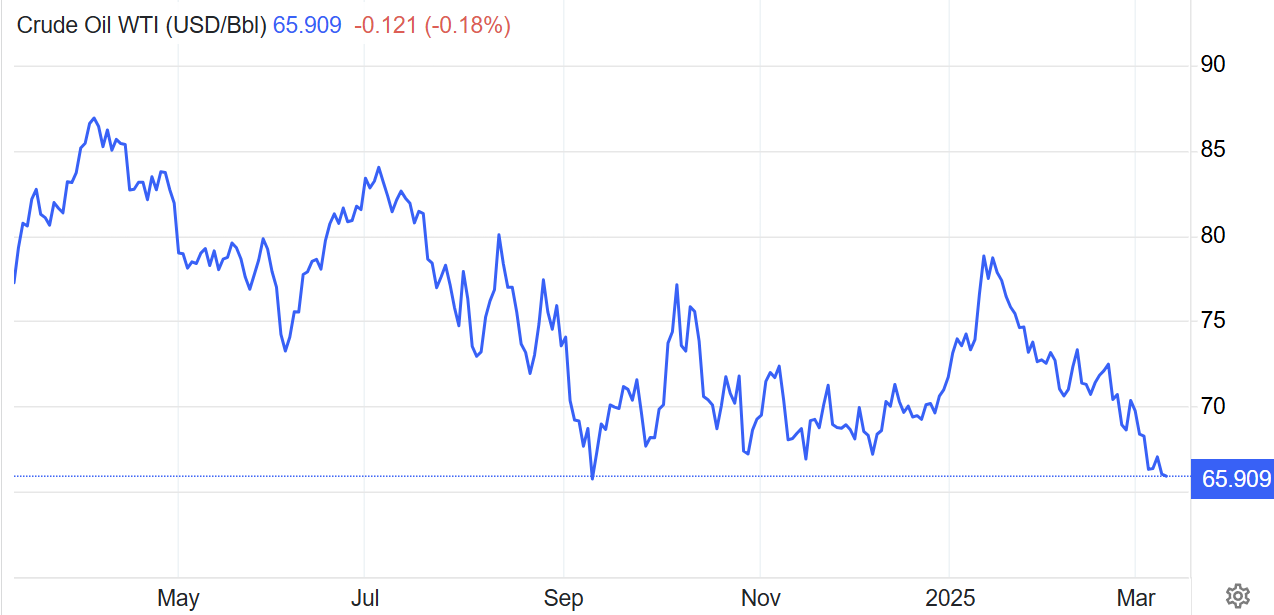
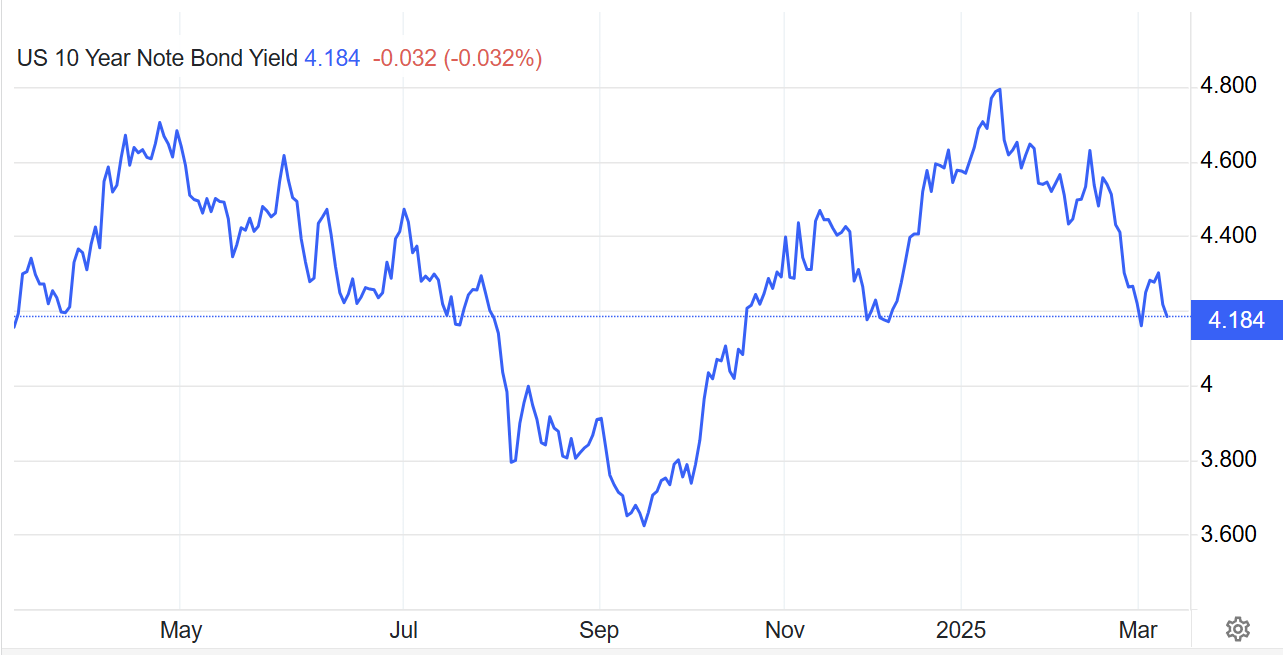
Demand destruction isn’t pretty though. Maybe President Trump (or Commerce Secretary Howard Lutnick) thought they could do all this without crashing the stock market, but that’s a definite no. Markets rejected the uncertainty these sudden actions created.
To better understand where all this is heading, I don’t know that there’s a great historical precedent that contains all these elements. The rampant inflation of the 1970’s that was killed by Treasury Secretary Paul Volcker jacking up interest rates to the moon has some similarities, but isn’t anywhere close to a similar situation.
What’s been in the back of my mind since I read a Jim Rogers book ages ago is the fact that we might be coming up on the end of a commodities supercycle. Equities have been up and to the right for much of the past 10-15 years. From memory, Rogers said these cycles typically last 14-17 years at which time they flip and, in our case, equities will drop while commodity prices will boom. Given all the geopolitical uncertainty and wars around the globe, it’s very likely that could come soon.
The Next Age of Railroading
With that backdrop, I think we can make some projections about how this will impact freight rail in the near to mid-term. During the last commodities boom of the 2000’s (approx. 1999-2014), the railroads enjoyed their last big volume growth, peaking in 2006. Chinese commodity consumption drove that; Will India drive the next one?
I was in India a few weeks ago meeting to finalize a partnership we have there with Oriental Foundry, a railcar manufacturer. It was my first time in the country and I was blown away by the energy and activity. The Modi government is seen as very pro-business and there’s a lot of excitement about increased investment in and industrialization of India. It’s been the same story for a long time, but if India can get its industrial engine going, 1.3 billion people can drive huge economic growth akin to China in the 2000’s.
If we’re entering a new era of protectionist policies driving greater domestic industrialization, supply chains are going to become shorter and more dynamic. Trade wars and reciprocal tariffs, not to mention conflict, both hot and cold, that these points of friction could create will drive product sourcing and distribution to smaller, flexible, and more nimble supply chains. Optionality – not “just in time” or “just in case” – will be the overarching strategy. That’s not something railroads are particularly good at.
Which means that if they want to have any hope of growing modal share, they’re going to have to be more flexible. There are several ways they could do this:
Add additional flex assets, such as warehousing, tank farms, terminals, storage tracks. I think there’s already well known, if not well documented, demand for these options by shippers.
Increase channel partnerships/partner ecosystems. Railroads could become “preferred providers” with port operators, supply chain management software, or service providers like mobile repair crews (tricky with unions) that indicate a greater level of operational and administrative integration for smoother performance. Set up shop in dedicated lanes for a particular commodity (i.e. Gulf Coast chemicals, renewable diesel, etc.) to attract a dedicated business.
Expand into technology and digital services tools. Class 1’s or shortline holding companies could buy and integrate visibility tools that offer different modules around inventory planning and visibility, fleet management, and railcar maintenance management. Bourque Logistics would be a good acquisition for UP or BNSF with a lot of Oil & Gas shippers; Kaleris would be a more general one. The best part: It would give railroads deeper insight into their customer’s behavior for more accurate demand planning and forecasting.
You’ll notice that none of these are directly related to the hook and haul. That’s because supply chain management has evolved. It’s a different game today than it was even a decade ago. Maybe I’ll write more about that in the next article.
One of the most striking graphs I’ve come across since I started writing was the one below showing rail industry carload volume since 2004. What’s notable is that every time there’s a significant disruption event (Global Financial Crisis, Covid), rail lost significant modal share. To me, this says that when shippers had a chance to reevaluate their supply chains, they reoriented away from rail.
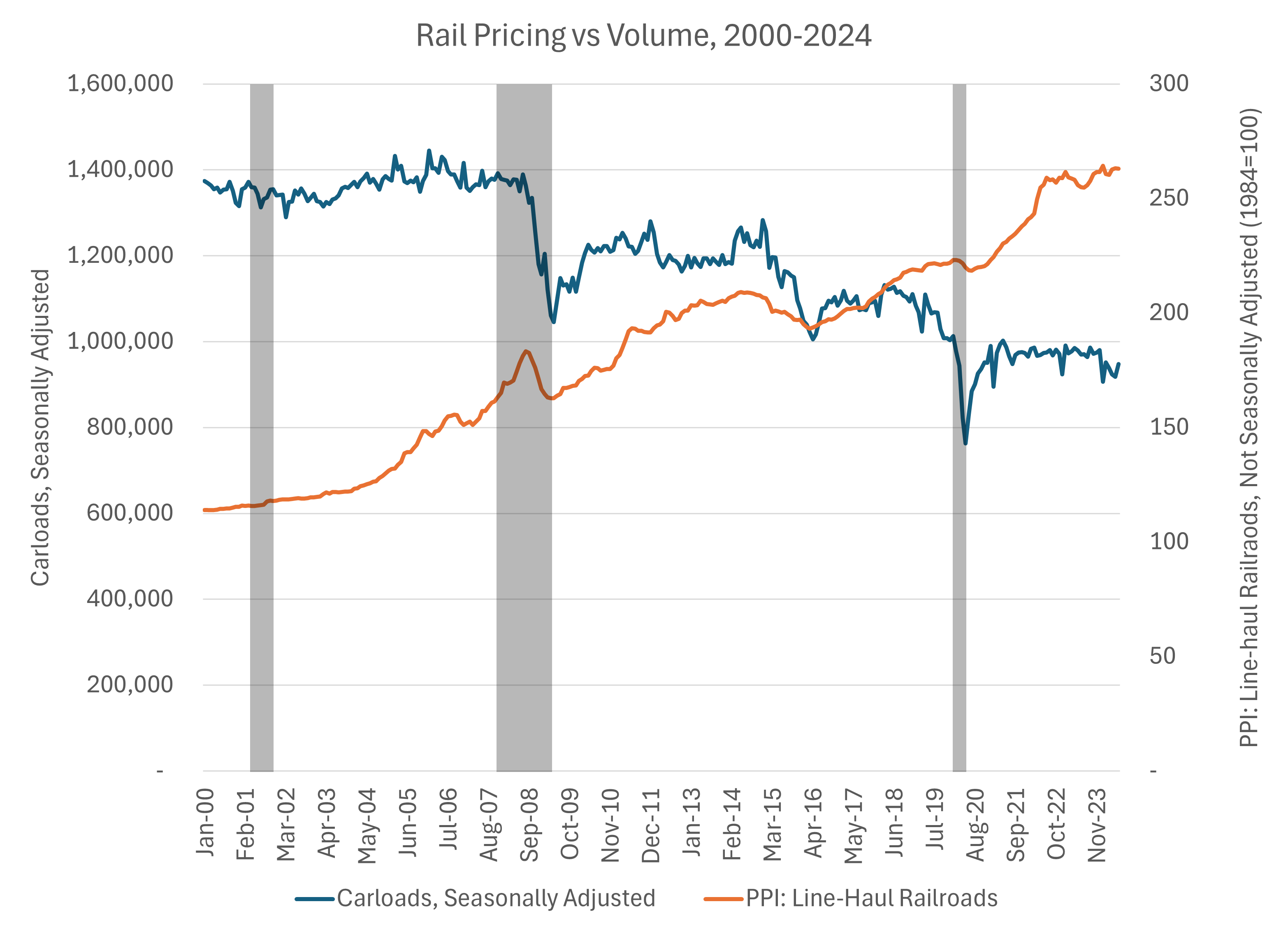
Shorter supply chains and, perhaps, greater domestic rather than international trade flows in the coming years will only make the fight to keep modal share that much more difficult. Preparing for the Next Age of Railroading should be a catalyst railroads need to get a jump on defining the rules of engagement and winning before the battle lines become trenches they’ll never overrun.