Recap
In my last article, “The Next Age of Railroading,” I highlighted some of the of the big moves in the forex, commodity, and bond markets and what that might mean for freight flows in the future.
You can look at this at through the lens of both short and long-term phases. After WW2, the US remade the world order in its image: pro-democracy, capitalism, and shared “American values” only counteracted by the Soviet Union and its allies. The US Navy, the physical arm of our power projection, patrolled the seas ensuring safe passage of commerce and (relatively) free international trade. With Bretton Woods in 1945, the US dollar became the world’s currency and the US provided the liquidity necessary for the global markets to run efficiently. The World Bank, the IMF, the United Nations, and NATO were all global or regional organizations created to unify many disparate countries and create frameworks for stabilizing markets and settling disputes.
With the collapse of the Soviet Union in 1991, that world order became unbalanced. That was the moment that America began its long, slow march towards nationalism and isolationism. Aside from the US’ lengthy and costly foray into the Middle East during the GWOT, successive US presidents largely ignored foreign policy. You could make the argument that Middle East foreign policy during the Bush years wasn’t even really foreign policy in the sense of Grand Strategy and realpolitik, but rather a reaction to internal stimuli. In fact, you could argue that the Iraqi War was more akin to President Trump’s “What’s in it for me?” approach than any master plan a la Kissinger or Bismarck trying to balance a multi-polar world.
Since the 1990’s, we’ve seen the explosion of the Internet, incredible growth in globalization, the emergence of commodity-export driven BRICs countries (Brazil (and Argentina), Russia, India, China), the housing bubble and Global Financial Crisis, the ZIRP era of cheap financing, and a global pandemic followed by the largest bullwhip effect probably ever recorded.
These events saw a massive run up in equity values (the dot com crash followed by the housing boom and bust) followed by dramatic consumption of basic commodities like energy, metals, and ag. All the while, North American freight flows shifted from domestic-driven to international-driven consumption. In other words, supply chains lengthened and became more complex. China, all the while, was hoovering up energy and agriculture commodities as it industrialized, skilled up, and is now producing highly engineered finished goods like EVs (BYD), telecommunications equipment (Huawei), and AI (Deepseek).
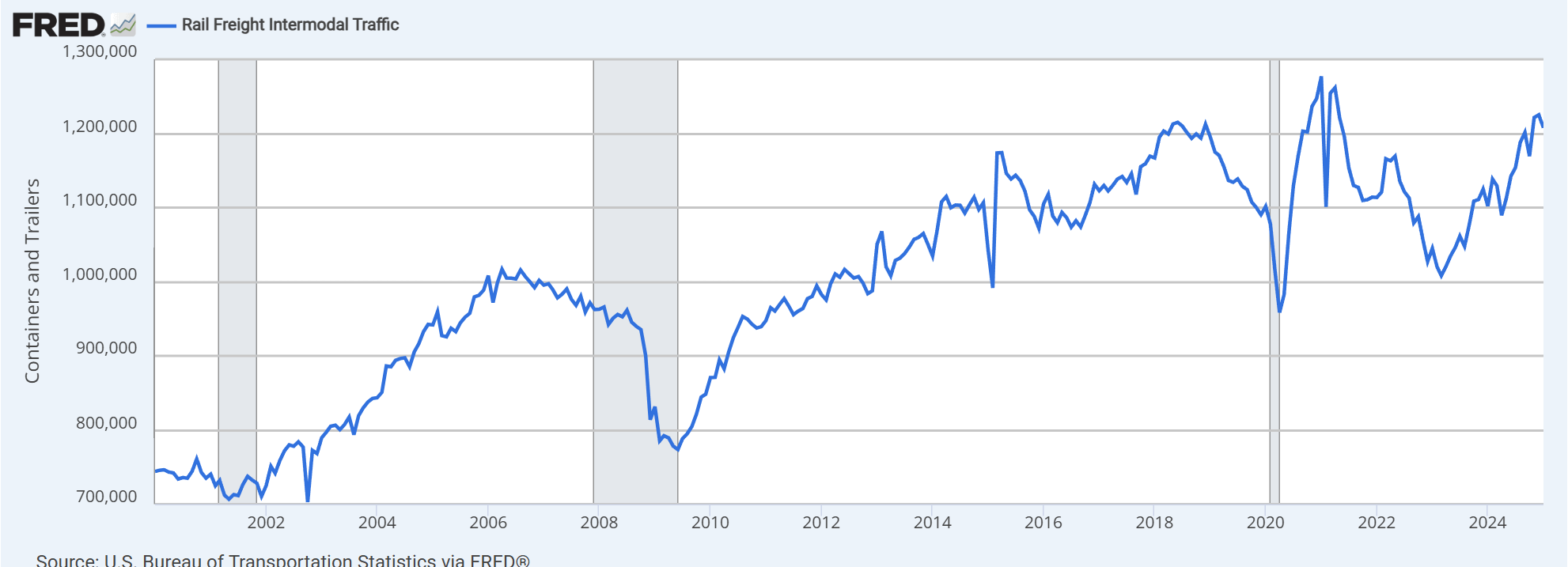
Containerized freight, aided by the rise of Amazon and cheap Asian goods, spurred an explosion in intermodal as shown in the chart below. What’s interesting is the period from about 2018 to today where, although choppy, intermodal volumes haven’t grown at all. Maybe 2025 will change that; we are on a nice upward climb since the bottom of 2023, but current intermodal volumes appear modest and not strong. As I’ve highlighted recently, the most notable contributors to this phenomenon are the richest quintile ordering stuff off Amazon all day.
The point of this exercise is to show the direct links between geopolitical macro events, like wars, pandemics, and technological leaps forward like the Internet, to the demand for things like rail freight transportation. These are linked and the more upheaval we see globally, the more likely existing freight flows are going to rupture in the chaos.
Let’s take a look at the chaos and see if we can find some signal from the noise:
#1 - Reshoring isn’t happening
After all the talk about supply chain resilience and “just-in-case” instead of “just-in-time,” it appears we’ve learned absolutely nothing. In fact, we’re probably worse off than we were before the pandemic.
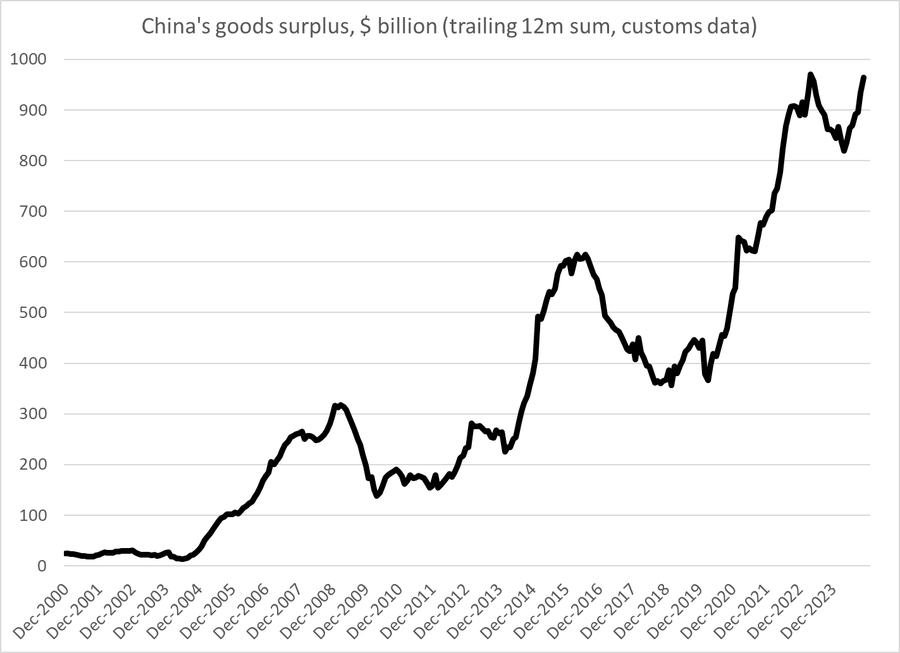
There’s a number of charts that show the strength of Chinese exports, but take the chart below, for example. Since 2020, China’s goods surplus (net exports) climbed above $500B and is now approaching $1T. That doesn’t look like manufacturers shifting production out of China.
As I wrote at the beginning of the year, Chinese autos are eating the world. This has been especially impactful to German and Japanese automakers. If there’s a fixed amount of demand for autos and Chinese are outselling everyone, that means they’re displacing cars that could be sold by other auto manufacturers. The world is more reliant on China than ever before.
There are other signs that show this narrative is more fantasy than reality. The next chart shows Foreign Direct Investment (FDI) into Mexico. While FDI has been increasing over the past few years, that doesn’t mean there’s all this new manufacturing capacity springing up. Instead, greenfield investment dropped off a cliff in 2023 and went even lower in 2024.
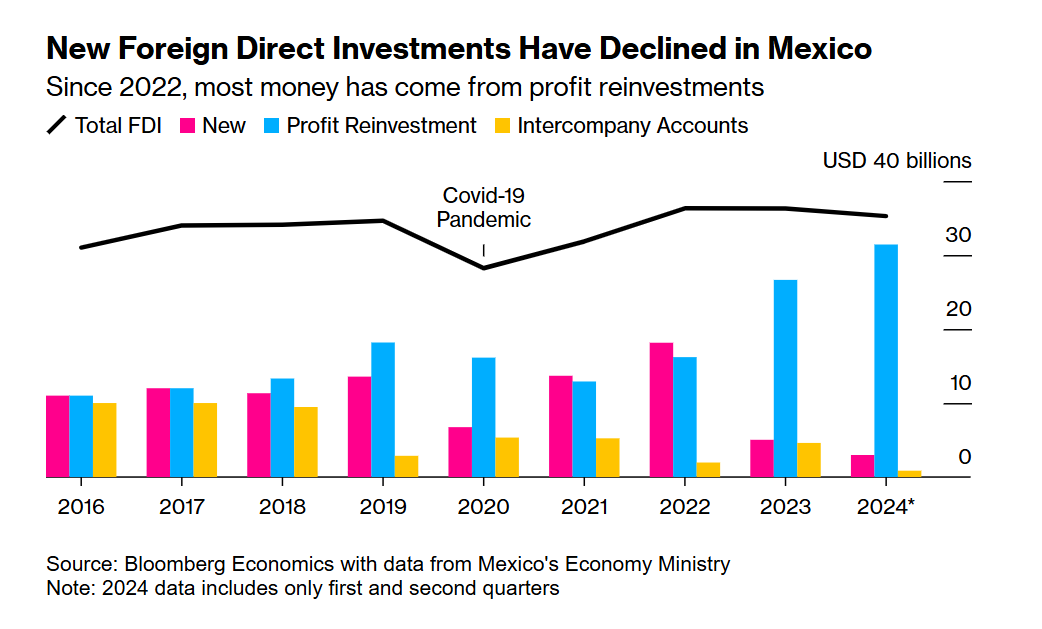
What these charts really show is that under the guise of “nearshoring,” Chinese producers are simply shifting the port of entry into the US to Mexico. North American rail may still benefit from goods that end up on the railroad from Mexico into the US, but without physical plants being located on Class 1 rail lines, this freight can shift just as easily to other lanes and modes. With new tariffs on both Chinese and Mexican-sourced goods, we’ll see relatively soon how this freight may shift elsewhere.
We’ll see what happens over the next 4 years with the Trump administration, but President Trump has already made it abundantly clear that “Made in Mexico” isn’t enough. Even if the next administration were to reverse course, the damage has already been done.
#2 - More competition, more war, and more nationalism

A totally globalized world of completely free trade fulfills the economist’s dream of perfectly allocated comparative advantage. The only problem is that you can’t have a functional country if, for example, the United States has a small group of extremely wealthy, high consumption individuals able to consume goods and services made outside the US. If it were, we wouldn’t have a populist in the White House.
Rather, countries are going to protect their national interests and compete for resources just as they’ve done for millennia. The last 80 years have been the exception, not the rule. President Trump took a hard line with Ukraine and the EU over military support and then the EU quickly announced a massive defense spend.
As has happened throughout the course of history, upending the balance of power in Europe and the rearmament of certain countries (Germany), tends to lead to war. Even with a truce and end to the war in Ukraine, I find it hard to believe that’s the last chapter in the story that Vladimir Putin is writing.
What this means in the world of freight is demand and disruption. There will be a renaissance of sorts for defense contractors and, to the extent that railroads have exposure to that industry, this should spark confidence and business investment. Sticky growth.
Disruption will come from events like the Ukraine war on global wheat trade, Houthi rebels sniping Asia-Europe container ships, and the increased demand for US nat gas to replace Russian supply. Expect to see plenty more of that over the next 5-10 years as the US pulls back from international security concerns and lets regional powers like Turkey, Germany, France, India, Japan, and South Korea fight over resources.
#3 - Rail gets cut out of the new supply chain
One of the most glaring inadequacies in rail is the fact that there is no on ramp for new customers looking to use rail. It’s a different language and requires a different skill set than what is being taught in schools today. Railroads, Class 1 and shortline, need to hold the hands of potential and existing customers to get their business locked in. They aren’t going to get there on their own.
I mean, we can probably say that rail was already cut out of the next stage of growth in freight during the massive distribution center buildout during COVID. Given that rail hasn’t woken up to that reality only makes it more troubling.
There are numerous things that can and should be done to reorganize railroads to go after new volume. I wrote about some of those involving the sales organization at railroads in “How to Fix Railroad Sales.” Far more can be done to align FM/LM service with local customers, expand productivity through the adoption of new digital tools (sensors, hint hint), and simplify the customer experience.
We’re still right at the beginning of a very dynamic period that will reshape freight flows and supply chains for decades to come. Railroads can sit on their hands and watch it go by, but I’m afraid they’ll miss out on any fighting chance they might have had if they had just reformed themselves to adapt with the times.