Last week, UP and NS filed additional information requested by the STB when their merger application was accepted for review on May 28. The STB parked the application until it had received the additional information.
“We are more confident than ever that creating America’s first transcontinental railroad is good for America. The merger will provide our customers faster, more reliable and efficient coast-to-coast service from day one and create cost savings that will flow through to consumers,” said Union Pacific CEO Jim Vena. “We talk to our customers every day, and as we listened to them and reviewed the STB’s comments, we saw opportunities to provide additional assurances through an unprecedented set of voluntary commitments to our customers.”
There are a few things to highlight in these latest filings, aside from Jim Vena’s confidence. The way he talks, I don’t think he’s lacked for that a day in his life.
Resolving Ownership of TRRA, KCT, and TTX
UP has an ownership stake in several “railroad owned” entities. Terminal Railroad (TRRA) in St. Louis, Kansas City Terminal (KCT), and TTX with their multi-Class 1 ownership structure all will need to be resolved as part of this merger.
UP believed they resovled the first two when announcing their July 7 agreements with CN, which I wrote about in my last article. It’s certainly a good deal for CN, which would see them get a stake in KCT (albeit small) and increase their stake in TRRA to add a 2nd director seat. The deal would also see UP reduce their ownership share below the symbolic 50% threshold. Whether that’s meaningful is up for debate based on the nuances of each terminal RR’s operating structure, but it at least removes the optics of controlling interest in either one by the new Super UP. This is an important issue that would need to be resolved with the merger, so it was good for UP to put forward at least part of a solution to the STB.
Still nothing mentioned on TTX, so I guess UP is either going to present a deal with the other Class 1’s in the future or they’re just asking the STB to solve the problem for them.
CGP Expansion - UP’s proposed Committed Gateway Pricing (CGP) got an upgrade as UP added bulk unit trains to its list of eligible traffic. This change signifies an increase in program eligible carloads from 133,890 to 257,971.
The combined share of BNSF and CSX traffic in 2024 was 15.9 million carloads. Relative to this volume, CGP would be eligible for a whopping 1.6% of BNSF and CSX’s combined traffic.
I noted in my last article that UP should be working harder to curry favor with NGFA and Ag customers.
“Ag has always been an important constituent in the rail industry. Initial industry regulation was brought on by Ag (Fear the Grange!). Getting NGFA and Co. invested through some type of concessions would be a key win for UP. I don’t know that it’s possible.”
I’ve no idea if this is meaningful to the small group of shippers who would be impacted by this expanded eligibility criteria for CGP, maybe it is. (NGFA, notably, was absent from a group of Shippers who were definitely NOT impressed by UP’s additional filings- ACD, ACC, NITL, and The Fertilizer Institute).
What I have heard from some Ag shippers is that UP hasn’t made much of an effort to encourage their support. It could be that UP has focused its efforts on those directly impacted by the merger, such as the shippers dropping from 3-to-2 or 2-to-1. Still, getting a key constituent like NGFA on board would go along way to winning key political and customer support.
Service Failure Safeguards - Previously, penalties for service failure as a result from the merged operation required “substantial deterioration.” Like the STB’s proposed reciprocal switching mechanism that relied on missing defined service metrics, this was always going to be tough to make serviceable.
This go around, UP has proposed a Targeted Access Program (TAG) that would unlock reciprocal switching for shippers impacted by service failures. For facilities that have their Original ETA (OETA) or Industry Spot & Pull (ISP) fall below pre-merger levels AND that performance falls below 70% OETA and 85% ISP, they would be “eligible for expedited reciprocal switching” for the next 6 months. (OETA and ISP are the two new metrics requested by the STB earlier this year to clean up Class 1 data reporting).
If a shipper did show that their service qualified them for reciprocal switching, UP would be able to avoid it if “the railroad proves an affirmative defense or cures the service deterioration within 30 days.” How long would the process take for the railroad to prove “an affirmative defense?” What happens if UP can recover, but not comprehensively and it bounces above and below this threshold for weeks and months? No program is going to be perfect…just like no integration will be as rosy as UP professes.
But let’s just assume that the obvious doesn’t happen and this becomes a pretty straightforward mechanism. This could appeal to the STB as a backstop against any significant merger meltdowns. I’m not sure there’s a world where a meltdown would be localized to UP-NS, but we’ll just ignore that point too.
Well, They’ve Got a Point
The reaction from oppositional trade groups was, as expected, not welcoming. One aspect from their rebuttal that I found interesting was the idea that the Watershed concept isn’t eliminated by the merger, it just moves it around.
“There is nothing about the gateway watershed problem that is unique to the watershed region as defined in the Application. The alleged problem that Applicants identify exists for all interline movements wherever the origin or delivering carrier has a short haul (e.g., <250 miles) before or after an interchange. Notably, this merger will create new ‘gateway watershed problems’ in other regions of the country for nearly every movement from captive UP locations to captive CSX locations and from captive NS locations to captive BNSF locations because ‘[n]either carrier owns the full trip, so no one can offer single-line service.’ Today, both interline carriers on those routes benefit from their long haul when connecting through the Mississippi River gateways. Post-merger, the UPNS extended longhauls could reduce the BNSF and CSX segments for nearly all of these moves well below the 250 mile demarcation that the Applicants use to define watershed moves.
“The Applicants thus are using this merger to solve the gateway watershed problem for their customers near the Mississippi River gateways by creating new watershed regions for BNSF and CSX customers at gateways further east and west. In other words, this merger will increase the number of watershed locations on those carriers to the detriment of them and their customers. The Applicants’ own ‘watershed’ claims affirmatively demonstrate that this merger will cause competitive harm.”
In this situation, Super UP could capture new business from the Mississippi region, but strand segments further East and West of the Watershed.
Sure, this would create a competitive reaction from BNSF/CSX, but not the good kind. Instead of reducing rates and adding service to try and attract customers in this region, the lone roads would be forced to do the opposite. A fixed capital base spread across fewer volumes or, more accurately, less revenue per carload, would force the carriers doing the shorthauls to raise prices and/or reduce service on this short segments. Ultimately, it’s hard not to believe that the remaining railroads would be rushing to the STB with their own merger application.
But what if Greg Abel digs his heels into Berkshire’s tremendous cash stockpile while CSX gets eaten alive? CSX still has 38% gross margins, so they’ve got a lot of fat to eat through, but at what point does their cost of capital start to become a serious challenge? Why would an investor buy CSX stock when they can get Super UP?
I’ve argued previously that shipper relief tools like reciprocal switching may seem attractive generally, but in practice they could result in very little benefit. Similarly, a competitive move by Super UP to hoover up Watershed traffic (assuming they could do this) would likely result in a final consolidation that leaves shippers with even fewer options.
I haven’t spent much time considering 2nd and 3rd order effects from the merger, but this could absolutely be one of them.
What’s Missing
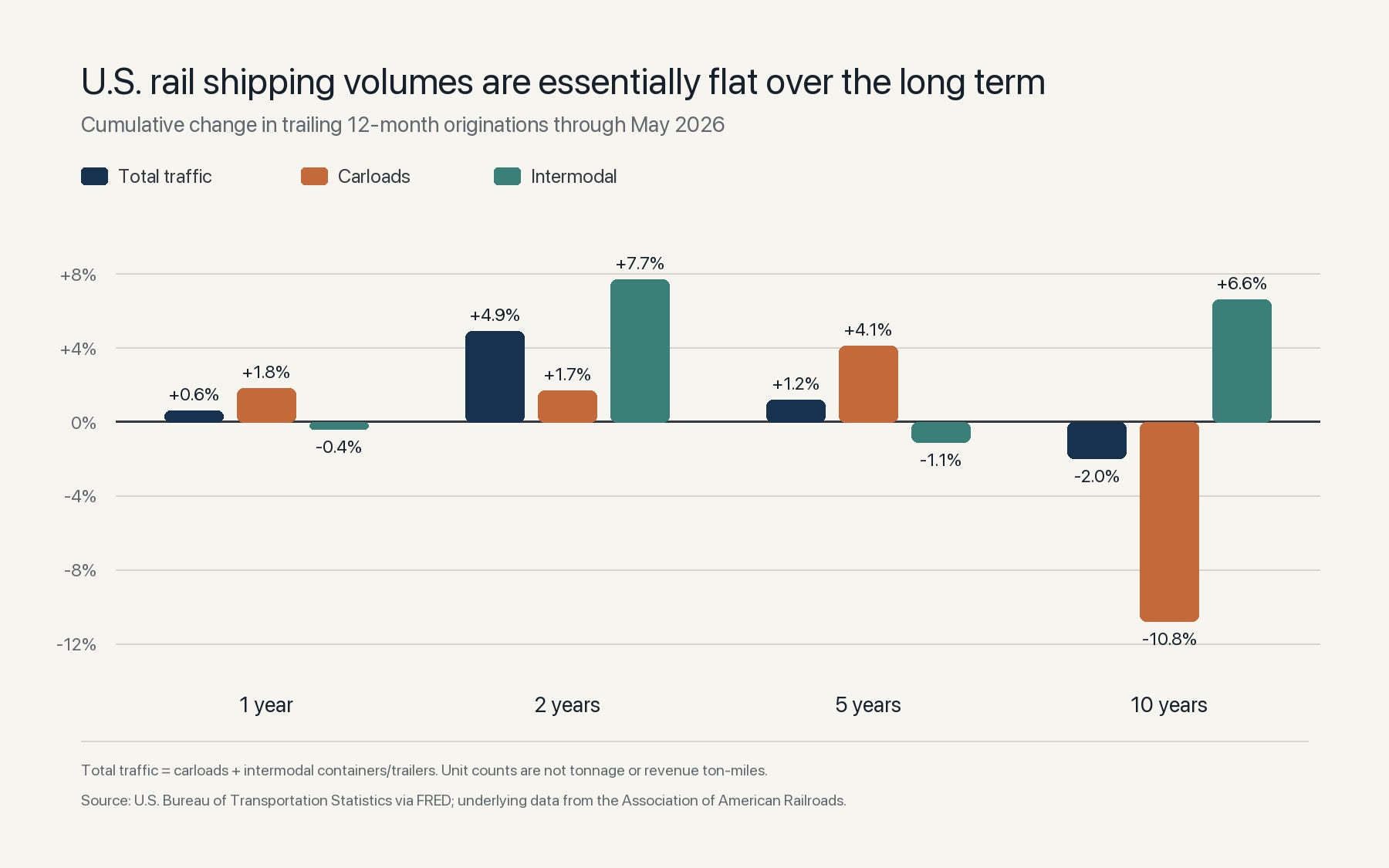
The reason why I’m so negative on much of the merger is because it does nothing to address the two most pressing issues in US freight rail: Market power abuse and volume decline.
The industry is dying. Not in a tragic and sudden car accident kind of way, but more like a drip, drip, drip of sedation lulling us into a vegetative state. Still alive, but the lights are on and no is home. Customers are leaving, tearing up their tracks, and not coming back. There was a huge COVID-triggered buildout of distribution centers at the beginning of the decade. How many of those were built with a rail spur?
Bulk commodities like ag, energy, and chemicals will still move by rail. Containers, intermodal will ebb and flow, but only as the leftovers from a vibrant, competitive trucking market. How sticky will the new intermodal volumes be when the $2/gal diesel premium starts eroding?
Like a burned out urban neighborhood, the only ones who are left are the ones that can’t move.
And this will continue so long as railroad sales departments continue to look like an overworked call center, where account managers are forced to firefight angry customer issues instead of going out and sourcing new business or keeping ahead of their customer’s needs.
This will continue so long as a railroad continues to treat its customers like a nuisance interrupting its network instead of a valued partner requiring deeper operational integration to the benefit of both parties.
This will continue so long as every contract negotiation between a shipper and a railroad resembles a hostage taker collecting their ransom.
This all continues until the market is forced into a correction, such as a new regulatory regime that addresses the limited power the STB has to actually provide relief to shippers. It’s not going to get there on its own!
Is it any wonder that every chance a shipper can get to reevaluate their supply chain, they exit rail? An industry in decline that requires M&A to spark any kind of earnings growth is not the future I envision for rail. It can and should be so much better, but I’m afraid it’s unlikely we’ll get there short of some existential crisis.
I was hopeful the post-PSR hangover was forcing folks to start thinking seriously about commercial strategy, but the UP-NS merger derailed that. Will we be back to the same place once it’s all done?
The STB’s competition standard that UP has to meet says, “Consolidations reducing shipper transportation alternatives are disfavored unless supported by substantial, demonstrable benefits that cannot otherwise be achieved.”
What I haven’t seen mentioned in any of the merger discussion yet is how this standard includes more than just a facility going from 3-to-2 or 2-to-1. Your rail service doesn’t start when the railroad shows up and it doesn’t end when the cars are placed.
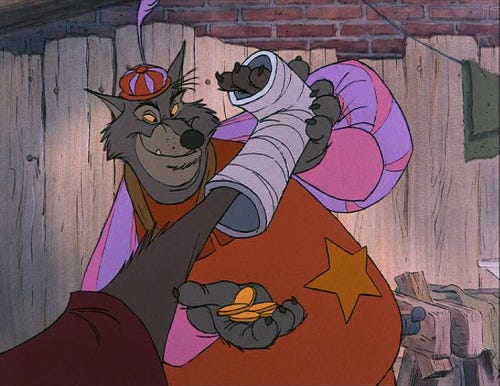
The reason shippers aren’t lining up to cheer on this merger is because they already have a laundry list of issues that are only made worse by further consolidation. Shippers are frustrated about demurrage and accessorial fees, choppy service reliability, poor communication and shipment visibility, damage claims that never pay out, and rates that keep marching up every year in a “take-it-or-leave-it” fashion. As one shipper told me just today, “We’re reliant on railroad reporting data about their performance. It’s a bit like the foxes guarding the henhouse.” In what world does further consolidation improve any of these issues?
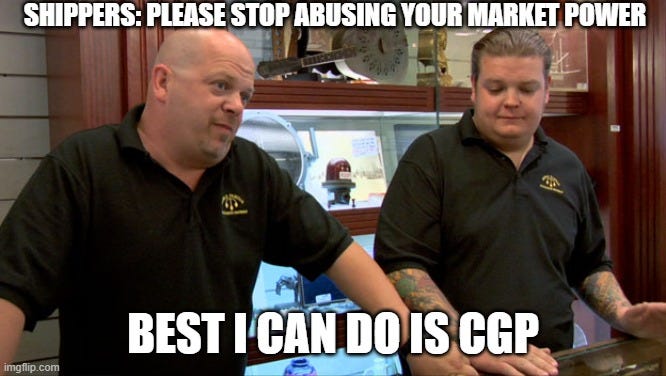
I’ve spent 3 years writing about the disproportionate amount of market power wielded by the Class 1s. Things like CGP just feel like trying to use a Bluey bandaid to stop a guy from bleeding out.
UP is quite understandably trying to narrow down the review scope as much as possible. I would be doing the same thing if I was in their shoes. But this merger isn’t happening in a vacuum and the STB shouldn’t ignore the state of the industry since the 90s mergers.
The scope of this merger can’t be understated. The STB has a monumental task in sifting through the facts and figures to properly evaluate it. It’s been 1 year since the announcement and they haven’t even scratched the surface.
Bed in. This train isn’t going to stop anytime soon.