I’ve heard some stories from shippers and railroads recently that seem to indicate the Class 1’s have slowly come around to the idea that PSR gains in earnings growth have reached their limit. Pressured by a freight recession on one side and a still oversupplied trucking market on the other, the ability for Class 1’s to push pricing gains has become more desperate.
The chart below shows how average revenue per unit (ARPU) has not only stagnated, but has also fallen across every Class 1.
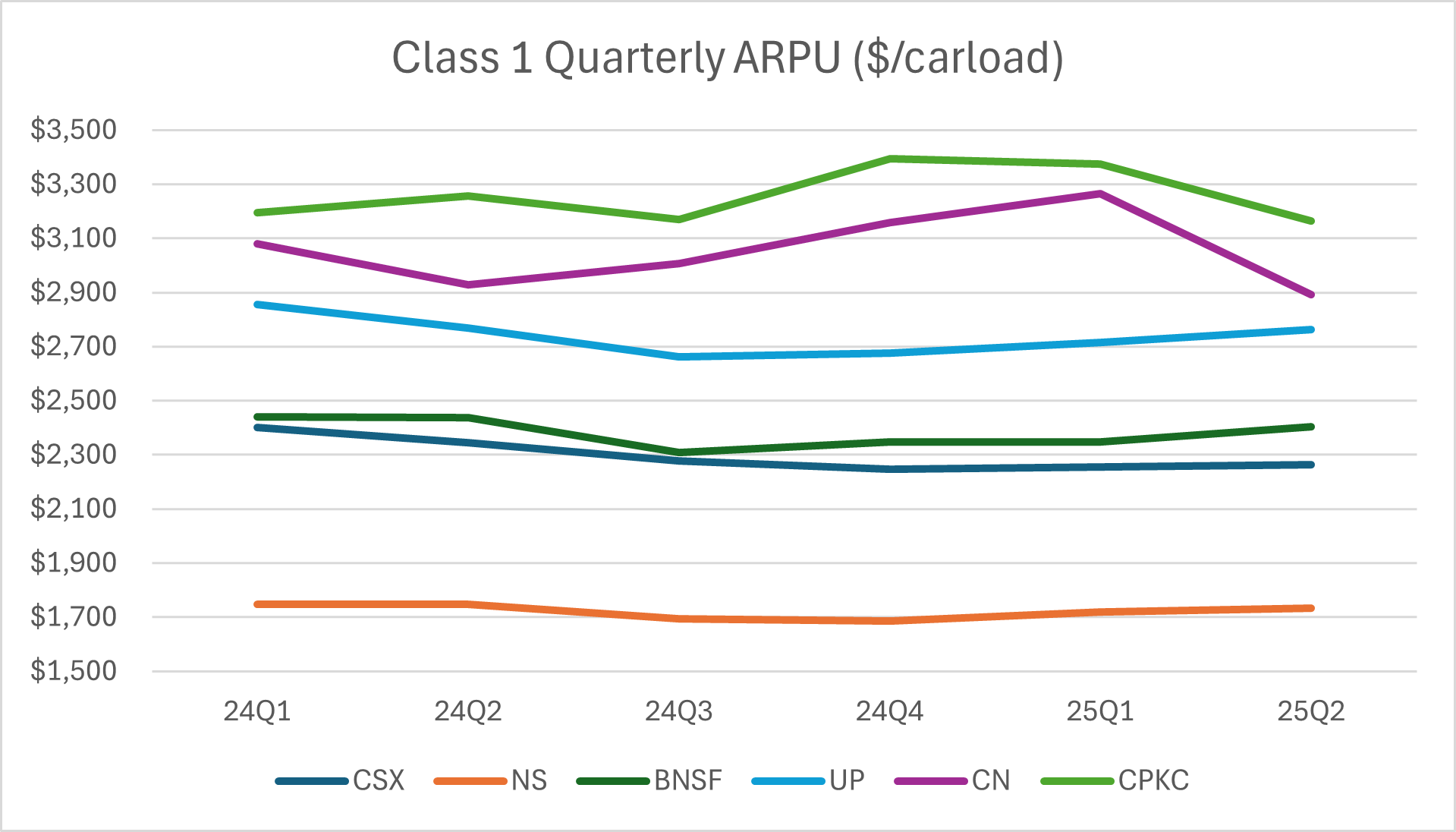
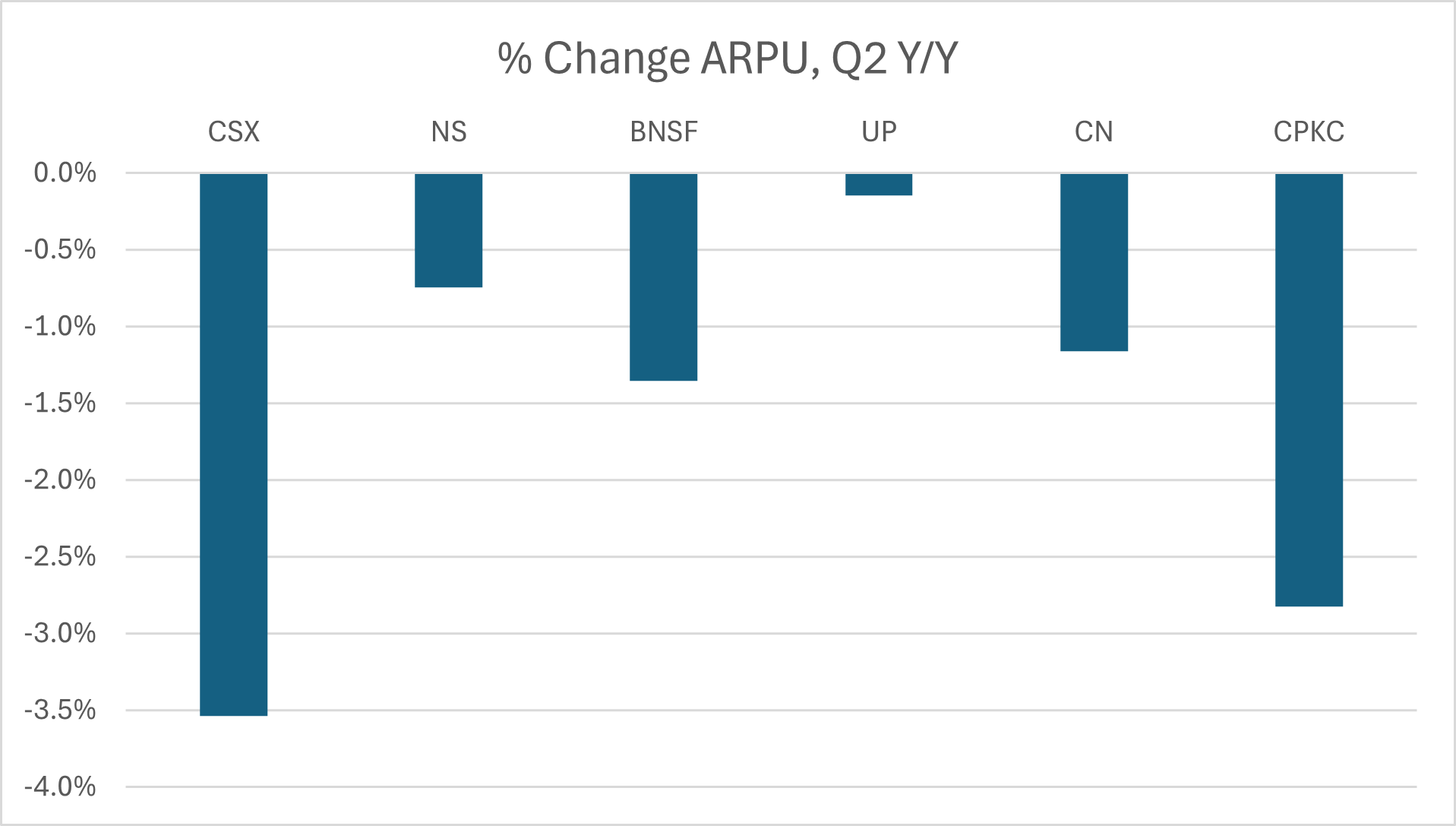
Normally in a down cycle, you focus on tightening the belt. However, PSR already took all the slack out of the system so there’s nothing else to take up. The Class 1’s are challenged by a soft market not receptive to continuing price increases and an operation cut to the bone with little fat left.
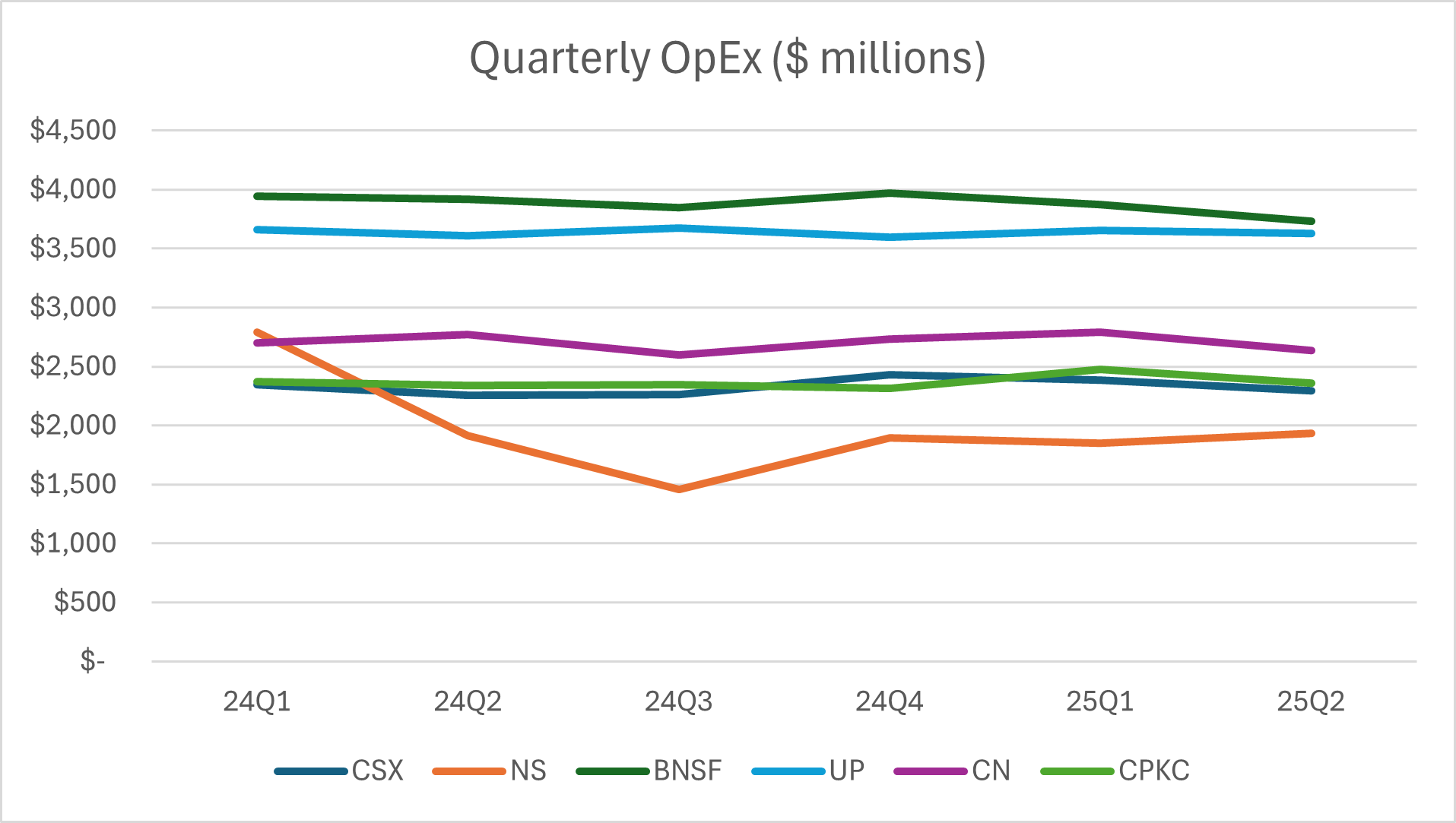
Something must be done!!
Which Way Railroad Man?
I wrote about this strategic day of reckoning recently in “Railroad Strategy is Lost at Sea,”
“So what’s the plan? What’s the next move? Up to this point it’s been to double down on PSR cost savings while continuing to push pricing above inflation. It’s not going to grow the industry but it’s a safe bet to stay in the warmth of the pack…
“Why didn’t they do [new service announcements] sooner? Producing new services only after your competitor does something is such an indictment of all the anti-growth behaviors that the railroads are guilty of today. It reminds me of the famous Churchill quote, ‘The Americans will do the right thing after they’ve exhausted all other options.’ If alliances were pro-growth and unlocked new business, then they should have pursued these actions regardless of external competitive factors.
But they didn’t and they won’t for as long as the Ops guys are running the railroads. In fact, one could argue that the current crop of Commercial CEOs was more akin to changing the paint color rather than a full remodel of the strategic direction of railroading. Ancora came after Alan Shaw and successfully pushed out Paul Duncan for John Orr. CSX’s Joe Hinrichs got his hand slapped by Wall Street when he fired COO Jamie Boychuk. More recently, Greg Abel brought CN’s Ed Harris into BNSF as a “consultant” which has resulted, I’m told, in sidelining Matt Igoe and giving Ed a blank check to rework large swaths of the organization, including commercial.
My main critique of the Class 1’s has always been that there’s this sense that they live in this walled garden without any real understanding, interest, or appreciation for the wide world outside of just running their trains. Yes, running a network operation is hard, but when organizations allow the ops folks to overpower the commercial ones for too long, you end up in a no-growth dead end. Healthy organizations should flip control from commercial to ops and back again as needed to both plant the seeds and harvest them.
Remedying this myopic insularism through such means as integrating more deeply with their customers, completely reorganizing their sales organizations, or actually listening to their customers on just about anything (operational transparency, customer experience, technology integrations) is so foreign to them, you have to wonder if they’ll ever get there.
This last point touches on the heart of today’s debate in the industry: Is a transcontinental merger really what customers are asking from the railroads?
Union Pacific says yes. The argument that UP CEO Jim Vena has a made a few times now is that the merger is essential for 3 main reasons:
Service will get faster, drawing more customers including truckload conversions.
New growth opportunities will get put in play (“The Watershed”).
We have to stay ahead of autonomous trucks and tech innovation.
I’ve already written about how #3 is nonsense in “The Great Rail Bundling.” (TLDR - The impact of autonomous trucking on cost basis is pretty negligible overall).
Let’s look at #1 - will faster turn times unlock new business for a transcon? Maybe. Intermodal would be the winner here, which is why it’s been a no brainer for the intermodal companies who are already partnered with UP and/or NS. Asset-based IMCs would of course love to get better asset utilization, but is that what really moves the needle for shippers?
Vena has touted the speed of the UP in the past, particularly with the Falcon Premium service they do in conjunction with Ferromex and CN. Maybe that’s done something to grow volumes, but someone’s going to have to point out the impact to me in the numbers because I don’t see it.
It’s not that faster turn times aren’t beneficial. At ADM, our location was able to turn a unit train on the CN in 7 days which was immensely beneficial during harvest. In that window and if the market is right (it isn’t now), bulk commodities are all about getting volume to market as quickly as possible. Not every location can handle faster turns - some are limited by lack of track space or other localized constraints - but some do benefit.
But faster turn times don’t mean a lot if the service lacks reliability. I would venture a guess that most existing rail customers would value consistent service over faster service. Delivering and picking cars up on time and even simply giving shippers visibility into when they can expect service would be hugely beneficial to keeping product flowing efficiently for shippers.
If a merger that can divert traffic away from congested interchange hubs can help service get to that point, great. But that’s not what UP is saying, nor do I believe that a merger is the only way to build in that network resiliency.
With regards to #2, of the many shippers I’ve talked with about the merger and potential for new O-D pairs across the Watershed, not one has said it would do much of anything for them. That’s certainly not a comprehensive survey, but most rail customers with core rail commodities are indifferent to the supposed benefits of eliminated interchange across the Mississippi.
Werner’s Derek Leathers was on a Bloomberg podcast recently talking about the merger from a truck perspective,
“I get asked a lot about fears of vast swaths of truckload freight suddenly find its way on this new efficient model post merger, and that I have less concerns. I'm not saying no concerns, but less concerns about simply because if you look at what's happened with truckload length of haul over the last ten to fifteen years because of intermodal gaining momentum and gaining share, the current length of hauls just don't support or lend themselves to further conversion to rail, and in most cases there's certainly not long enough to even need a transcon railroad to produce a product to be able to move it.
“The stuff that does go transcon on truck generally is expedited in nature. It's super high service, high security type freight, where truck is simply a better solution for that, And so there'll be some marginal modal shift, but there's always going to be marginal modal shift, just like we've seen in this trucking downturn, freight shift from rail to truck simply because truck is so affordable right now, given a choice, they would prefer the reliability of it.”
I found this last bit on the opportunity for transcon truckload conversion to be pretty interesting and further proof of my skepticism that this merger is really going to finally unlock truckload conversion. It didn’t for CPKC, who hasn’t hit anywhere close to the truck conversion numbers they put in their merger application.
Maybe truckload conversion isn’t limited so much by certain service metrics like speed, but rather by, I don’t know, things like customer service, actually fielding a sales org that knows how to do biz dev, pricing flexibility instead of rate increases come hell or high water, and service resiliency, not speed.
If railroads truly wanted to attack truckload conversion, I still see a lot of things they could do today without going through a merger.
Now, this is just my perspective. I’m sure there are shippers out there who do benefit from things like faster turn times or single-line service from Denver to Nashville. But where are they? If this is an intermodal growth play, which it should produce at least some growth in intermodal volumes on UP, then why aren’t there more companies coming out in favor of this merger?
UP could be right on the money or is this just another sign that operations have been in charge of the Class 1’s for too long?